
Facebook Video Ad Examples: 7 Sources Worth Studying
Study seven Facebook video ad examples and the tools that surface them, with practical tactics for hooks, angles, and creative tests.
You’ve got a new Facebook video campaign to launch. The brief is blank, the product team wants a concept today, and every obvious hook already feels overused. Guessing from a blank page is slow. Studying live and recent ads gives you a faster starting point, especially when you look past the surface and ask what each creative is testing.
These seven sources cover that workflow from different angles. Meta Ad Library gives you free, first-party evidence from active campaigns. Curated galleries explain why selected ads work. Ad intelligence platforms help with broader competitor research, historical patterns, and creative iteration. Use them as working tools, not passive inspiration. Pull out the hook, offer, angle, format, and next test you can put into your own brief.
Table of Contents
- 1. Meta Ad Library
- 2. AdEspresso Facebook Ad Examples
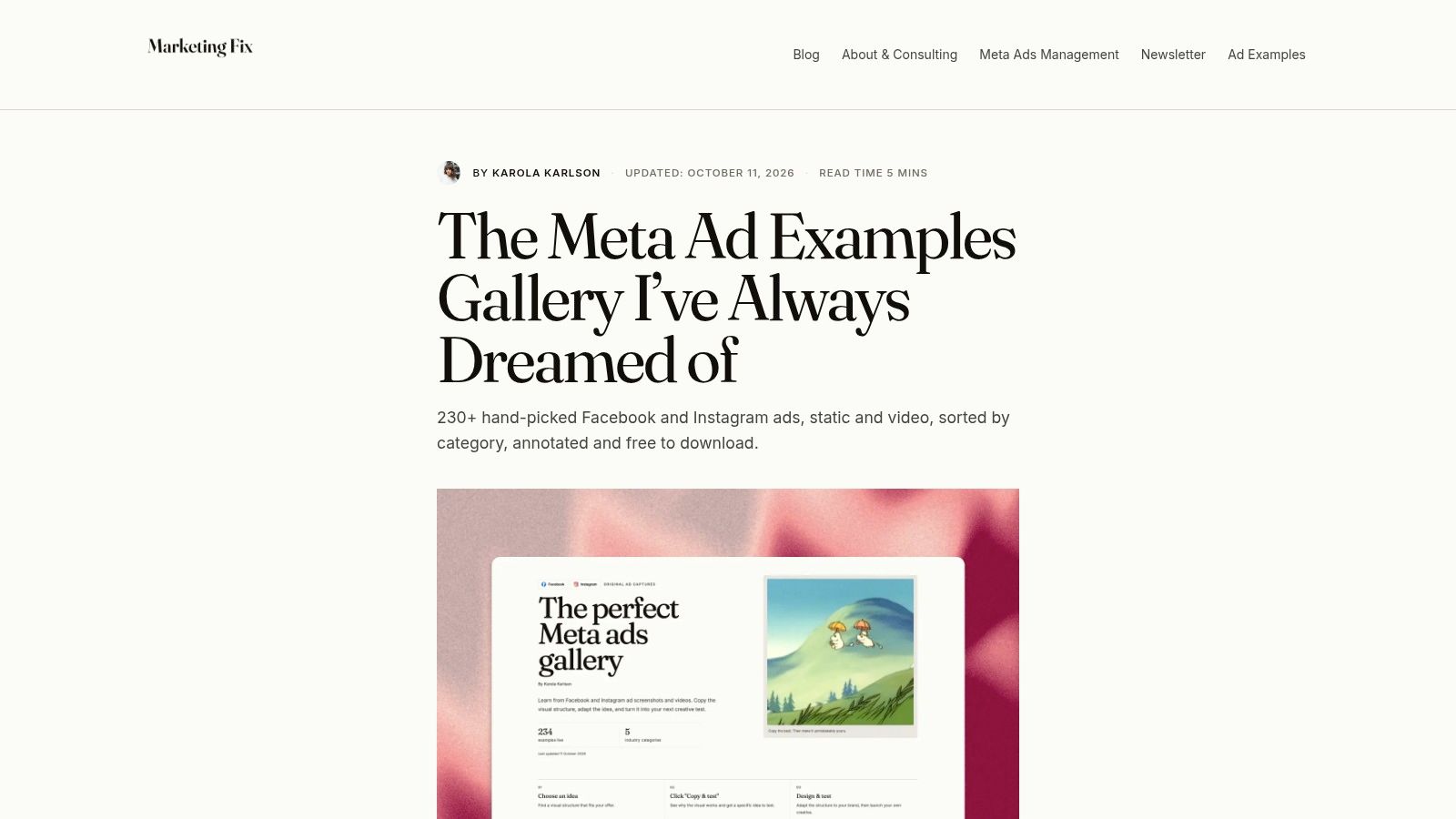
- 3. Karola Karlson’s Meta Ad Examples Gallery
- 4. AdFlex
- 5. BigSpy
- 6. PowerAdSpy
- 7. AdSpy
- Facebook Video Ads, 7-Source Comparison
- From Swipe File to Paused Test
1. Meta Ad Library
Start with Meta Ad Library when you need to know what a brand is running now. It’s Meta’s public archive for ads across Facebook, Instagram, Messenger, and Audience Network. Filter by Facebook, Video, language, region, active status, or date range, then open a Page-level view to study a brand’s wider creative system.
The value is evidence. You can see whether a competitor is using a product demonstration, testimonial, founder message, or vertical Reels creative. Beyond that, you can compare multiple ads from the same advertiser. Repeated openings, recurring offers, and small changes in copy often reveal an iteration pattern that a single ad can’t show.
Practical rule: Treat the library as a live market scan, not a performance report.
Save references as soon as you find useful examples. Ads can disappear when campaigns end, and the library doesn’t provide reliable ROI data for ordinary commercial campaigns. Record the advertiser, date checked, placement, opening frame, visible offer, CTA, aspect ratio, and landing page. This context matters when you return to the idea during production.
What to extract from live ads
Use the archive for questions such as:
- Hook: Does the video open with a pain point, a result, a person speaking, or the product in use?
- Angle: Is the advertiser selling speed, simplicity, proof, identity, or a specific use case?
- Iteration: Does the same concept appear with different intros, captions, or CTAs?
- Placement: Is the creative clearly built for Feed, Stories, or Reels?
If you’re connecting research to execution, the Facebook Advertising API overview can help you understand how account and ad data fits into a broader workflow. For a second visual reference, compare saved findings with CreativeClaw sample outputs. Meta Ad Library is the best first stop for a current, compliance-friendly scan, but it won’t tell you which visible variation is the winner.
2. AdEspresso Facebook Ad Examples
A junior buyer needs a clear example before reviewing a creative with a designer or client. AdEspresso’s Facebook ad examples gallery fits that job better than a live competitor audit. It groups examples by format, including video, carousel, and lead ads, then adds commentary about the ad’s apparent purpose and execution.
Use one example to run a focused review. Ask what the viewer sees first, which benefit appears without extra context, and where the proof enters. A product demonstration may show the product in use, while another ad may rely on explanation or customer context. Those differences give the team specific production choices to test rather than a frame-by-frame imitation.
Use the editorial notes as prompts for a creative review:
- Message: What single benefit appears before the viewer needs more context?
- Hook: Does the opening use a pain point, product action, result, or speaker?
- Proof: Does the ad demonstrate the product, show a customer, or explain the claim?
- Clarity: Would the core message remain understandable without sound?
- Action: Does the CTA suit awareness, consideration, or purchase intent?
Save the useful pattern, not the finished ad. Record the opening, angle, proof type, pacing, and CTA, then change one variable for your own audience. That approach turns a quick swipe-file source into a practical test brief without treating the example as performance evidence.
Gallery examples may be old, broad, or tied to an offer you cannot reproduce. Check the current version in Meta Ad Library before using it as a market signal. Confirm placement requirements with the current Instagram ad specifications before adapting the concept.
For production details, use this step-by-step Facebook ad guide. AdEspresso suits fast reference and team discussion. Its lighter filtering makes it less suitable for a detailed competitor study or a claim about business results.
3. Karola Karlson’s Meta Ad Examples Gallery
You need a focused reference when a broad ad database produces too many similar videos. Karola Karlson’s Meta ad examples gallery offers a smaller, curated collection across e-commerce, beauty, wellness, food, consumer apps, B2B, and AI. Its annotations point to the ad’s working idea and suggest directions to copy and test.
Use each example as a creative hypothesis. Pull out the opening hook, audience tension, proof method, pacing, and CTA. A creator-led opening can become a founder version. A product demonstration can shift to a customer use case. A B2B explainer can focus on one industry problem instead of listing every feature.
Turn each example into a test card
For a creative review, place the downloaded asset beside a short working card. Record:
- Opening pattern: Capture the first spoken line or describe the first visual.
- Audience tension: State the problem or desire that gives the hook relevance.
- Proof method: Mark whether the ad demonstrates, compares, reassures, entertains, or teaches.
- Adaptation: Change one variable, such as the speaker, opening, proof point, pacing, or CTA.
This keeps the team from copying another advertiser’s brand voice. It also gives designers a clear reference for framing, text treatment, and timing. Build the new storyboard from the pattern, then test the changed variable against a defined objective. The Facebook ad optimisation guide can help check the setup before launch.
The gallery works well as a quick swipe file and a source for concept reviews. It is less suitable for a full competitor study because the collection is curated rather than a live, in-depth feed. Examples may also be old or tied to offers you cannot reproduce. Check the current version in Meta Ad Library, and verify placement requirements with the current Karola Karlson’s Meta Ad Examples Gallery before adapting the concept.
4. AdFlex
AdFlex suits teams that need a quick way to compare video ads across Meta, TikTok, and YouTube. Its filters help isolate video formats, while page-level analytics and creative history show whether a brand repeats one idea or keeps changing direction.
Start with a question, not a broad search. For example, check whether competitors reuse the same opening across platforms, or whether each network gets a different hook. Save a small set of relevant ads, then compare the first visual, spoken line, proof style, pacing, and offer. This makes AdFlex useful for a fast swipe file and for deciding which concepts deserve a closer competitor review.
A practical session can examine four signals:
- Category patterns: Which openings appear across advertisers?
- Format choices: Do brands use Feed-style videos, vertical assets, or both?
- Creative history: Does one idea receive repeated variations?
- Cross-platform transfer: Which message survives a change in placement or aspect ratio?
The free plan includes Meta access and 2K monthly credits, according to AdFlex’s product site. Set boundaries before searching. Choose the brands, markets, and questions first, record useful findings as you go, and reserve credits for queries that can change a creative decision. A shared workspace also needs usage tracking when several people research at once.
Treat the results as prompts, not proof of performance. Coverage can be thinner in some niches than on older platforms, so verify important ads in Meta’s own archive. Check that the offer, audience, placement, and current version still match before copying a hook. AdFlex works well as a budget-friendly starting point for agencies and independent media buyers, provided the research question is clear.
5. BigSpy
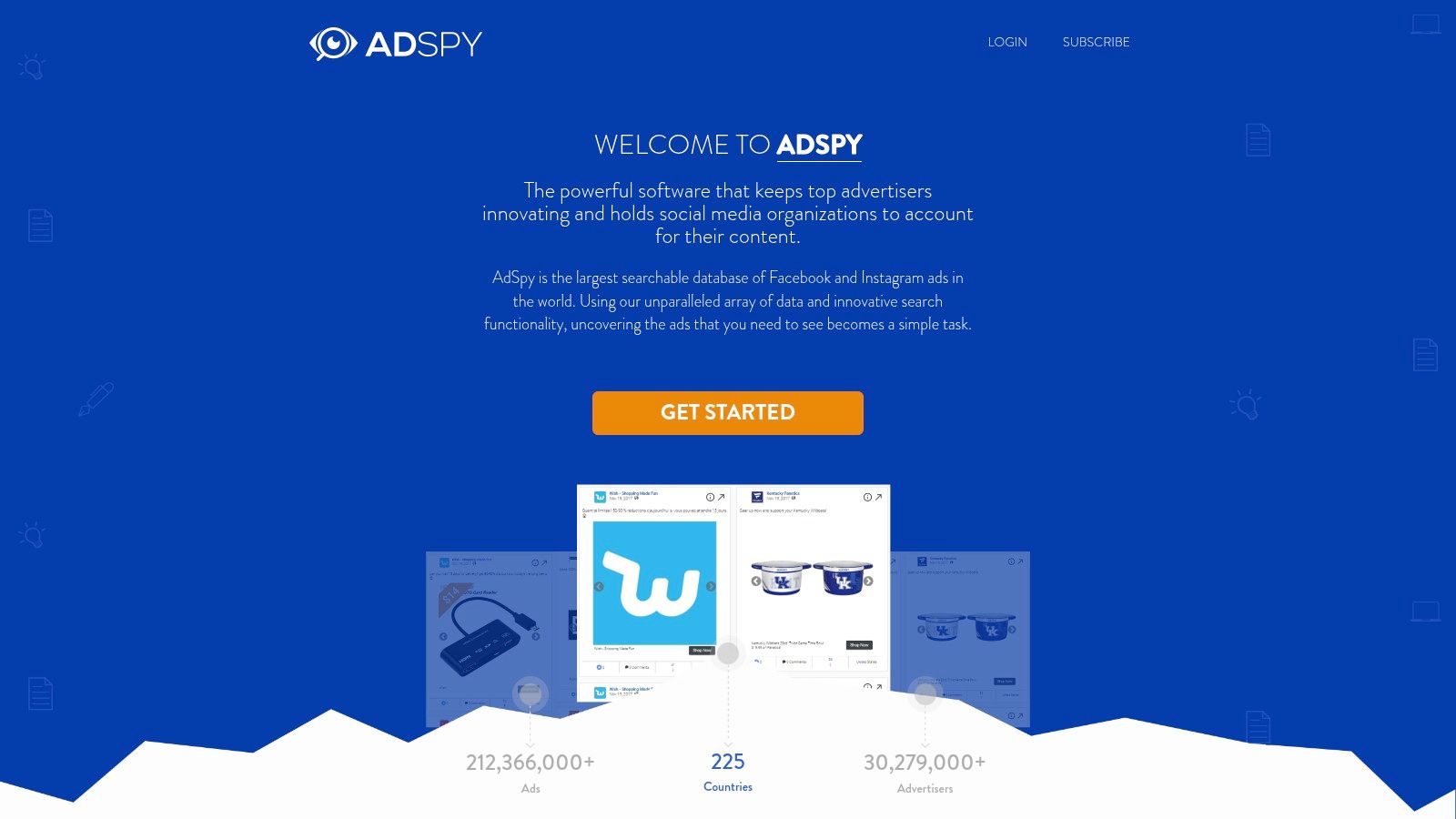
Start with a category question, then use BigSpy to find creative families rather than isolated ads. Its Facebook coverage sits alongside other channels, with filters for industry, country, format, date, and related attributes. Feeds such as Popular, Rising, and New Creatives help refresh a swipe file quickly.
Search a market and compare the first three seconds, the spoken hook, the proof device, and the offer. Several advertisers may frame the same product problem with different speakers, demonstrations, or calls to action. Save those variations together. The group shows which idea is being repeated and which execution choices are available for testing.
Use trends as leads, not decisions
The Popular feed can reveal themes worth investigating, but circulation does not establish suitability for your account. Metadata depth and accuracy may differ by advertiser and region. Before copying a hook, check the audience, offer, landing page, placement, and delivery context. A polished video may rely on conditions your campaign does not share.
Tag each saved ad with one action:
- Save: The hook or angle fits your audience and objective.
- Verify: A claim, offer, or format needs confirmation elsewhere.
- Adapt: The structure is useful, but the script or proof must change for your product.
This turns a fast gallery search into a working test list. Record the opening, visual change, proof type, and next viewer action, then compare those notes with a first-party check before presenting the concept.
Full functionality requires an account, so weigh the search depth against another research workspace. BigSpy suits volume and trend discovery. A carefully explained competitor study still needs your own interpretation of why a selected ad could influence the next creative test.
6. PowerAdSpy
PowerAdSpy supports detailed competitor research across Facebook and Instagram. Its filters cover keywords, advertisers, domains, languages, and placements. AI labels can sort ads by features such as hooks, CTAs, and visual style. Watchlists and reports help track changes over time.
Start with one recurring concept, then trace its variations. For example, a product may use a direct demonstration, a customer testimonial, and a creator-led problem-solution video. Save these executions together. Mark the fixed idea, such as the promise or audience pain, and the changing elements, such as the speaker, proof, opening shot, and CTA. That comparison gives you testable options instead of a folder of disconnected references.
The strongest pattern is often the repeated idea, not the most polished edit.
Review each creative in sequence:
- Attention: What visual or line earns the first moment?
- Recognition: What problem shows the viewer that the ad applies to them?
- Proof: Does the video show a result, process, person, or explanation?
- Conversion: What promise and CTA encourage the next action?
Before copying a concept, confirm its audience, offer, landing page, placement, and delivery context in Meta Ad Library. PowerAdSpy’s historical creative and engagement details may be incomplete, and its labels are starting points rather than final judgments. Watch the asset and inspect the copy yourself.
Use PowerAdSpy for ongoing category tracking, multi-account research, or a deeper competitor study. For occasional inspiration, its paid access may be more than you need. A focused search can supply a quick swipe file, while grouped variations support a stronger creative brief and clearer tests.
7. AdSpy
A competitor’s ad may look simple until you need to explain why it keeps running. AdSpy helps investigate that question across Facebook and Instagram with searches by text, Page, media type, reactions, or comment content. Filters for country, language, date, and longevity narrow the results. Affiliate-focused options also help when reviewing offers, domains, or networks.
Start with the audience problem, then trace how advertisers express it. Search a product mechanism, objection, or customer type instead of relying only on a brand name. Save related executions together and separate the fixed idea from the changing parts: opening shot, speaker, proof, offer, and CTA. This creates a useful test matrix rather than a folder of unrelated ads.
Comment search adds a practical diagnostic layer. Questions about shipping, setup, pricing, fit, or trust expose gaps in the video and copy. Turn those objections into possible hooks or follow-up variations. Treat comments as research signals, not proof that the campaign is profitable.
For each recurring concept, check four points:
- Promise: What outcome stays consistent across versions?
- Proof: Does the ad use a demonstration, testimonial, process, or explanation?
- Audience language: Which words describe the problem in copy and comments?
- Offer: Which elements belong to the creative, and which belong to a temporary promotion?
Longevity can suggest a concept deserves testing, but verify the audience, landing page, placement, and delivery context before copying it. Historical records and engagement details may be incomplete, and labels are starting points. Watch the asset and inspect the copy yourself.
The interface takes practice, and access is paid after its trial. Some ads may lack downloadable assets, so record the useful details while available. Choose AdSpy for a deep competitor study across markets. Use AdSpy as a quick swipe-file source only when its search speed matters more than a curated review.
Facebook Video Ads, 7-Source Comparison
| Tool | 🔄 Implementation complexity | ⚡ Resource requirements | 📊⭐ Expected outcomes | 💡 Ideal use cases | ⭐ Key advantages |
|---|---|---|---|---|---|
| Meta Ad Library | 🔄 Low, no setup; web UI | ⚡ Minimal, free, no login | 📊 Live, first‑party creatives; limited performance data ⭐⭐ | 💡 Verify live ads, spot iteration, compliance checks | ⭐ First‑party, current examples; easy access |
| AdEspresso Facebook Ad Examples | 🔄 Low, browse curated gallery | ⚡ Minimal, free | 📊 Curated, annotated examples; not real‑time ⭐⭐ | 💡 Training, inspiration, client presentations | ⭐ Editorial “why it works” notes; easy to teach |
| Karola Karlson’s Meta Ad Examples Gallery | 🔄 Low, curated gallery with downloads | ⚡ Minimal, web access; downloadable assets | 📊 High‑quality, testable creatives; smaller corpus ⭐⭐ | 💡 Structured creative reviews, briefs, designer handoffs | ⭐ Human‑curated, downloadable assets for briefs |
| AdFlex | 🔄 Medium, account, credits model | ⚡ Low–Moderate, free plan (2K credits); paid tiers | 📊 Cross‑platform search + page analytics; coverage may vary ⭐⭐ | 💡 Budget‑friendly trials for agencies/freelancers | ⭐ Free plan, modern UI, team features, API |
| BigSpy | 🔄 Medium, account required; intuitive UI | ⚡ Moderate, limited free, paid for full access | 📊 Large creative index; trend feeds surface current creatives ⭐⭐ | 💡 Trend spotting, category and format scans | ⭐ Strong filtering and large cross‑platform index |
| PowerAdSpy | 🔄 Medium, subscription; reporting setup | ⚡ Moderate–High, paid tool | 📊 Deep dataset with AI labels to map hooks/CTAs ⭐⭐⭐ | 💡 Reverse‑engineer hooks, funnels, creative families | ⭐ AI‑labeled elements, watchlists, reporting |
| AdSpy | 🔄 High, advanced features, steeper learning curve | ⚡ High, paid subscription; higher cost for power users | 📊 Very large corpus and historical depth; find recurring winners ⭐⭐⭐ | 💡 In‑depth competitor research, long‑running campaign analysis | ⭐ Extensive index, advanced search (comments, longevity) |
From Swipe File to Paused Test
A saved ad isn’t a brief. It becomes useful only after you translate it into a decision your team can test. Start by verifying the example in Meta Ad Library. Confirm that the advertiser, placement, visible message, and current version match what you recorded. A gallery can give you the idea, but the first-party archive gives you a better chance of checking whether the example is still active and how the brand is deploying it.
Save the creative and its context before it disappears. Store the video or screenshot with the Page name, date checked, region, placement, landing page, CTA, and the reason you saved it. Don’t rely on a browser bookmark. Your future self needs to understand what caught your attention and whether the example was a hook reference, an offer reference, a format reference, or a funnel reference.
Then write the creative anatomy in plain language:
- Hook: What happens first?
- Angle: Why should this audience care?
- Proof: What makes the claim believable?
- Format: Is it creator-led, demonstrational, testimonial, animated, or product-focused?
- Test: What single change will you make?
That final line matters. “Make a similar video” isn’t a test. “Keep the product demonstration, replace the brand voiceover with a customer speaking to the problem, and keep the CTA unchanged” is testable. Change one meaningful variable at a time when you can, and record the result against the campaign objective rather than judging the edit by views alone.
For teams managing multiple Meta accounts, AdCrunch can turn a tested concept into a paused draft on Meta. It can use uploaded video media to create a video ad, and its activity log records who made each change. Because new creations start paused, the draft can be reviewed before spend begins. That gives the research process a controlled endpoint, from saved example to documented variation to approval-ready build.
The best source depends on the question. Use Meta Ad Library for current market evidence, AdEspresso for guided learning, Karola Karlson’s gallery for curated creative direction, AdFlex for an accessible cross-platform start, BigSpy for trend discovery, PowerAdSpy for structured creative families, and AdSpy for breadth and historical research. Don’t ask one tool to do all seven jobs.
AdCrunch connects Meta, TikTok, and Google Ads to an AI-native operations workflow, with Meta write actions, paused creations, and a permanent activity log. Use your Facebook video ad examples as the starting point, then visit AdCrunch to turn approved video concepts into controlled Meta drafts without losing the audit trail.