
How to Optimise Facebook Ads in 2026 for Better ROI
Learn how to optimise Facebook ads with step-by-step tactics for diagnosing performance, adjusting budgets, testing creative, and refining audiences.
Facebook ads, optimise facebook ads, Meta advertising, ad optimization, performance marketing
Most Facebook ad advice starts with a new hook, a sharper image, or a lower bid. That sequence is often backwards. Meta is changing how it distributes impressions, expands inventory, and uses automation, so the larger opportunity may sit in your campaign structure and delivery settings before it appears in the creative.
The practical question is no longer how to make an ad more attractive. It’s whether your account gives Meta enough useful signal, enough room to find buyers, and enough operational control to move budget without creating noise. Here’s how to optimise Facebook ads by fixing those structural decisions first, then tightening measurement, creative, and lead handling.
Table of Contents
- Why Facebook Ads Optimization Has Changed
- Diagnosing Your Campaign Performance
- Manual Adjustments vs. Meta Automation
- Strategic Campaign Restructuring and Budgeting
- Creative and Lead Response Optimization
- Building Your Facebook Ads Optimization Checklist
Why Facebook Ads Optimization Has Changed
Creative still influences results, but it is no longer the obvious first fix. Meta reported ad impressions rose 12% year over year in full-year 2025, while average price per ad increased 9%, according to its 2025 results release. More inventory creates additional chances to reach buyers, while higher prices expose weak campaign structure faster.
Meta’s reporting also links AI-driven delivery changes with a 3.5% year-over-year lift in Facebook ad clicks during Q4 2025, as described in the same 2025 results release. That result does not mean every Advantage setting deserves an automatic pass. It does show why manual segmentation should earn its place through testing rather than assumption.

Inventory is now part of the optimization decision
Meta’s potential Facebook ad reach is estimated at 2.35 billion people, while another 2025 snapshot places it at 2.28 billion, equal to 27.9% of the global population and 41.1% of internet users, according to Facebook advertising reach estimates. Planning estimates vary, but the operating consequence remains clear. Small changes to delivery, placements, or budget can affect a very large pool of potential users.
That scale makes narrow, manually controlled structures attractive. They are easy to explain, but excessive control can split conversion signals and block the system from finding less obvious demand. Broad delivery, Advantage-style targeting, and expanded placements deserve a fair test when tracking works and the objective is clear.
Practical rule: Fix the signal and structure before replacing the ad. A stronger creative inside a confused account can make the problem look cleaner without improving performance.
Facebook’s original Ads launch in 2007 introduced a self-serve system that let businesses target users to specific audiences, as recorded in Facebook’s launch announcement. The platform now operates far beyond that starting point. Optimization means managing the relationship between the offer, available data, delivery system, and inventory.
Diagnosing Your Campaign Performance
Cheap results can conceal an expensive business problem. Before pausing an ad, locate the layer where performance breaks. A campaign may report an acceptable cost per result while producing poor leads. An ad set may generate inexpensive clicks while the landing page fails to convert. A strong creative may attract attention while the sales team responds too slowly.
Start with the commercial outcome and trace the account backward. This approach also reveals whether automation and placement changes deserve attention before another round of creative edits.
A practical diagnostic sequence
-
Confirm the event. Check that Meta is optimizing for the action that matters, such as a purchase, qualified lead, or completed booking. Optimizing for a shallow event can make delivery look efficient while revenue stays weak.
-
Separate delivery from economics. Review CPM, click-through rate, cost per result, conversion rate, and downstream revenue together. A high CPM can reflect competitive demand or a narrow audience. A low CPM can indicate reach among people unlikely to buy.
-
Compare placements. Break out Feed, Reels, Stories, and other inventory. Click volume alone is a poor placement decision rule. Compare the quality and value of the actions each placement produces, including lead quality and later revenue.
-
Inspect the funnel after the click. Match the landing page to the ad promise, test the form on mobile, and confirm that the CRM receives complete, usable data. Tracking failures often look like weak advertising, so check the handoff before changing delivery.
Use this guide to ad performance metrics to standardize definitions and reporting across the account.
Use benchmarks as signals, not verdicts
A benchmark places median Facebook CPM at $15.06 and median CPA at $38.99 across industries, according to Triple Whale’s Facebook Ads benchmarks. Treat those figures as context, not a pass or fail grade. Margin, sales cycle, average order value, and lead quality determine whether a result works commercially.
Ask four questions before making an adjustment:
- Is delivery expensive, or is the audience valuable?
- Are users clicking but abandoning the page or form?
- Does one placement create cheap volume but weak outcomes?
- Did performance fall after a structural edit, creative fatigue, or a tracking change?
A tool such as this Meta Ads automation guide can help teams investigate active advertising patterns before changing live campaigns. Use that research to identify recurring offers, formats, and placement choices. Do not copy another advertiser without recording the test, its hypothesis, and the business result it is meant to improve.
Manual Adjustments vs. Meta Automation
Manual control and Meta automation address different decisions. Automated delivery can test combinations of people, placements, and signals that a buyer would not enumerate by hand. Manual restructuring protects business logic the platform cannot infer, including regulated audiences, separate geographies, and products with different margins.
The choice should follow the account’s evidence and constraints. A team that insists on manual segmentation for a €2,000/month account with 30 weekly conversions is fighting the available signal, while a regulated brand separating audiences by compliance requirement has a defensible reason to stay manual.
Let automation do the exploration
Advantage-style systems are worth testing when:
- the conversion event is configured correctly;
- the audience is large enough for exploration;
- the creative can address more than one customer segment;
- quality can be assessed beyond platform-reported conversions;
- the objective benefits from broader placement access.
The case for automation strengthens after a proper Conversions API implementation. For incrementality work, expert guidance recommends a lower-funnel goal, a fully implemented Conversions API, Event Match Quality above 5, and 50 to 100 weekly conversions per test cell, with most studies lasting 2 to 4 weeks, as outlined in Meta incrementality measurement guidance.
Review AI-driven Meta Advantage Plus ads when deciding whether automated creative and delivery options suit the account. Automation can find delivery opportunities, but it cannot judge margin, compliance exposure, or lead quality without reliable downstream feedback.
Take control when the business requires it
Manual restructuring fits situations that require clean separation between markets, offers, customer types, or compliance rules. It also helps answer a narrow commercial question. If profitability differs by region, product line, or audience, an isolated structure can make that comparison clearer.
Manual intervention becomes counterproductive when every metric fluctuation triggers an edit. Frequent changes interrupt learning, contaminate tests, and obscure whether performance moved because of the audience, budget, creative, or delivery system. Hold the structure steady long enough to interpret the result, unless a business or tracking issue requires immediate action.
Give automation room to learn. Use manual control to protect the business questions Meta cannot answer.
Teams reviewing workflow mechanics can use this guide to Meta ads automation for operational context. Automate discovery where signal quality supports it, then impose structure where commercial requirements demand a clear boundary.
Strategic Campaign Restructuring and Budgeting
The biggest gains often come from restructuring delivery, not from another bid adjustment. Change one layer at a time. If you rebuild campaigns, replace creative, change the conversion event, and move budget on the same day, you cannot identify which decision changed performance.
Write the intended account state before opening Ads Manager. Define the campaign objective, conversion event, audience logic, placements, budget owner, and the conditions for pausing or scaling each asset. This gives the team an executable plan and makes automation easier to supervise.
Reduce structural noise
Find campaigns competing for the same audience, ad sets separated only by minor settings, and ads that never received enough delivery for a fair read. Consolidation can give Meta a stronger signal, but preserve separate campaigns when economics, offers, markets, or customer journeys genuinely differ. Placement and automation changes deserve the same scrutiny. A broader delivery setup may improve efficiency, while a tightly controlled structure may be required for compliance or reliable commercial reporting.
Use this cleanup sequence:
- Archive obvious clutter. Keep historical records, but remove inactive experiments from the active operating view.
- Pause clear losers. Base the decision on the business outcome, not one isolated click metric.
- Protect proven assets. Do not edit a stable ad only to perfect its naming convention.
- Create replacements paused. Check destination URLs, tracking, copy, and budgets before launch.
- Move budget gradually. Shift spend toward stronger entities while monitoring delivery, conversion quality, and marginal efficiency.
Budget changes need their own log. Record the old amount, new amount, reason, requestor, and expected review point. Use this ad budget optimization framework to give those decisions a consistent operating process.
Keep creation and launch synchronized
Multi-account work breaks down when one person approves the plan, another builds the campaign, and a third changes the budget without a shared record. Use one campaign plan with explicit line items, owners, status, and rollback instructions. That record protects the test and shows whether a later result came from structure, budget, or delivery settings.
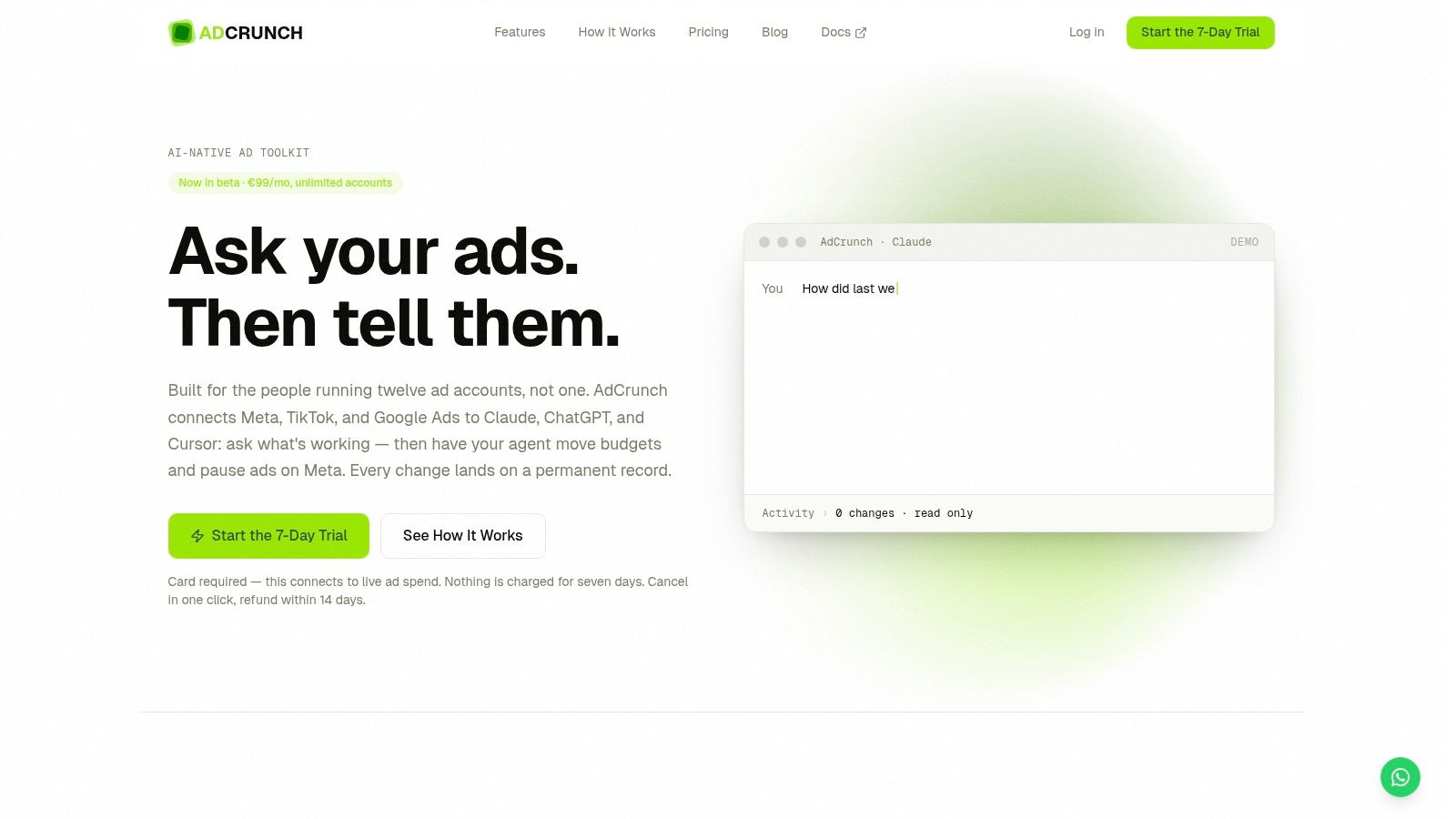
AdCrunch is one option for this workflow. It connects Meta, TikTok, and Google Ads to agent-based operations, supports campaign and budget actions on Meta, creates new entities paused, blocks hard deletes and targeting changes to existing ad sets, and records actions in a permanent activity log. Those controls help agencies execute changes across multiple accounts while retaining an audit trail.
The video below shows the account-level workflow media buyers should define before allowing an operational tool to act.
Never scale a campaign solely because its reported CPA is low. Verify that the conversion is real, the sales team can handle the volume, and the next increment of spend still reaches valuable users.
Creative and Lead Response Optimization
Creative still matters, but it should follow the account’s delivery logic rather than distract from it. Placement changes and automation can shift results before a new concept is produced, so review where ads appear and how campaigns are structured first. Then make the asset fit the placement and the user’s context.
Across 12 million ad sets, vertical video with audio produced a 35% higher click-through rate in Reels and a 12% higher conversion rate than other video types, according to Backlinko’s Facebook Ads statistics. Use that finding as a testing direction, not a reason to turn every asset into loud vertical video.

Build for the first interaction
Give each asset one clear message. Put the problem, product context, or offer in the opening moment. Add captions or on-screen text when the message depends on sound, but avoid dense copy that viewers must decode while scrolling.
Mobile-friendly video under 15 seconds, or vertical video, recorded a 12.3% lower cost per conversion than non-mobile-optimized video in the same benchmark. Treat that result as a testing input, not a production rule. A longer demonstration can outperform a short clip when the product needs explanation.
Teams that want a systematic way to analyze paid social creatives should log the hook, format, offer, proof point, and call to action for every test. That record separates a useful creative test from random replacement.
Treat response speed as part of media buying
Lead generation continues after the form submission. A benchmark cited by this lead-response benchmark reports that leads contacted within 5 minutes were 21 times more likely to convert than leads contacted after 30 minutes. If the sales team responds slowly, better ads may only produce more unworked demand.
Build a response path with a named owner, immediate CRM delivery, alerts, qualification fields, and a fallback when the primary representative is unavailable. Review lead quality by source and campaign, not only by form completion. A shorter form may increase volume while lowering the share of people who can or will buy.
Media buying includes the handoff: an ad creates an opportunity, while the response process determines whether that opportunity becomes revenue.
Building Your Facebook Ads Optimization Checklist
A useful checklist prevents reactive edits. Review delivery, economics, structure, creative, and sales operations together, then change one condition at a time. The largest gains often come from cleaning up campaign structure and placement decisions before replacing ads.
Account and measurement
- Verify the objective: Confirm that the campaign optimizes for the commercial action that matters to the business.
- Check event quality: Review Pixel and Conversions API signals, deduplication, event priority, and CRM handoff.
- Compare reported and real outcomes: Reconcile Meta conversions with sales, qualified leads, purchases, or booked revenue.
- Run causal tests when appropriate: Use randomized test and holdout groups to isolate incremental lift instead of relying only on platform attribution. Apply this method when the account has enough volume and a clear business outcome.
Delivery and structure
- Inspect CPM in context: Compare costs with the $15.06 median Facebook CPM cited earlier, then adjust the interpretation for margin, market, audience value, and placement mix.
- Review placement economics: Look beyond cheap clicks. Identify where qualified conversions and profitable revenue occur.
- Remove structural duplication: Consolidate overlapping ad sets, archive clutter, and preserve tests that answer a defined question.
- Choose automation deliberately: Let Advantage-style delivery explore when conversion signals are reliable. Use manual separation for distinct commercial, geographic, or compliance requirements.
Creative and operations
- Check mobile fit: Review aspect ratio, opening message, captions, load experience, and landing-page continuity.
- Test one meaningful variable: Change the hook, offer, format, or proof point separately so the result remains interpretable.
- Watch response time: Measure how quickly new leads receive human or automated follow-up, and check whether that response produces qualified conversations.
- Document every action: Record budget moves, pauses, launches, reasons, and review dates.
Use restraint. A weak day does not justify rebuilding an account, and an attractive reported metric does not prove that a campaign should scale. Diagnose the leak, choose the smallest useful intervention, and hold conditions steady long enough to read the result.
AdCrunch connects Meta, TikTok, and Google Ads to an agent workflow that can query performance and execute controlled actions such as budget changes, pauses, resumes, and campaign creation. Teams managing multiple accounts can visit AdCrunch to review a platform that records optimization decisions.