
Ad Performance Metrics: A Multi-Platform Guide
Master ad performance metrics across Meta, TikTok, and Google. Learn how to interpret benchmarks, validate causality, and optimize multi-account workflows.
- ad performance metrics
- media buying
- ad operations
- marketing measurement
- ROAS optimization
You’re looking at Meta, TikTok, and Google Ads dashboards, and each one appears to tell a different story. Meta reports efficient conversions, TikTok shows inexpensive clicks, and Google captures demand at a higher cost. The budget question still lands on your desk: what should be scaled, what should be restrained, and which result came from the advertising?
Ad performance metrics help answer that question, but only when you treat them as operating signals rather than isolated scoreboard numbers. A low CPC can hide weak intent. A strong ROAS can reflect conversions that would have happened anyway. A high CTR can come from compelling creative, loose targeting, or a promise the landing page fails to deliver.
The practical job is to connect fast platform feedback with slower business validation, then turn the interpretation into controlled action across every account you manage.
Table of Contents
- The Reality of Cross-Platform Measurement
- Defining Core Metrics Across Meta TikTok and Google
- Interpreting Benchmarks Without Overgeneralizing
- Moving Beyond Directional Metrics to Causal Measurement
- Optimizing Multi-Account Workflows with AI Agents
- Building a Unified Reporting and Audit Framework
- Transforming Metrics into Operational Action
The Reality of Cross-Platform Measurement
A media buyer can spend the morning moving between dashboards without ever seeing one coherent performance picture. Meta may emphasize delivery and attributed purchases, TikTok may make short-form creative look highly engaging, and Google Ads may capture users who already know what they want. Each platform reports useful information, but each also defines success through its own auction, attribution settings, and interface.
That fragmentation creates a familiar operational mistake. Teams optimize the metric that is easiest to see instead of the outcome the business needs. More impressions can look like progress when reach quality is deteriorating. More clicks can look like demand when visitors don’t convert. A platform-native ROAS figure can look decisive even when the broader measurement setup hasn’t established whether the advertising created incremental revenue.
A more useful measurement baseline
The IAB Europe measurement framework offers a useful historical baseline because it separates performance into media effectiveness, brand effectiveness, and sales effectiveness. Impressions, target reach, and frequency belong to the media layer. Unaided and aided brand awareness, along with ad awareness, belong to the brand layer. Sales penetration, customer lifetime value, return on profit, ROAS, and incrementality or sales lift belong to the sales layer.
That structure matters because it prevents a delivery metric from standing in for a business result. A campaign can reach the right audience efficiently without producing immediate sales. Another can generate conversions while contributing little new demand. Measurement becomes more reliable when campaign actions map back to the correct outcome category.
Practical rule: Don’t ask whether an ad performed well until you’ve specified which layer you’re judging, delivery, brand response, or sales impact.
What this changes operationally
For a cross-platform team, the framework becomes a naming and reporting discipline. Standardize campaign objectives, conversion definitions, spend fields, and downstream revenue fields before comparing networks. Then keep separate views for daily media decisions and business validation.
The result isn’t a perfect single number. It’s a shared language that lets a media buyer explain why a creative change improved response, why a budget shift improved efficiency, or why a reported conversion shouldn’t yet justify more spend. The dashboards still disagree, but your operating model no longer has to.
Defining Core Metrics Across Meta TikTok and Google
The same label can describe very different buying conditions. CPM, CPC, CTR, CPA, and ROAS are useful only when you understand the auction and user behavior behind them.

Cost and response metrics
CPM, or cost per thousand impressions, tells you what it costs to buy delivery. It’s most useful for understanding auction pressure, audience availability, and reach efficiency. A lower CPM can help an awareness campaign, but it doesn’t prove that people noticed, remembered, or acted on the ad.
CTR measures the share of impressions that produced clicks. On Meta and TikTok, CTR often reflects the strength of the hook, visual, and audience fit in a fast-scrolling environment. On Google Search, CTR is more closely tied to query intent, ad relevance, position, and the language of the search itself.
CPC is the resulting cost of each click. A cheap TikTok click may represent light curiosity. A more expensive Google Search click may come from a user actively comparing solutions. Comparing those CPCs without comparing intent is like comparing the cost of a conversation with the cost of a sales appointment.
Conversion economics by platform
CPA, or cost per action, is closer to business value because it evaluates the cost of a selected conversion. The definition still matters. A platform can optimize toward a form completion, purchase, registration, or another event, and those actions don’t carry equal commercial value.
ROAS compares attributed revenue with ad spend. It can guide budget decisions, especially in ecommerce, but the attribution window, conversion event, returns, repeat purchases, and baseline demand all shape the result. A platform’s reported ROAS is therefore a directional operating metric, not automatic proof of causal profit.
| Metric | Meta | TikTok | Google Ads |
|---|---|---|---|
| CPM | Useful for delivery cost and audience pressure | Useful for evaluating reach and creative distribution | More relevant in display, video, and broader reach activity |
| CTR | Indicates scroll-stopping creative and audience response | Strongly influenced by the opening hook and format | Closely tied to query intent, relevance, and position |
| CPC | Reflects social auction and engagement response | Can be inexpensive without strong commercial intent | Often reflects active demand, especially in Search |
| CPA | Depends on event quality and attribution | Depends heavily on post-click experience and conversion signal | Often useful for intent-led conversion campaigns |
| ROAS | Useful for attributed purchase analysis | Needs careful validation because discovery may precede conversion | Useful for revenue capture, but still attribution-dependent |
The paid advertising analysis guidance from Supermetrics makes the same practical distinction across funnel stages. Awareness work may prioritize delivery and engagement, traffic activity may prioritize CTR, and conversion campaigns should focus more heavily on conversion rate and CPA. The right metric follows the objective. It doesn’t replace it.
Interpreting Benchmarks Without Overgeneralizing
Benchmarks are reference points, not verdicts. A median can tell you where a distribution sits, but it can’t tell you whether your campaign has the right audience, creative, offer, landing page, conversion signal, or margin profile.
The available 2026 benchmark summaries illustrate that context clearly. A Meta/Facebook summary reports a median CPA of $38.99, median CPM of $15.06, median ROAS of 1.88, and median conversion rate of 1.53%. A separate aggregated Google Ads benchmark reports median CPC of about $1.53, CTR of 4.695%, and conversion rate of 2.546%. These figures come from different platform environments and shouldn’t be merged into a universal performance target. See the Meta and Google benchmark comparison for the reported dataset and context.
The same platform can produce different economics
Objective changes the auction. The 2026 Meta benchmark coverage reports CPM around $14.68 for conversions and around $7.19 for reach, showing why a reach campaign and a conversion campaign shouldn’t be judged against one CPM expectation. The 2026 Meta benchmark analysis also emphasizes material differences by industry across CPA, ROAS, and CTR.
| Platform | Median CPA / CPC | Median CPM | Median ROAS / Conv. Rate |
|---|---|---|---|
| Meta/Facebook | CPA $38.99 | $15.06 | ROAS 1.88 |
| Google Ads | CPC about $1.53 | Not provided | Conversion rate 2.546% |
The table is useful for orientation, not for automatic budget rules. A campaign with a CPA above the Meta median may still be profitable if its customers have stronger economics. A campaign below the median may be wasteful if it produces low-quality conversions. Google’s CPC and CTR figures also don’t make a Search campaign comparable with a social awareness campaign.
How experienced teams use the data
Start with an internal comparison set. Segment by platform, objective, market, audience, creative format, and conversion event. Then examine medians and quartiles within comparable groups instead of ranking every campaign against one blended average.
“Good” is a decision relative to margin, intent, and incremental value, not a number copied from a benchmark report.
Use benchmarks to identify an investigation. If CPM rises, inspect auction pressure, audience size, placements, frequency, and creative fatigue. If CTR falls, inspect the message and opening frame. If CPA rises while CTR holds, examine the landing page, conversion event, tracking, and downstream quality. The benchmark starts the diagnosis. It shouldn’t end it.
Moving Beyond Directional Metrics to Causal Measurement
A high ROAS number feels like proof because it connects revenue to spend. It isn’t necessarily proof that the ads generated that revenue. Platform attribution can claim credit for users who were already searching, returning, or likely to purchase.
CTR has the same limitation. A compelling ad can attract attention without creating qualified demand. CPA can improve because the platform found people most likely to convert, not because the campaign created additional customers.
Use each measurement method for its proper job
Recent measurement guidance recommends a sequence that separates speed from causal confidence. The 2026 measurement discussion from AdSight describes a practical hierarchy built around server-side collection, attribution for daily optimization, incrementality testing for causal validation, and Marketing Mix Modeling for strategic allocation.
These methods answer different questions:
- Server-side collection improves the reliability and completeness of incoming event data.
- Attribution helps operators decide what to adjust during active campaigns.
- Incrementality testing asks whether exposed users or regions produced more outcomes than a comparable control.
- Marketing Mix Modeling supports broader allocation decisions across channels and time.
Attribution is fast and operational. Incrementality is slower but better suited to causal questions. MMM works at a strategic level and helps account for broader media activity and market conditions. No single method should carry every decision.
A workable operating rhythm
Use attributed CTR, CPC, CPA, and ROAS to detect changes and manage the auction. Log the action, the reason, the expected effect, and the observation window. Then use controlled tests to check whether the change generated net-new business rather than merely rearranging credit.
A budget shift should therefore have two labels. The first is directional evidence, such as improving CPA or stronger conversion rate. The second is causal confidence, based on experiments, holdouts, or a broader model. Keeping those labels separate makes stakeholder conversations more honest and prevents short-term platform movement from being mistaken for durable growth.
A useful reporting view should show both. Put platform metrics beside qualified revenue, margin, customer value, and test results. That arrangement makes it harder to scale a campaign because its dashboard is flattering.
Optimizing Multi-Account Workflows with AI Agents
Finding a metric anomaly is only half the work. The bottleneck appears when the same diagnosis affects many accounts, markets, or brands and a buyer must open each platform, verify the context, make the change, and document what happened.
AI agents can reduce that execution lag, but only when the workflow treats them as controlled operators rather than unrestricted autopilot.
Start with a repeatable decision loop
A useful agent workflow has a clear sequence:
- Query the same fields across accounts. Pull spend, impressions, clicks, CTR, conversions, CPC, CPA, and ROAS into a consistent structure across Meta, TikTok, and Google Ads.
- Filter for a defined anomaly. Look for a meaningful change against the campaign’s own history or its matched comparison group, not an arbitrary universal threshold.
- Inspect the cause. Separate delivery problems from creative response, conversion tracking, landing page friction, or audience quality.
- Propose the write action. The agent should state which campaign it will pause, resume, or adjust, and why.
- Apply guardrails. Restrict the action to approved fields, accounts, and budgets.
- Record the outcome. Capture the request, account, change, origin, and result in a permanent activity record.
This sequence keeps interpretation ahead of execution. The agent shouldn’t move budget merely because one metric changed. It should understand the objective, the comparison window, and the business constraint.
Safety matters more than novelty
Write access requires boundaries. New campaigns, ad sets, creatives, and ads should start paused. Hard deletes should be unavailable, and existing ad sets should be protected from unintended targeting changes. Bid edits can also remain outside the agent’s scope when the operating model calls for tighter human control.
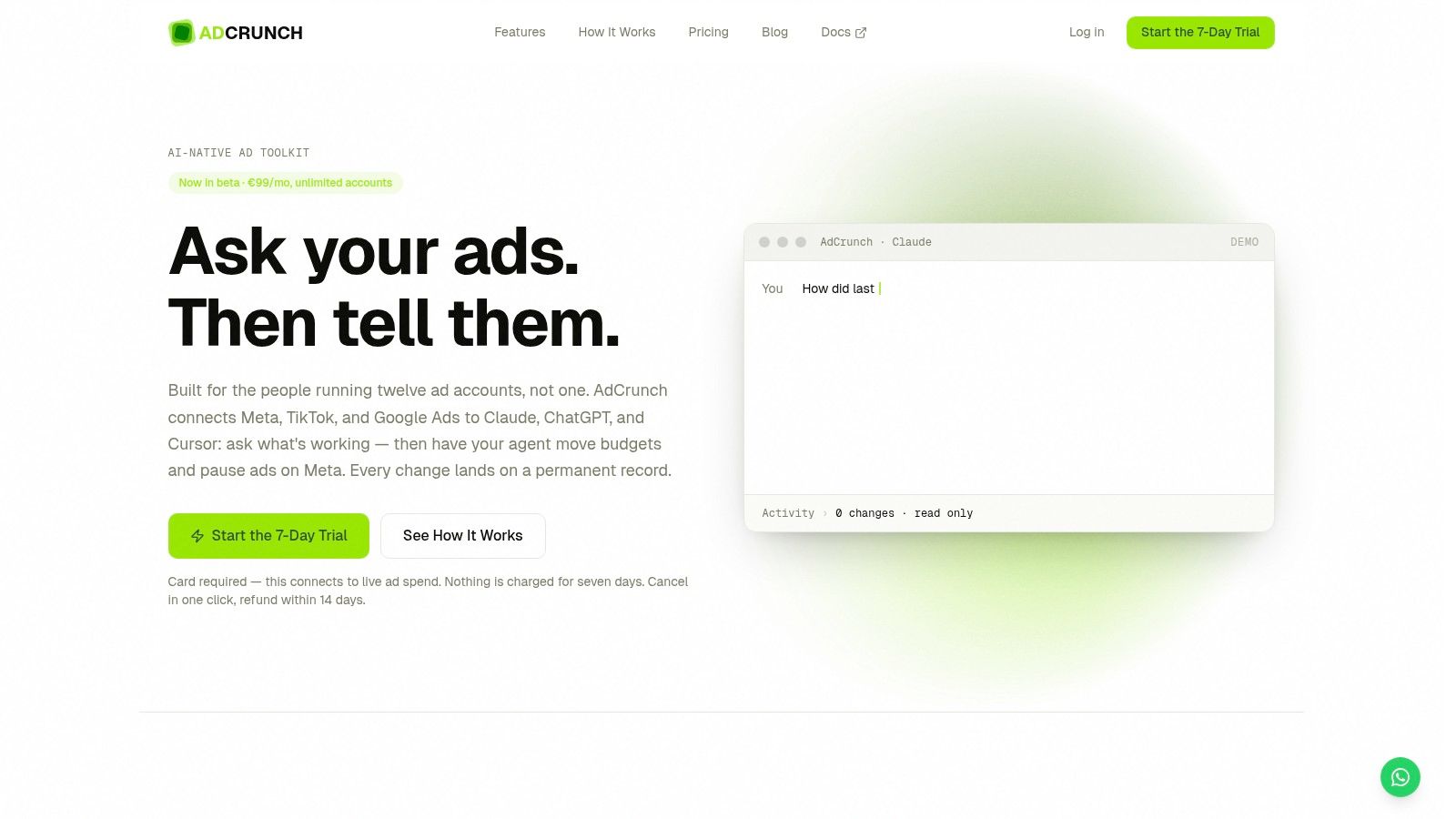
AdCrunch connects Meta, TikTok, and Google Ads to agents in Claude, ChatGPT, and Cursor, with write actions on Meta and safety controls that include paused creations, no hard-deletes, no targeting changes to existing ad sets, and no bid edits. Credentials stay with the service while actions run server-side against connected platforms.
The strongest workflow combines machine speed with human approval where risk is high. Let the agent collect context, compare accounts, draft a change, and execute low-risk approved actions. Require review for major budget reallocations, new markets, or changes that could alter measurement integrity.
Building a Unified Reporting and Audit Framework
Cross-platform reporting fails when each network uses a different connection shape, naming convention, and definition of success. The team then spends its time translating fields instead of deciding what to do.
A unified framework starts with a common schema. Map each platform into shared fields for account, campaign, objective, spend, delivery, response, conversion, revenue, and status. Preserve the original platform value as well, because normalization shouldn’t erase the details needed for diagnosis.
One operating view, not one misleading score
A useful reporting layer should let a buyer move from a portfolio view to the campaign and ad level without losing context. It should filter by provider and date range, expose breakdowns beneath the main trend, and distinguish reported conversions from qualified or validated business outcomes.
Don’t force Meta, TikTok, and Google into one blended ROAS if their attribution systems and objectives differ. Use a common reporting structure, then keep platform-specific interpretations visible. That gives leadership a comparable view without pretending that every conversion carries the same meaning.
The operational economics matter too. Per-account and per-seat pricing can discourage teams from instrumenting smaller brands or testing new markets. A flat per-organization model makes it easier to connect the full portfolio, especially when the marginal value of consistent monitoring is high and the account budget varies.
Make every change explainable
An activity log should record more than a timestamp. It should show the account, entity, field changed, previous value, new value, request origin, operator or agent, and outcome. That record helps resolve disputes, investigate unexpected movement, and connect a metric change with the action that preceded it.
The ad account management tools guide is relevant to this operating problem because account management at scale requires both execution controls and accountability. A dashboard can show that spend changed. An audit trail can show who changed it, why the change was requested, whether the platform accepted it, and what happened afterward.
Audit principle: If a budget shift can’t be reconstructed later, it isn’t a complete optimization record.
Transforming Metrics into Operational Action
Mastering ad performance metrics doesn’t mean memorizing formulas. It means building a system that turns ambiguous signals into deliberate, reviewable decisions.
Use this checklist to assess your current setup:
- Shared definitions: Do Meta, TikTok, and Google use consistent conversion and revenue fields?
- Objective alignment: Does each campaign use the metric that matches its funnel role?
- Contextual benchmarks: Are comparisons segmented by platform, objective, market, audience, and format?
- Causal validation: Can you distinguish attributed performance from incrementality evidence?
- Execution speed: Can an approved insight become a controlled action without repeated dashboard switching?
- Safety controls: Do new creations start paused, and are destructive actions restricted?
- Auditability: Can you trace every pause, budget shift, and launch to a request and outcome?
The future-proof operating model isn’t a passive dashboard. It’s an active command center that combines standardized reporting, human judgment, AI-assisted execution, and permanent records. Performance marketing automation becomes valuable when it reduces wasted operational time without hiding the reasoning behind each change.
AdCrunch connects Meta, TikTok, and Google Ads to AI agents that can query performance and execute controlled write actions on supported accounts, with new creations paused and every action captured in an activity log. Visit AdCrunch to evaluate whether its unified ad operations workflow fits your multi-account measurement and optimization process.