
Social Media Ad Platform Comparison for 2026
Compare top social media ad platforms in 2026. See strengths, costs, and use cases for Meta, TikTok, Google, LinkedIn, and more to pick the right fit.
A social media ad platform can report a winning campaign while your business gains nothing it wouldn’t have gained anyway. That gap matters in a market where worldwide social-media ad spending was estimated at approximately $276 billion in 2025, alongside a global social-media user base of about 5.44 billion. (Statista’s overview of social networks)
The right platform isn’t the one with the lowest click cost or the most convenient dashboard. Choose for the job you need done, then build the measurement and operating controls to establish whether it’s doing it.
Table of Contents
- Why Choosing a Social Media Ad Platform Is an Operations Decision Now
- The Major Social Media Ad Platforms at a Glance
- The Cost and Performance Benchmarks That Matter
- Which Social Media Ad Platform Fits Which Advertiser
- How to Tell If a Platform Is Actually Incremental
- Governance, Brand Safety, and AI Creative Oversight
- Selection Checklist and Common Buyer Questions
Why Choosing a Social Media Ad Platform Is an Operations Decision Now
Social advertising operates at mass-market scale, and at that scale a platform choice does far more than set CPMs. It determines who approves creative, how budgets move between accounts, what counts as a conversion, and whether your team can explain results to a CFO who wants an audit trail rather than a dashboard screenshot.
Four operational realities should drive the decision.
Scale creates coordination work. Managing Meta, TikTok, and Google Ads means different account structures, bidding logic, reporting conventions, and creative specs. If each lives in a separate workflow, the analyst who spots a problem often can’t fix it, and the person who can fix it never sees the data. Budget errors can sit for days because ownership lives in the wrong queue.
Formats set the creative workload. A short-form video channel demands a steady pipeline of native-feeling assets. Other placements reward product imagery, longer demos, search copy, or professional content. Pick a platform your team can feed. An attractive audience profile means nothing if you ship three creatives a quarter to a channel that burns through them weekly.
Automation changes who holds the controls. Platforms automate delivery and bidding, but they know nothing about your approval rules, acceptable claims, or margin floors. Decide which actions run automatically, which require human review, and how you reverse a change that misses the mark.
Measurement creates friction across networks. Every platform grades its own homework using its own attribution conventions. Numbers that look comparable can describe completely different user journeys, and the gap between reported return and real incremental gain is where budgets leak. A working operations process logs definitions, budgets, and changes alongside results, so analysts can reconstruct what happened instead of exporting dashboards and hoping.
Treat selection as a workflow decision. Match the channel to the objective, then test whether your team can create, govern, measure, and improve there. Reach is the easy part; team structure and reporting maturity determine whether that reach turns into performance you can defend.
The Major Social Media Ad Platforms at a Glance
The platforms don’t do the same job, so a feature-by-feature checklist can distract from the decision that matters: what kind of demand are you trying to reach, and what can your team produce consistently?
| Platform | Best-Fit Objective | Funnel Role | Format Strength |
|---|---|---|---|
| Meta | Demand generation and ecommerce | Discovery, consideration, retargeting | Feed, Stories, Reels, product creative |
| TikTok | Reach and creative-led discovery | Awareness and consideration | Short-form vertical video |
| Google Ads and YouTube | Capture existing intent and build video reach | Search conversion and upper-funnel video | Search text, video |
| B2B audience development | Consideration and lead generation | Sponsored professional content | |
| X | Timely conversation and message distribution | Awareness and engagement | Short text, video, promoted posts |
Meta is a versatile starting point for consumer campaigns that need both prospecting and retargeting. Its auction distributes ads according to delivery and advertiser objectives, while the creative mix can include feed placements, Stories, Reels, and product-focused ads. Advertising is central to the company’s business: Meta reported $160.633 billion in advertising revenue in 2024, about 97.7% of total revenue, with ad revenue up 22% year over year in its full-year filing. That scale makes the platform commercially important, but it doesn’t make every campaign a fit.
TikTok is built for discovery through short-form video. Use it when your product can be shown quickly, creators or in-house talent can make native-feeling content, and the team can refresh assets as audience response shifts. Its auction can find audiences for creative, but low-cost reach isn’t proof of purchase intent.
Google Ads and YouTube serve different roles within the same broader ad ecosystem. Search is suited to capturing demand expressed through queries; YouTube supports video-led reach and product explanation. A team can use both, but should keep search conversions distinct from video’s contribution to discovery. For teams mapping channel roles alongside practical execution, this guide to Meta and Google ad tactics offers a useful complementary perspective.
LinkedIn suits professional audiences and business-focused offers. Sponsored content can support consideration and lead generation, especially when the buyer’s role or industry matters. Expect the creative and conversion path to feel more like professional education than consumer entertainment.
X is most useful when a campaign benefits from timely conversation, fast-moving topics, or a message that can travel through a public feed. Treat it as a specific audience and context choice, not a default substitute for Meta or TikTok. Its strengths depend heavily on whether your customers engage with your category there.
The Cost and Performance Benchmarks That Matter
A benchmark earns its place in a media plan only when the metric matches the job the campaign was hired to do. Search captures demand that already exists; social spend often has to create it. Treating their click costs as interchangeable is how budgets get moved for the wrong reason.
One cross-platform dataset puts Google Ads at a 6.64% average CTR, 8.18% conversion rate, and $5.42 CPC. In the same source, Meta traffic campaigns average 1.71% CTR and $0.70 CPC, while TikTok averages 1.77% CTR, 2.01% conversion rate, and $13.26 CPM. Treat these as directional reference points and read them alongside the benchmark methodology and campaign definitions, since campaign objective, audience, and conversion definition change what a “good” number looks like.
Google’s higher CPC can be money well spent when the click comes from someone already searching for a solution. Meta’s cheaper traffic buys visits efficiently, but a visit is not revenue; the real test is what those sessions do downstream and whether creative stays fresh enough to hold delivery. TikTok’s CPM prices an impression. It says nothing about whether the viewer ever becomes a customer.
A second dataset, the paid-media benchmark report, reports Meta Facebook and Instagram at a 2.19% average CTR, $0.70–$1.92 CPC, and $38.17 average CPA, with TikTok in-feed ads at $1.02 CPC and $9.16 CPM against a $13.48 Meta CPM. Two sources, same lesson: delivery price and acquisition cost measure different things.
Cheap reach is easy to buy. Profitable customers are not.
Cardinal sin: Moving budget because one platform has a lower CPM. Cheap impressions can still produce expensive customers.
For cleaner definitions before you compare platforms, this breakdown of ad performance metrics covers how each measure is calculated and where teams misread it.
Benchmark tables also ignore timing. Every platform reports conversions on its own attribution clock, and the gap between click and credited conversion varies by campaign objective and sales cycle. Pause an ad after a handful of clicks and you may be reacting to noise; leave it running for weeks on faith and you fund waste. Set an observation window that matches your conversion cycle, write down the attribution assumptions behind every reported figure, and keep an audit trail before you call a result real.
Practical rule: Judge each platform against its own marginal CPA or ROAS target. Reserve cross-platform benchmark tables for directional portfolio decisions, and let incrementality testing rather than dashboard averages decide where the next dollar goes.
Which Social Media Ad Platform Fits Which Advertiser
Start with the sales motion, then match the platform to it. The same channel that prints profit for one advertiser burns budget for another, and the difference is rarely the interface. It is whether the team can staff the creative, read the reporting, and connect spend to an outcome the business recognizes.
DTC ecommerce brands spending under $5 million a month should run Meta as the primary platform and TikTok as the secondary test. Meta handles prospecting and retargeting at scale; TikTok earns budget when the brand can ship product-demonstration video week after week. Using the benchmark figures above, judge the pairing on purchase value and contribution margin rather than impression price.
B2B SaaS teams with long sales cycles should open with Google Search for demand capture and layer LinkedIn when role or company context shapes the deal. Search meets buyers already looking; LinkedIn puts educational material in front of buying committees months before they sign. Measure qualified pipeline and stage progression. Form fills flatter the dashboard while the sales team rejects the leads behind them.
Agencies running mixed-client portfolios should pick each client’s primary platform from that client’s objective, then standardize how launches, changes, and results get documented. Meta anchors most consumer accounts; Google Search fits clients whose prospects actively hunt for a service. Teams weighing a combined service model can use this overview of a Google and Facebook ads agency to frame where channel execution and account management meet. Set client-level targets per account. Portfolio convenience is a bad reason to force every client onto one platform.
In-house teams entering new markets should lead with Google Search when identifiable intent already exists, then add Meta to test audience-led and creative-led demand. Define the campaign objective before buying a single impression, so creative, landing pages, and success measures line up from day one.
One rule cuts across every archetype. A cheap form fill means nothing if sales will not accept it. Ask whether the pipeline advances, and keep a written trail of what the platform promised versus what the business gained. When a team cannot trace the media outcome to the next business step, the apparent bargain is a reporting artifact.
How to Tell If a Platform Is Actually Incremental
Low CPM and strong CTR can both hide cannibalization. A platform may receive credit for conversions from people who would have purchased anyway, particularly when several channels touch the same customer and their reports use different attribution windows. In industry research, 45% of marketers identified declining ability to measure campaign effectiveness across platforms and the open web as their leading media concern, while 67% said proving incremental ROI is becoming more difficult, according to Marketing Brew’s report on marketer concerns.
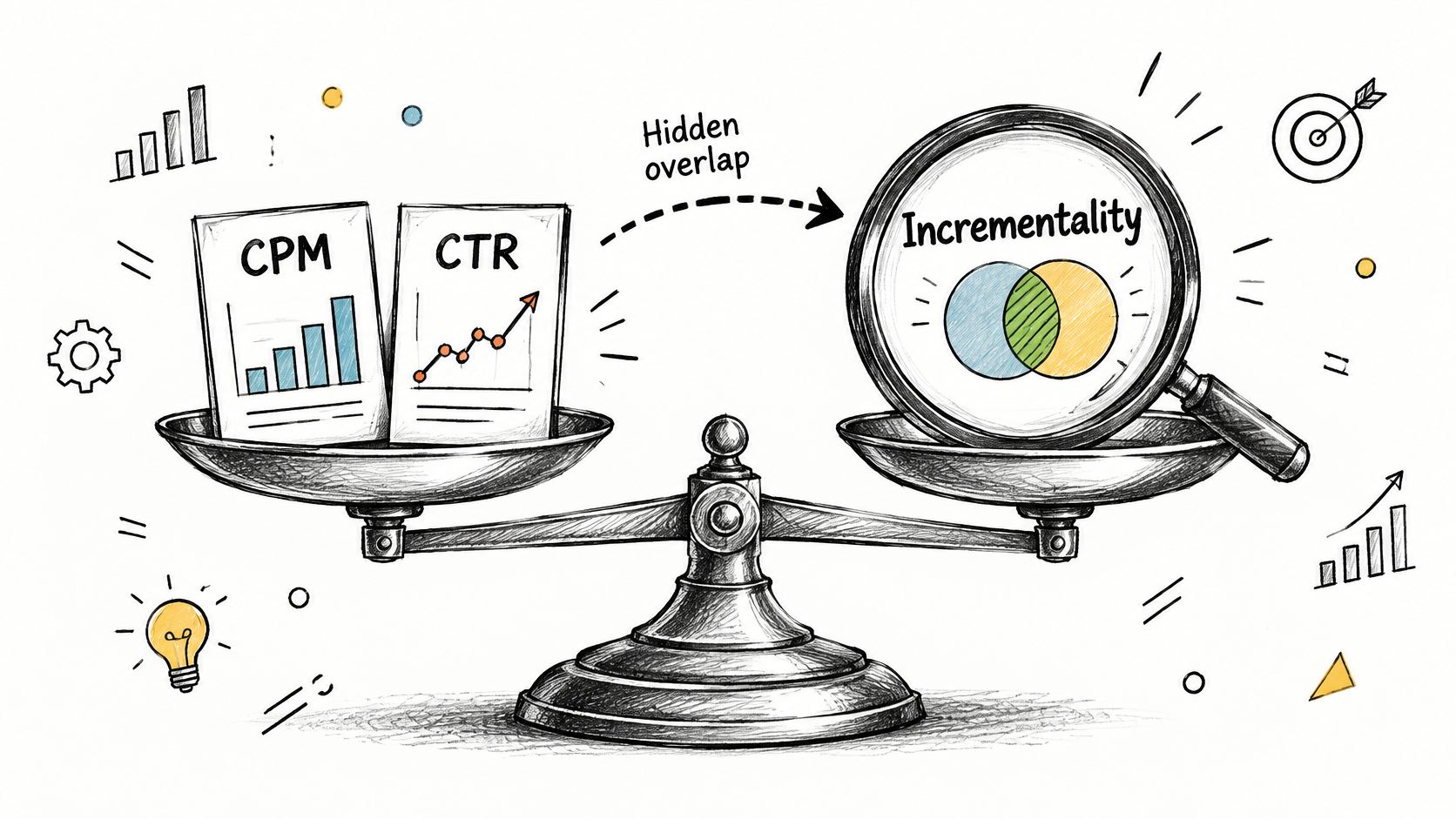
To test whether advertising adds business value, establish the comparison before the campaign launches. A geo-holdout withholds or changes media in selected markets, then compares outcomes against similar exposed markets. A matched-market test pairs areas with similar characteristics so the team can assess whether results diverge when advertising changes. A conversion-lift study can test whether exposed audiences convert more than an appropriate control group. Each method answers a different question, so define the decision the test must support before choosing one.
The comparison only works if the team records what changed and keeps other major marketing activity in view. Document campaign dates, audiences, spend, attribution windows, conversion definitions, and concurrent promotions. If a platform changes its budget or targeting during a test, the result becomes harder to interpret. An operations layer can preserve those actions and their outcomes, but it cannot replace a sound experimental design.
A lower-ROAS channel may still add value if it introduces customers who later convert through another channel or creates demand that wasn’t already present. Conversely, a high reported ROAS may overstate contribution if the platform claims credit for customers already on the path to purchase. Compare platform reporting with the experiment’s business outcome, then decide whether the channel should be scaled, revised, or stopped.
Use this short walkthrough as a prompt for the team’s testing conversation.
Governance, Brand Safety, and AI Creative Oversight
A multi-account team can have clean dashboards and still lack control. Consider an agency running campaigns for several clients: one buyer drafts AI-assisted creative, another adjusts spend, and a client questions where an ad appeared. A performance report may show delivery and conversion totals, but it won’t necessarily explain who approved the asset, what changed, or why the team made that decision.
Research from DoubleVerify found that 46% of marketers consider reaching their target audience their biggest social-advertising challenge, 38% struggle to keep up with content trends, and nearly two-thirds express concern about brand suitability in social placements. (DoubleVerify’s global research) Those concerns call for operating rules, not a bigger pile of reports.
Brand safety is about avoiding clearly harmful or unacceptable content environments. Brand suitability is more specific to the client’s context: an environment may be acceptable for one advertiser and wrong for another. Write the distinction into client guidelines, then apply exclusions based on documented risk and business context.
For AI-assisted creative, require human approval before launch. Review factual claims, product imagery, rights, disclosures, and whether the asset fits the brand’s voice. Set a review owner and preserve the approved version so the team can tell which asset ran. Teams considering creative automation can also consult this practical perspective on AI ad creative.
Monitor frequency and creative fatigue alongside delivery. When results weaken, first check whether the audience has seen the same asset repeatedly, whether the offer has changed, and whether a replacement has passed review. Keep an audit trail connecting each creative and budget change to its requester, rationale, and outcome. A process for AI campaign management can help teams define what agents may prepare and what a person must approve.
Strict exclusions can reduce reach and raise costs. Choose exclusions for a documented reason, not because a longer list looks safer.
Selection Checklist and Common Buyer Questions
Run this checklist before committing budget or signing a platform contract:
- Objective fit: Does the platform match the action you need, such as capturing search demand, generating discovery, or reaching a professional audience?
- Creative capacity: Can your team regularly produce the formats that work on the channel?
- Measurement maturity: Can you define a qualified outcome and separate platform reporting from business impact?
- Governance: Are approval rights, exclusions, and change records clear?
- Operating cost: Have you accounted for the people, creative, reporting, and account-maintenance work required to run it?
How many platforms should we run at once?
Run only the channels your team can support with suitable creative, reliable measurement, and active ownership. Add a platform when you have a clear test question and someone accountable for interpreting the result.
When should we consolidate spend?
Consolidate when separate campaigns compete for the same audience or divide budget so thinly that you can’t make a confident decision. Keep channels separate when they serve distinct roles or require different measurement.
What justifies leaving a platform?
Leave when repeated, well-documented tests fail to meet the business outcome, the channel’s audience doesn’t fit, or the team can’t maintain the creative and governance it requires. Don’t exit solely because one reporting window looks weak.
AdCrunch connects Meta, TikTok, and Google Ads account data to AI agents, and records Meta campaign actions in a permanent activity log. If your team needs to connect cross-platform analysis with controlled execution, visit AdCrunch to see how its workflow fits your account operations.