
How to Set the Objective of a Campaign
Learn how to choose the right objective of a campaign, map it to business KPIs, and align platform delivery for better ad performance and ROI.
campaign objective, advertising goals, marketing KPIs, ad operations, media planning
You launch a traffic campaign for a new product. The ads get clicks, the dashboard turns green, and the cost per visit looks reasonable. A week later, sales have barely moved because the platform found people who enjoy clicking, not people likely to buy.
That outcome usually isn’t a creative problem. It starts with the objective of a campaign, the instruction that tells the advertising platform what result to prioritize. If the objective, conversion event, and business goal don’t point in the same direction, the system can spend efficiently while producing the wrong kind of success.
Table of Contents
- Defining the Objective of a Campaign
- Mapping Objectives to the Marketing Funnel
- Connecting Business Goals to Measurable KPIs
- Choosing the Right Objective for Your Use Case
- Designing Measurement Before Launch
- Executing and Auditing Campaign Changes
Defining the Objective of a Campaign
A DTC brand can have polished creative, a well-defined audience, and a reliable Shopify checkout, yet still waste budget by selecting the wrong campaign objective. If purchase events fire consistently, choosing Traffic tells the platform to find people likely to click. Choosing Sales or Purchases gives it a different job: identify users more likely to complete checkout. The objective of a campaign is therefore an operational decision, not a label added during setup.
A campaign objective is the specific outcome an advertising campaign is designed to produce within a defined audience and timeframe. It turns a broad business priority into instructions for the media buyer, tracking setup, bidding system, and reporting dashboard. “Grow the brand” may describe an ambition, but it does not tell the platform which event should receive budget or tell the team how to judge delivery.
The selected objective also determines what counts as a useful impression. A click-focused campaign can find people who regularly visit websites without showing strong buying intent. A purchase-focused campaign can spend more per click while producing stronger downstream results. Those are different trade-offs, not reporting errors.
The objective is an algorithmic instruction
Campaign platforms use objectives to influence audience selection, delivery, bidding, and budget allocation. Meta can optimize toward outcomes such as purchases, leads, clicks, video views, or reach. Google Ads uses objectives to recommend settings and guide campaigns toward outcomes such as sales, leads, or website traffic. These choices affect the behavioral signals the system learns from, including which users receive impressions, which placements receive budget, and which conversion events shape future delivery.
The event must be both commercially meaningful and technically dependable. A purchase objective supported by missing or duplicated events gives the algorithm weak feedback. A lead objective tied to a form completion may also need a later quality check if many submissions never become sales. The highest-value event is useful only when the tracking and follow-up process can support it.
Practical rule: Choose the objective according to the highest-intent event you can track reliably, not the metric that will look cheapest in the first reporting cycle.
For example, a Shopify store with stable purchase tracking should select Sales or Purchases rather than Traffic. Meta can then use checkout completions as an optimization signal instead of concentrating delivery around click propensity. The account may show a higher cost per visit, but visit cost is no longer the primary performance question. Revenue, purchase volume, and the quality of the measured conversion become more relevant.
Advertising planning now depends on measurable, optimization-driven targets. Historical advertising effectiveness work framed objectives around defined audiences, product qualities, time periods, sales, and market share. Platform automation applies the same discipline at event level. Facebook campaign benchmarks for 2025 can provide context for performance categories, but benchmarks should not replace account-specific targets or explain why a campaign is winning.
Before writing an ad, define the intended action, the audience expected to take it, and the timeframe for evaluation. “Get attention” cannot configure delivery or support a useful audit. “Generate qualified demo requests from a defined B2B audience during the launch period” gives the team a trackable event and a basis for judging lead quality.
For teams managing multiple accounts, ad operations planning should record the objective, conversion event, audience, budget logic, and reporting KPI together. If the campaign name says purchases while the optimization event says landing-page views, the account contains an operational contradiction that should be fixed before more budget is added.
Mapping Objectives to the Marketing Funnel
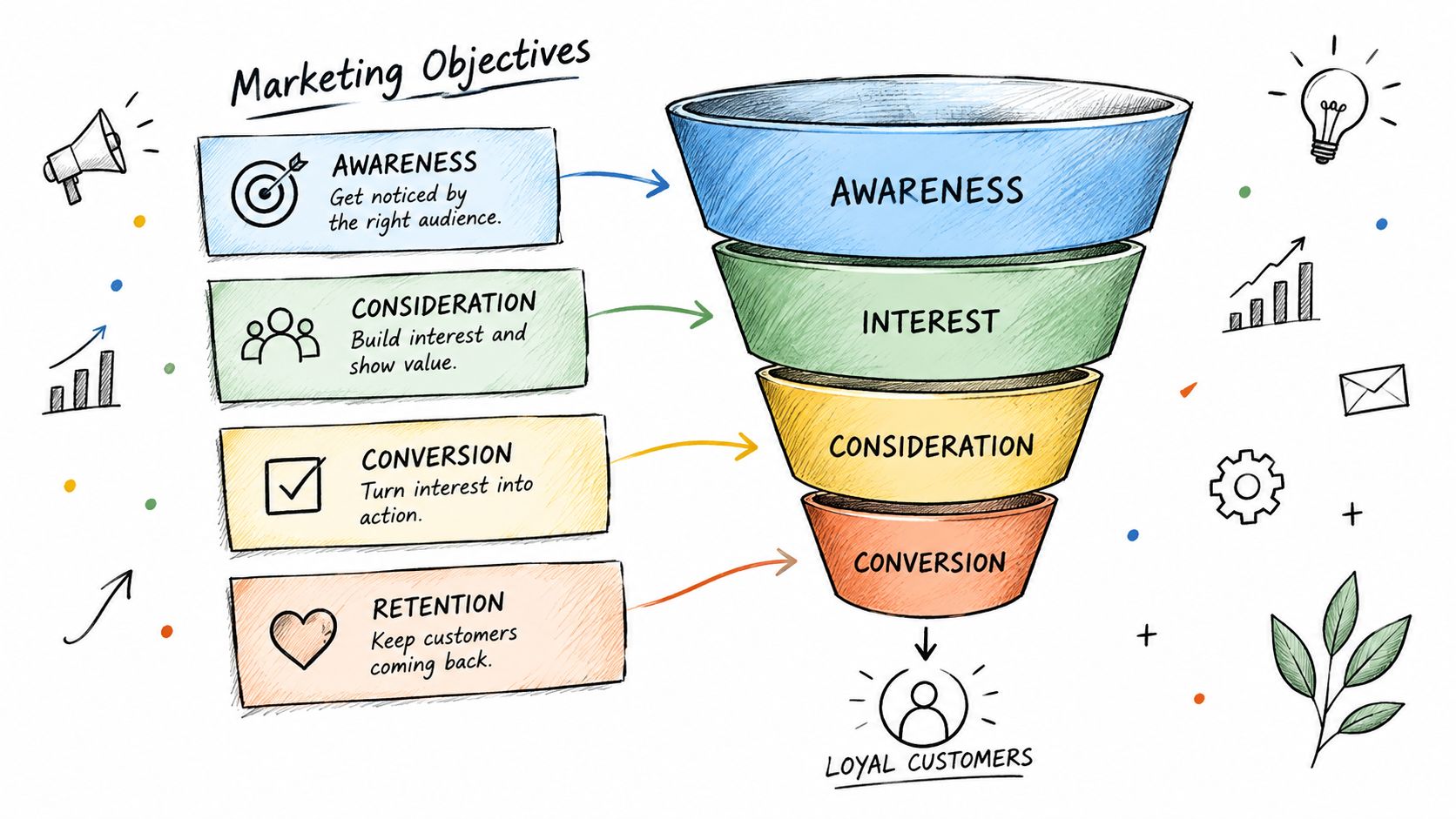
The funnel is useful only when each stage is connected to a different optimization signal. Awareness, consideration, and conversion aren’t interchangeable labels. They describe different audience behaviors, and platforms use those behaviors to decide whom to reach and when.
Awareness objectives buy exposure
An awareness campaign is appropriate when the immediate requirement is to introduce a brand, product, or message to a relevant audience. The system generally prioritizes reach, impressions, or completed exposure, depending on the platform and configuration. The buying logic is not primarily looking for a purchaser today. It’s looking for opportunities to put the message in front of the selected audience.
That makes awareness useful for a new category, a market entry, or a broad brand message. It becomes wasteful when a team judges it only by short-term purchases without considering the role the campaign was designed to play. The mistake isn’t using awareness. The mistake is expecting an exposure objective to behave like a sales campaign.
Consideration objectives seek signals of interest
Traffic, engagement, and video-view objectives sit closer to active interest. The platform looks for people more likely to click, watch, interact, or visit a destination. Those actions can help a buyer build an audience for later activity, test a message, or create a low-friction step for a product that requires education.
The trade-off is clear. A click is easier to produce than a purchase, and a video view is easier to produce than a qualified sales conversation. If the business needs revenue now, a consideration objective can become a proxy trap. The platform finds users who are likely to perform the selected action, even when those users have little commercial intent.
Google’s guidance on media objectives and KPIs describes this relationship directly. Meta’s objective tells its system which outcome to prioritize, while Google Ads uses objectives to steer recommended settings toward outcomes such as sales, leads, or traffic. The practical implication is simple: the selected objective determines what the system learns to value.
Conversion objectives pursue business events
A conversion objective is designed around an event such as a purchase, qualified lead, completed registration, or another action with a clear relationship to the business goal. The event must be measured consistently. If the purchase event fires unreliably, or if the lead event includes low-quality submissions, the algorithm receives a distorted instruction.
A retail advertiser seeking purchases shouldn’t automatically choose traffic because it produces more visible volume. A B2B advertiser shouldn’t optimize for form fills if the sales team only values qualified opportunities and no mechanism connects the form to qualification. The right event is the one that represents meaningful intent and can generate a stable learning signal.
A platform doesn’t understand your commercial strategy unless you express that strategy through a measurable event.
Use the funnel as a decision aid, not a rigid sequence. A product launch might need an awareness layer and a conversion layer at the same time. A mature brand may focus directly on purchases among warm audiences. What matters is that every campaign has one primary job, and the reporting view separates that job from supporting activity.
Connecting Business Goals to Measurable KPIs
A campaign can report strong delivery while producing weak business results. A lead-generation campaign may lower cost per form completion, for example, while sales representatives receive contacts that never become opportunities. The KPI framework must therefore connect the commercial result to the signal the platform can optimize and the checks that expose low-quality volume.
“Grow the business” is a business goal. “Generate qualified trial sign-ups from a defined audience by the campaign end date” is a campaign objective. “Cost per qualified sign-up, conversion rate, and conversion value” are KPIs.
These levels serve different decisions. The business outcome sets the direction. The campaign objective defines the action the ad system is asked to produce. The primary KPI determines how delivery is judged. Quality diagnostics and guardrails show whether the apparent improvement is commercially useful. Google’s framework for campaign objectives and KPIs describes this separation and connects measurement choices with business performance and benchmarks.
Start with the commercial result
Write the result in plain language before opening Meta Ads Manager or Google Ads. It may be revenue, qualified pipeline, new customers, registrations, or adoption of an existing product. Platform menus contain available optimization settings, not your complete business strategy. Choosing a button because it offers cheaper volume can make the account efficient at producing the wrong outcome.
Then define the audience, action, and time boundary:
We want [audience] to complete [specific action] within [timeframe], because it supports [business result].
The action must be observable and close enough to the result to matter. “Understand our value proposition” is a communication aim. “Request a demo after reviewing the product page” is an action that can be measured and evaluated.
Select a KPI that exposes value
The cheapest event is rarely the whole story. Select one primary KPI that reflects the campaign’s job, then add a diagnostic that reveals whether the resulting volume has quality. Teams comparing exposure, engagement, and deeper response can use guidance on key metrics for brand campaigns, but the reporting set should remain small enough to support a decision.
A worked B2B example makes the distinction practical:
- Business outcome: Create sales pipeline from new accounts.
- Campaign objective: Generate demo requests from the defined account audience.
- Primary KPI: Cost per qualified demo, with qualification defined by the Salesforce stage “SQL”.
- Quality diagnostic: SQL-to-opportunity rate, checked by account segment and source.
- Guardrail: CAC payback, so lower acquisition cost does not come from accepting accounts with weak commercial potential.
This setup changes how performance is read. A campaign with a higher cost per demo may be the better program if its SQL-to-opportunity rate is materially stronger. A campaign that produces cheap SQLs but poor opportunity progression needs a targeting, message, or qualification review. The platform may optimize toward the selected event, while the business decides whether that event deserves continued investment.
For ecommerce, purchase value may be a better primary KPI than checkout starts when purchase tracking is dependable. Useful diagnostics can include average order value, new-customer share, or repeat purchase behavior. A traffic campaign should not be judged successful solely because visits are inexpensive if landing-page engagement and later commercial actions remain weak. Teams can also review ad performance metrics and their practical uses when building a reporting view.
Use an intermediate KPI with a defined business relationship
Some final outcomes arrive too slowly or too inconsistently to guide optimization well. A long sales cycle may delay revenue feedback, and a small number of purchases may not provide a stable learning signal. An intermediate KPI can be appropriate when the business has evidence that it predicts the final result.
For example, a completed product configuration or booked sales call may be more useful than a generic page view. The choice should be tested against later sales or revenue outcomes, rather than accepted because the event is plentiful. Campaign measurement guidance on evaluation design stresses that measurement should reflect expected responses such as sales, profit, and ROI and should be considered during communications planning.
A planning guide on concrete campaign objectives likewise recommends specific, time-limited actions instead of broad ambitions. Define the KPI and its quality test before launch, document the business rule behind qualification, and give the platform a signal that the team can defend commercially.
Choosing the Right Objective for Your Use Case
The right objective depends on the job, the audience temperature, and the quality of the available conversion data. There isn’t one universally correct setting for every account. A new product, a retargeting campaign, and a B2B acquisition program can all use the same advertising platform while requiring different optimization paths.
| Business Scenario | Recommended Objective | Primary KPI |
|---|---|---|
| Introducing a product to a broad, relevant audience | Awareness or reach | Qualified reach or impressions |
| Educating prospects about a complex offer | Video views or traffic | Engaged visits or completed video views |
| Driving people to a product or service page | Traffic, if visits are the immediate job | Landing page visits and downstream engagement |
| Selling an ecommerce product with reliable purchase tracking | Sales or purchase conversion | Purchases or conversion value |
| Capturing demand from people already familiar with the brand | Conversion or lead generation | Completed conversions or qualified leads |
| Building a B2B pipeline | Lead generation tied to qualification | Qualified leads or sales-accepted opportunities |
| Testing a message before a larger conversion push | Consideration objective | Meaningful engagement and assisted conversion signals |
New product launch
A new product often needs two different jobs. The first campaign may create familiarity and explain the problem. A second campaign can target people who engaged with that message and ask for a purchase, registration, or enquiry.
Combining both jobs under a traffic objective can create confusion. The platform will seek visitors, while the team expects education and sales. Separating campaigns makes the reporting cleaner and lets each delivery system optimize for a behavior that matches its role.
Retargeting warm audiences
Retargeting audiences already have some relationship with the brand. They may have visited a page, watched a video, added an item to a basket, or interacted with an earlier message. That context usually supports a more direct objective than broad awareness.
Use a purchase or lead objective when the final event is trackable. If the audience is too small or the event is too sparse to produce a dependable signal, an intermediate conversion can be reasonable. Don’t choose engagement because the audience is warm. Warmth changes the likelihood of action, but it doesn’t change the business action you want.
B2B lead generation
B2B accounts expose the difference between a cheap lead and a useful lead. A platform can find people willing to submit a form, but the sales team decides whether those submissions represent a viable opportunity.
For that reason, the campaign objective should connect to a lead event that the business can qualify. If the platform only receives a form completion and never receives feedback about lead quality, it may keep finding the easiest forms to complete. The media buyer should compare volume with downstream progression, then adjust the event or audience strategy when the two diverge.
Multi-account management
Agencies and in-house teams often copy structures across accounts because repetition saves time. Copying the objective without checking the use case creates hidden risk. One brand may have reliable purchase data, another may depend on sales qualification, and a third may still be building demand.
Keep a short objective brief for each account. It should state the business result, campaign action, audience, timeframe, primary KPI, quality diagnostic, and event owner. That document gives buyers a reference point when platform recommendations, client requests, or early dashboard results pull the campaign in different directions.
Designing Measurement Before Launch
A campaign can go live with polished creative, approved targeting, and a broken purchase event. The platform will still optimize, but it will optimize against incomplete evidence. Objective selection is a data-collection decision: it determines the event sent into the ad system, the signal used for delivery, and the KPI that dominates the first reporting view.
Treat launch readiness as an operational handoff, not a strategy exercise. A traffic campaign needs a visit event that excludes obvious noise and records the intended landing page. A lead campaign needs a submission event plus fields that let the business separate valid enquiries from spam or poor-fit contacts. A sales campaign needs confirmed transactions or conversion value, with consistent currency and deduplication. If those conditions are not met, delay optimization or launch with a diagnostic setup rather than pretending the signal is reliable.
Assign owners before launch
Write the selected event and its acceptance criteria in the launch brief. Then assign each check to a person:
- Event owner: RevOps confirms that the purchase or lead event fires once in GTM or the relevant server-side setup. They test duplicate browser and server events.
- CRM owner: The analyst confirms that campaign identifiers, lead status, revenue fields, and consent data map into the CRM correctly.
- Media buyer: The buyer verifies that the platform objective, conversion event, attribution window, and optimization setting match the sales cycle.
- Landing-page owner: The web team tests form validation, thank-you-page behavior, mobile loading, and redirects.
- Reporting owner: The analyst reconciles platform conversions with CRM or order records and documents the expected reporting difference.
Run a test conversion from ad click to business record. Save the event timestamp, identifier, value, and status. Check that the record appears once in each system and that a rejected lead or refunded order does not remain classified as a successful outcome.
Use a short launch checklist:
- Event integrity: The selected event represents the intended action and fires once.
- Attribution continuity: Campaign and click information survive the handoff from ad to landing page to CRM.
- Reporting agreement: Buyer, analyst, and client use the same primary KPI definition.
- Quality feedback: A named owner returns lead or order quality to the advertising team.
- Decision rules: The brief states what evidence can trigger a pause, investigation, creative change, or budget change.
Test the measurement, not just the dashboard
A campaign can report cheap clicks, abundant views, or low-cost forms while commercial results remain weak. Measurement guidance from communications evaluation research supports defining the evaluation method during planning and matching it to the expected response, including sales, profit, and ROI.
The World Health Organization’s campaign objective planning guide also connects objectives with the change required, the affected audience, and intermediate conditions. Use that logic to schedule a validation review when the final outcome arrives later. An intermediate event can support delivery, but the review must test whether it predicts qualified opportunities, purchases, or value.
A detailed dashboard cannot repair a faulty event. Validate the handoff before spend makes the error expensive.
Executing and Auditing Campaign Changes
A well-written objective can still fail during daily management. Buyers change budgets, pause ad sets, replace creative, and adjust delivery based on partial information. Across multiple accounts, small actions can gradually move a campaign away from its original purpose.
The operating discipline is to test every change against the objective. If the campaign is optimized for qualified leads, a budget shift should be judged by qualified lead capacity, not just by cheap form volume. If it’s designed for purchases, a creative pause should consider conversion value and tracking stability rather than click-through rate alone.
Protect the optimization path
Avoid changes that accidentally replace the signal. A buyer who pauses the strongest conversion ad and leaves only high-engagement creative may improve visible interaction while weakening sales delivery. A team that moves budget into a traffic campaign because it has a lower cost per result may create more visits without creating more demand.
Use ad budget optimization guidance to structure budget decisions around the campaign’s actual objective, constraints, and evidence. Review the selected event, audience, spend, and downstream quality together. No single platform metric should authorize a major change in isolation.
Keep a permanent record
An activity log should capture the account, campaign, change, request origin, timestamp, and outcome. It should also record the reason for the change and the objective it was intended to support. That record makes reversals easier and helps teams distinguish a measurement issue from a delivery issue.
For multi-account operators, an AI-native operations toolkit such as AdCrunch connects Meta, TikTok, and Google Ads for consistent account and performance access, supports write actions on Meta, starts created entities paused, and records changes in a permanent activity log. Those controls don’t replace media judgment. They provide a controlled execution layer so the objective brief remains connected to what changes in the accounts.
The strongest workflow is simple. Define the business outcome, select the campaign event, validate tracking, launch with a documented plan, and audit every material change against the same objective. When the platform optimizes for the behavior the business values, reporting becomes more useful and daily account management becomes far less reactive.
Use AdCrunch to connect your advertising accounts, query live performance, and execute controlled campaign changes while preserving an activity record. Start by documenting each campaign’s objective and conversion event, then use the platform to keep budgets, pauses, and launches aligned with that plan.