
PPC Campaign Optimization: A Practical Playbook
Learn PPC campaign optimization with audits, budget shifts, creative tests, audience segments, and safe automation across Meta, TikTok, and Google Ads.
It’s Monday morning. Google Ads shows a rising cost per acquisition, Meta still reports healthy returns, and TikTok has plenty of clicks but few sales you can reconcile. Someone wants a budget change before the next meeting. You haven’t established whether the problem is tracking, traffic quality, or the offer.
PPC campaign optimization works better as a checked loop than a collection of platform tricks. Diagnose the constraint, make a controlled change, test the outcome, and record the decision. Use the same process across networks without pretending their metrics or controls are interchangeable.
Table of Contents
- Auditing Your Accounts Before You Change a Thing
- Setting Bids and Budgets Around Real Conversions
- Testing Budget Moves with Holdouts and Geo Tests
- Segmenting Audiences and Creative Tests Across Platforms
- Choosing How Much Automation Your Team Can Handle
- Building a Weekly Optimization Routine You Can Keep
Auditing Your Accounts Before You Change a Thing
An expensive campaign isn’t automatically a bidding problem. Start in the campaign performance table, then inspect the conversion action behind the reported result. A purchase, a submitted lead, and a qualified sales opportunity aren’t interchangeable outcomes.
Compare the platform’s conversion totals with your order system or CRM. Look for missing transactions, repeated events, inconsistent values, and leads that never become qualified. Record discrepancies before interpreting CPA or return on ad spend.
Separate Business Results From Diagnostics
In Google Ads, open the search keyword table and add Quality Score, expected CTR, ad relevance, and landing-page experience. Google reports Quality Score on a 1–10 scale, with component ratings based on competitor comparisons over the previous 90 days; the score itself isn’t an auction input or a primary business KPI, according to Google’s Quality Score documentation.
Read those diagnostics alongside qualified conversions, conversion value, CPA, and ROAS. A relevance warning identifies something to investigate. It doesn’t establish that a profitable keyword should be paused.
Use the same audit sheet for Meta, TikTok, and Google Ads, but leave platform-specific diagnostics blank where they don’t apply.
| Audit field | What to record |
|---|---|
| Business outcome | The event that represents a valuable customer action |
| Measurement status | Reconciliation issues, duplicate events, missing values |
| Spend concentration | Campaigns and delivery groups consuming the budget |
| Commercial result | Qualified conversions, conversion value, CPA, ROAS |
| Suspected constraint | Message fit, engagement, post-click experience, or measurement |
| Evidence | Report view, date range, and the observation supporting the diagnosis |
A PPC audit tool workflow can help structure the review. Keep the sheet focused on decisions rather than collecting every available column.
Find the Weakest Connection
Consider a hypothetical search ad promising a product comparison that sends visitors to a generic category page. The mismatch gives you a specific post-click issue to inspect. By contrast, an ad that attracts irrelevant searches points toward a message or intent problem before the visitor reaches the site.
On Meta or TikTok, inspect the creative beside its destination. Check whether the advertised product, offer, and customer expectation remain consistent. Don’t diagnose the landing page from CTR alone.
- Message check: Does the ad address the audience’s actual need?
- Destination check: Can a visitor find the advertised offer and complete the intended action?
- Structure check: Can you trace the ad to the correct account, campaign, and conversion definition?
For account organization in a specialist vertical, Evoteam’s guide to Business Manager setup for nutra campaigns provides a relevant reference to review alongside your own permissions and structure.
Finish the audit with a diagnosis, not a budget instruction. If the evidence is incomplete, mark the issue unresolved.
Setting Bids and Budgets Around Real Conversions
Choose the outcome before choosing the bidding strategy. If the account optimizes toward an event that doesn’t represent business value, more efficient delivery won’t solve the underlying problem.
Use a conversion-focused view during the review, with the sales funnel beside the campaign results.
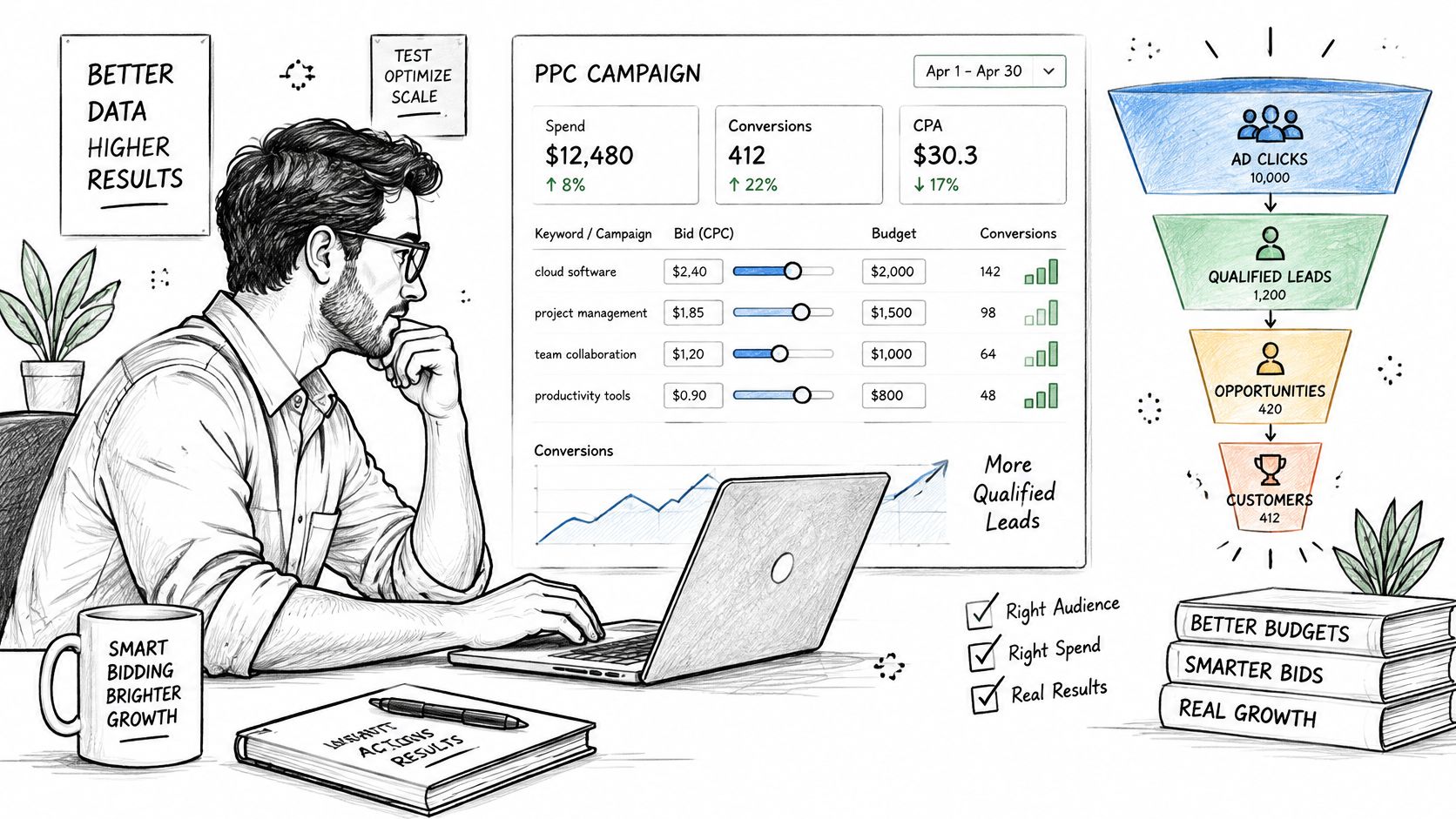
Make the Conversion Signal Usable
Before a bid change, resolve the measurement issues identified in the audit. Deduplicate events, verify revenue values, and separate primary business outcomes from diagnostic actions. Where possible, bring qualified offline outcomes into the measurement process rather than treating every submitted form as equally valuable.
Document what each metric means. A shared ad performance metrics reference helps prevent a buyer, analyst, and client from using the same label for different outcomes.
Google’s Smart Bidding moved bid decisions toward the individual auction. Its strategies include Target CPA, Target ROAS, Maximize Conversions, and Maximize Conversion Value, using contextual signals such as device, location, time of day, and remarketing-list membership; learning depends on conversion data and stable objectives, as described in Google’s Smart Bidding guide.
Match the strategy to the outcome you can measure reliably. Conversion volume and conversion value answer different questions. A value-based objective needs trustworthy values, not just a populated revenue column.
Practical rule: Don’t ask the bidding system to compensate for an outcome your team hasn’t defined.
Distinguish a Budget Constraint From a Target Constraint
Open the campaign’s budget, bidding settings, and delivery status together. Then compare actual spend with the available budget.
A hypothetical campaign that consistently uses its available budget while producing acceptable qualified outcomes is a candidate for a budget test. The decision still needs a profitability limit. Historical average CPA doesn’t tell you what the next increment of spend will produce.
An underspending campaign needs a different diagnosis. If the efficiency target is too restrictive, adding budget may leave delivery unchanged. Check the target alongside conversion history and delivery restrictions before deciding which control to test.
Use this sequence for an operational change:
- Name the constraint: State whether you suspect insufficient budget, a restrictive target, or another delivery issue.
- Choose the control: Adjust the budget or the target, not both in the same intervention.
- Set the boundary: Write down the acceptable spend exposure and the condition that would trigger review.
- Review mature outcomes: Allow for the campaign’s conversion cycle before judging the result.
Across Meta and TikTok, apply the same decision order even when the strategy names differ. First establish the event, then inspect delivery, then select the control.
Avoid stacking corrective edits while conversions are still arriving. You’ll lose the ability to explain which change mattered, and your next review will start with uncertainty instead of evidence.
Testing Budget Moves with Holdouts and Geo Tests
A higher platform-reported ROAS after a budget cut doesn’t prove the cut improved the business. The remaining ads might capture customers who were already close to buying. Equally, a campaign with modest attributed returns might support demand that another channel receives credit for.
Incrementality testing asks what happened because the advertising ran. That’s a different question from asking which platform claimed the conversion.
Write the Test Before Touching Delivery
Establish a baseline using spend, conversions, revenue, search demand, competitor presence, and auction metrics. Record promotions, stock changes, and other commercial events that could complicate interpretation.
Choose comparable geographic regions or eligible audience cells, then randomize treatment and control assignment where feasible. Specify the intervention in advance. For a budget test, change the treatment allocation as planned, then hold each group’s assigned policy and creative rules steady.
Your test plan should include:
- Primary outcome: Prefer incremental profit or a business outcome closely connected to it.
- Minimum detectable effect: Define the smallest difference worth acting on.
- Run length: Cover normal weekly demand and the relevant conversion lag.
- Exclusions: Identify regions, customers, or unusual trading periods that don’t belong in the comparison.
- Decision rule: State what would justify scaling, holding, or reversing the change.
Acquisition and retention also need clear definitions. For a hotel account, Purple Engage’s discussion of distinguishing acquisition from repeat guest retention is a useful prompt when deciding which customer outcome belongs in the test.
Read the Result Without Cherry-Picking
A real geographic experiment illustrates why platform attribution isn’t enough. In a 12-week study of non-branded search, disabling ads produced a decline 43% larger than the advertiser’s tracking system had attributed to Google, as documented in the lastminute.com search incrementality case study.
That result isn’t a forecast for another account. It demonstrates why a causal comparison can change a budget decision.
When reviewing an experiment report, inspect the uplift estimate and its uncertainty together. In Google Ads, review the treatment/control comparison, margin of error, and available statistical reporting rather than reading the headline result alone. An estimate can look commercially attractive while remaining too uncertain to support a confident rollout.
A promising result is a reason to finish the test properly, not a reason to stop early.
Don’t end the experiment because the chart looks favorable during an early check. Don’t replace the creative halfway through a budget test and then attribute the outcome solely to spending.
A weak or inconclusive result still supports a decision. It may justify preserving the current allocation, improving the design, or testing a larger meaningful contrast. Record which explanation you accept and what evidence would change your mind.
Segmenting Audiences and Creative Tests Across Platforms
Consider a hypothetical retargeting audience at the top of a Meta report. Its attributed CPA looks attractive, while prospecting appears expensive. Moving more budget toward retargeting feels sensible until you ask how many of those returning visitors would have purchased anyway.
Keep the audience definition and creative hypothesis visible beside the performance report.
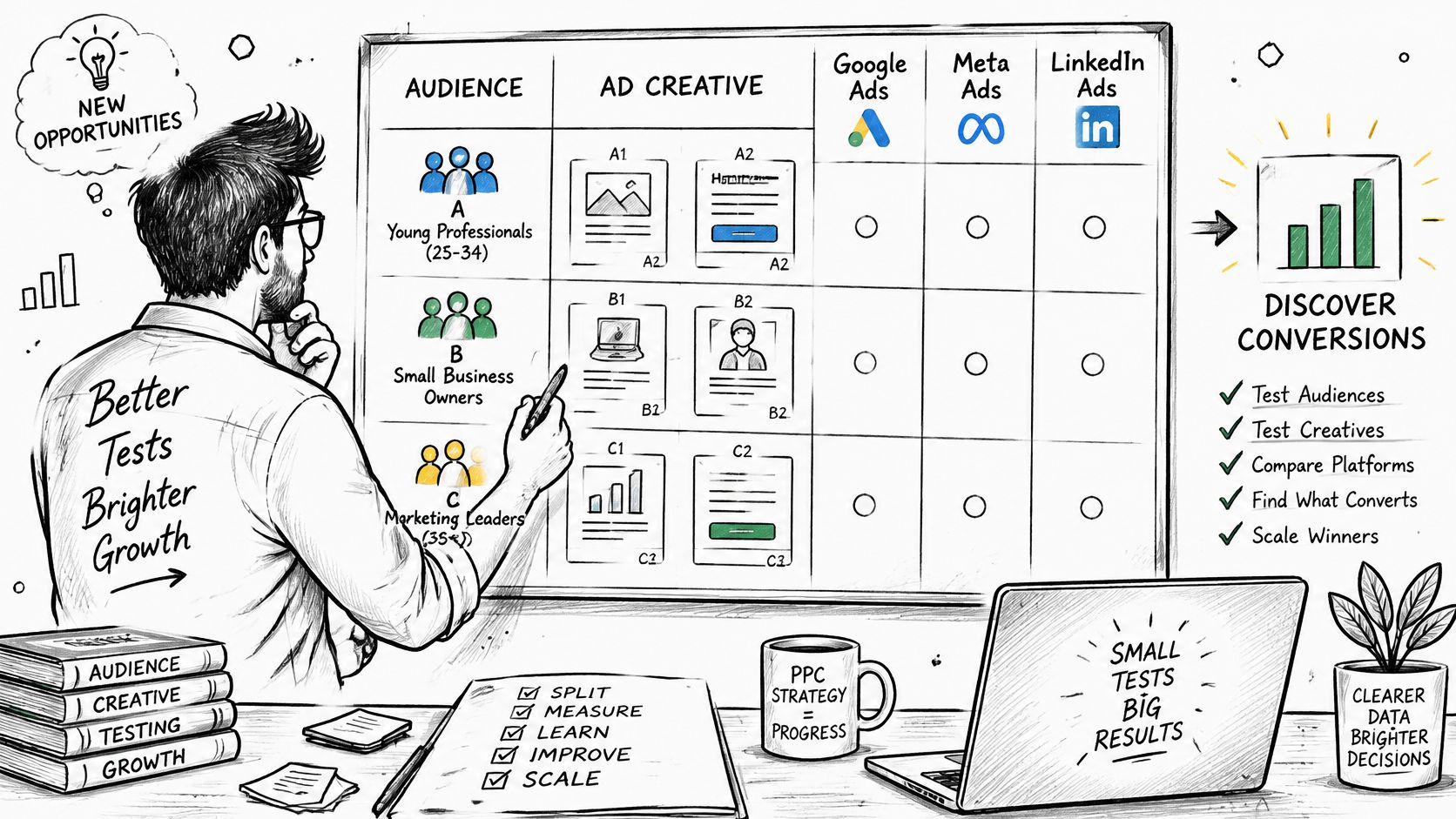
Separate Likely Buyers From Persuaded Buyers
Randomized experiments covering 7.16 million and 22.7 million users found that clickers had at least a 75% higher conversion probability than non-clickers, yet standard conversion-optimization targeting performed similarly to uniform targeting and worse than causally optimized alternatives in the research on causal advertising optimization.
The practical distinction is between finding likely buyers and influencing additional purchases. Strong observed conversion propensity isn’t proof of persuasion.
For the retargeting example, compare eligible customers exposed to the campaign with an appropriate holdout. Keep the acquisition definition consistent. If incremental customer value doesn’t justify the spend, don’t preserve the allocation merely because the platform report looks efficient.
Build a segment view that separates the questions you need to answer:
| Dimension | Diagnostic question |
|---|---|
| Market | Does the offer fit this customer context? |
| Device | Does the buying journey work on this device? |
| Funnel stage | Are we creating interest or capturing existing demand? |
| Customer status | Are outcomes coming from new or returning customers? |
| Search intent | Are branded and non-branded results being mixed? |
Give Each Creative Test a Clear Hypothesis
Now consider a TikTok prospecting creative that attracts clicks but few new customers. Don’t immediately label it a winner or a failure. Inspect whether its opening promise attracts the intended buyer and whether the offer matches that promise.
For an educational video reference alongside the review:
Test a defined creative difference while preserving the audience policy. Alternatively, test the audience while holding the creative policy steady. Changing both leaves you unable to distinguish better persuasion from a different customer mix.
For teams selling to business buyers, ContentBuck’s resource on how to improve B2B ad creative testing offers a relevant companion for planning the creative comparison.
Use the same test record across Google Ads, Meta, and TikTok. Don’t force identical creative formats across them. Preserve the hypothesis and business outcome, then adapt the execution to the placement.
Avoid declaring success from a sparse proxy event. A compelling click result needs a connection to qualified customer outcomes before it supports a commercial decision.
Choosing How Much Automation Your Team Can Handle
Manual reviews, scripts, and agent-assisted operations solve different problems. Choose according to the actions your team can supervise, not the volume of recommendations a tool can generate.
Review the operating model with the people who approve changes and answer for the results.
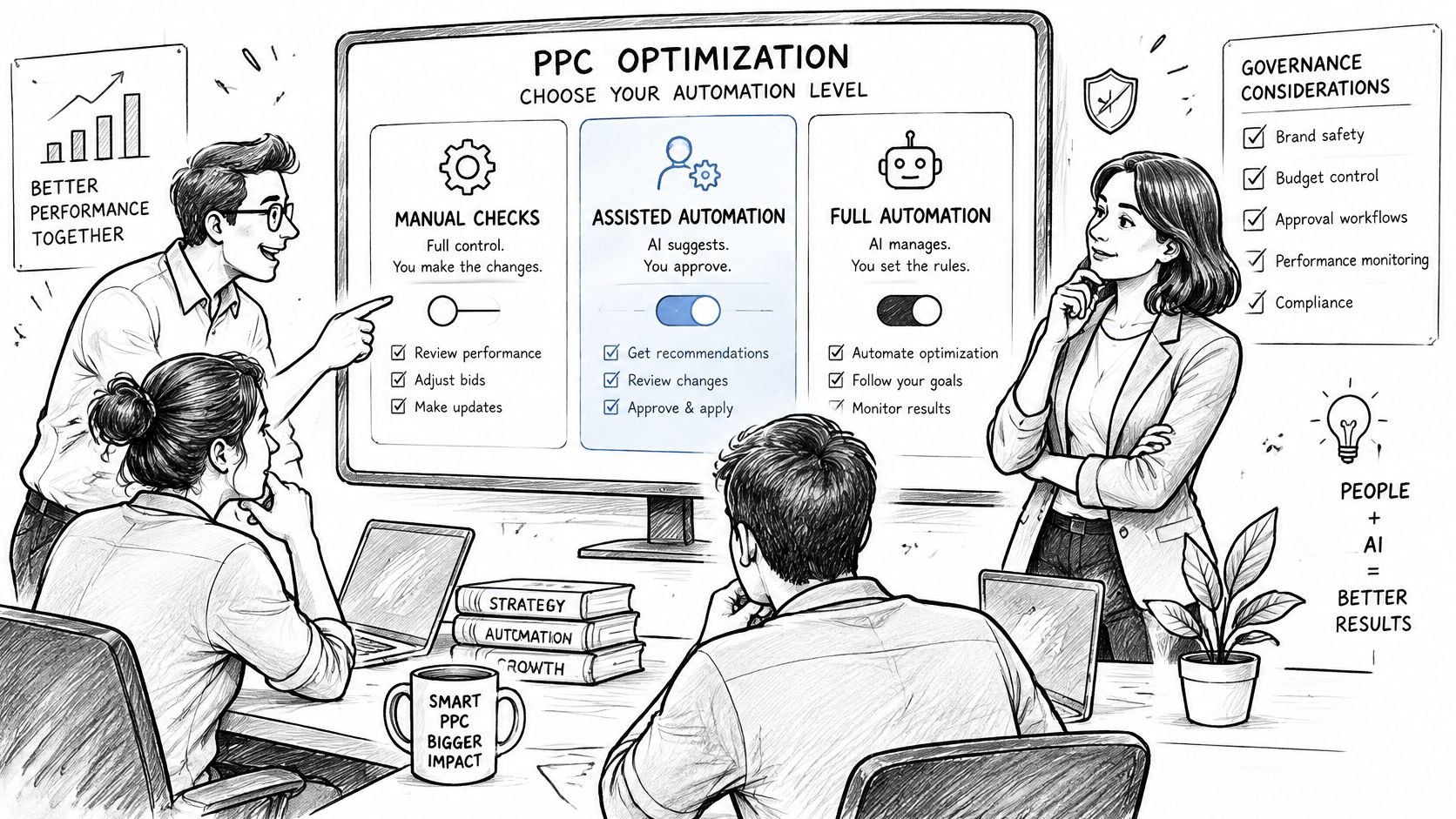
Compare the Control Models
| Approach | Useful when | Main trade-off |
|---|---|---|
| Platform consoles | A buyer needs close inspection of a limited workload | Context and records must be maintained across networks |
| Rule-based scripts | Conditions and permitted actions are well defined | Someone must maintain rules, exceptions, and failure handling |
| Dedicated operations layer | Several people or agents coordinate account work | Permissions and review boundaries need deliberate setup |
Manual work gives the reviewer direct contact with the native account screens. It becomes harder to coordinate when several people work across accounts. A shared change register is still necessary.
Scripts suit bounded instructions, such as flagging campaigns that meet defined conditions. They don’t remove the need for judgment. A rule that acts on incomplete conversion data can execute consistently and still make the wrong decision.
Google’s API release notes document capabilities including generative asset creation, automated image enhancement, and additional Performance Max reporting segments in the Google Ads API release history. Treat that expanding capability as a reason to define permissions explicitly, not to approve every available automation.
Require Accountability Before Execution
A dedicated AI campaign management workflow is another option. The publisher’s toolkit reads structure and performance across Meta, TikTok, and Google Ads, while its write actions are limited to Meta.
Those Meta actions include building campaigns and ads, adjusting budgets, and changing entity status. New entities start paused. The toolkit doesn’t permit hard deletes, bid edits, or targeting changes to existing ad sets, and its Activity page records the account, change details, request origin, and outcome.
Keep the distinction between cross-platform analysis and platform-specific execution explicit. Reading data from a network doesn’t imply permission or capability to modify it.
- Allowed actions: Define what can run automatically and what requires review.
- Preserved states: Record the prior configuration and intended replacement.
- Recovery procedure: Specify how to reverse a reversible change or contain an error.
- Experiment boundaries: Prevent unrelated automation from modifying active test cells.
Control check: If nobody can explain who initiated a change and how it ended, execution is ahead of governance.
A freelancer may prefer native consoles and a disciplined log. An agency may need centralized records across client accounts. An in-house team should match permissions to brand, market, and approval responsibilities. Automate only as far as the team can supervise.
Building a Weekly Optimization Routine You Can Keep
A useful weekly review ends with a short set of justified decisions. It shouldn’t produce an unowned list of possible improvements or reward the buyer who makes the most edits.
Keep a shared review board organized by account, hypothesis, owner, current state, and next decision date. Separate observations from approved actions so a comment doesn’t accidentally become an instruction.
Assign Ownership to the Decision
Start the week with measurement exceptions. The analyst or designated measurement owner confirms which reports are usable and which campaigns need investigation. The media buyer then brings forward changes supported by the audit.
Review active experiments before approving new interventions. The experiment owner should identify protected campaigns and explain whether their results are mature enough for a decision. A creative lead can then propose new hypotheses without disrupting existing comparisons.
| Review activity | Accountable owner | Required output |
|---|---|---|
| Measurement review | Analyst or measurement owner | Usable data and unresolved exceptions |
| Delivery and allocation review | Media buyer | Proposed change with a stated constraint |
| Experiment review | Test owner | Continue, conclude, or investigate |
| Creative and segment review | Creative lead or buyer | Next hypothesis and eligible test cell |
| Activity review | Account lead | Confirmed actions and follow-up responsibility |
One person can hold several roles. What matters is knowing who makes each decision and who checks the result.
For every approved action, record the entity, reason, previous setting, replacement setting, initiator, approval, execution outcome, and next review condition. Attach the supporting report or experiment record. Someone who wasn’t in the meeting should still be able to reconstruct the decision.
Close Decisions Instead of Accumulating Changes
At the next review, compare the result with the original expectation. Don’t rewrite the hypothesis to fit the outcome. If the evidence doesn’t support a conclusion, document what remains uncertain and whether further testing is worthwhile.
Scale a winner only when the predeclared test conditions are satisfied and the commercial result clears your organization’s threshold. Keep operational emergencies separate from performance experiments. A broken destination needs containment, not a prolonged debate about statistical interpretation.
Use this closing checklist:
- Data accepted: The measurement owner has cleared the outcome being used.
- Constraint identified: The proposed action addresses a named problem.
- Test protected: Active comparisons remain interpretable.
- Action verified: The executed setting matches the approved instruction.
- Decision scheduled: An owner knows when and how to assess the result.
This week, pick an active campaign on Google Ads, Meta, or TikTok. Complete the diagnostic audit and draft a holdout test for the next two weeks, extending the planned duration if conversion lag or test power requires it. Assign an owner before changing delivery.
AdCrunch offers cross-platform account analysis and controlled Meta execution, with paused creation and a permanent activity trail. Visit AdCrunch to connect your accounts and bring diagnosis, approved actions, and follow-up into the same PPC optimization workflow.