
How Does Cross Platform Work in Ad Ops
Learn how does cross platform work for ad operations, with a focus on unified data models, orchestration, workflows, and tradeoffs. Read our expert guide.
cross-platform, ad operations, ad tech, media buying, AdCrunch
You open Meta Ads Manager to check a client’s prospecting campaign, switch to TikTok Ads to compare video performance, then move to Google Ads to investigate search demand. By the time you’ve copied the numbers into a report, the original question has changed: which campaigns need action, and who can make that change safely?
That’s the practical reason teams ask, how does cross-platform work? In ad operations, it isn’t just one dashboard with several logos. It’s an operating model that translates different account structures, permissions, metrics, and actions into a consistent workflow, then sends approved changes back through each platform’s own systems.
Table of Contents
- What Cross-Platform Ad Operations Actually Means
- The Core Model Behind Cross-Platform Ad Work
- How Orchestration and Unified Data Models Work Together
- Why Agent-Driven Ad Ops Differs from Dashboards
- Real-World Workflow Example Across Meta, TikTok, and Google Ads
- When Cross-Platform Ad Ops Breaks and What to Watch For
- How to Evaluate Cross-Platform Ad Operations for Your Team
What Cross-Platform Ad Operations Actually Means
A performance marketing team might manage several client accounts across Meta, TikTok, and Google Ads. Each network uses different campaign hierarchies, naming conventions, attribution views, creative rules, and budget controls. The team member responsible for optimization must keep switching contexts, remember which actions are available on which network, and explain differences that clients often see as reporting inconsistency.
Cross-platform ad operations addresses that fragmentation by creating one working model for the operator. The model brings together account data, campaign status, performance signals, permissions, planned actions, and change history. It doesn’t erase platform differences. It makes those differences explicit enough for people and software to handle them without rebuilding the workflow from scratch each time.
The distinction matters. A reporting connector may collect spend and conversions from several networks, but collection alone doesn’t create operational consistency. Someone still has to interpret the data, decide what to do, open the correct account, find the correct entity, apply the change, and record what happened.

From separate interfaces to one operating model
The useful unit isn’t the dashboard. It’s the workflow.
A cross-platform workflow usually has four connected parts:
- Common data language: Campaigns, ad groups or ad sets, ads, budgets, statuses, and results receive normalized fields.
- Connection and permission layer: Each network authenticates separately, while the operator works from one connection shape.
- Decision and execution layer: A person or agent can inspect performance, propose an action, and send an approved request.
- Accountability layer: Every meaningful change has a record showing what changed, where, when, and with what result.
This approach follows a broader evolution in software. Java popularized “write once, run anywhere” after Sun Microsystems introduced it in 1995 and released Java 1.0 in January 1996, using the Java Virtual Machine to run platform-independent bytecode across different operating environments, as described in this history of cross-platform software. Ad operations applies a related idea to data and control, not by pretending every advertising network is identical, but by placing translation between the operator and each native system.
Practical rule: A connection that only moves data is an integration. A connection that also governs decisions, writes, and accountability is an operating system for the work.
The business case is easy to understand. The cross-platform software market was estimated at $77.91 billion in 2023 and $90.09 billion in 2024, with a projected $162.25 billion by 2028, according to The Business Research Company’s market report. Those figures describe software broadly, not ad operations specifically, but they reflect the same pressure: teams want to reduce duplicated work while still reaching multiple environments.
The Core Model Behind Cross-Platform Ad Work
The technical model starts with a translation problem. Meta, TikTok, and Google Ads don’t expose the same permissions, object names, campaign settings, or API behavior. A reliable system therefore creates a normalized connection model for the operator while preserving the native connection and authorization rules underneath.
Think of it as a universal travel adapter. You plug different national connectors into the back of the adapter, but the front presents one familiar socket. The adapter doesn’t convert every appliance into the same appliance. It gives the traveler a predictable way to connect without carrying a different wall plate for every country.
One connection shape, several native APIs
In practice, the system asks each network for narrowly defined OAuth scopes and API permissions. It then stores the resulting connection securely and routes requests through the destination platform’s native API. The operator doesn’t hand shared passwords to an automation script, and an external language model doesn’t need to receive the credentials.
The cross-platform OAuth and API pattern documented by Synter describes this approach clearly: normalize platform-specific scopes into a single connection model, then execute reads and writes against the native API on the server side. A request to pause an ad on Meta remains a Meta API request. A performance query for Google Ads remains a Google Ads request, even if both actions began in the same workspace.
The unified layer also needs a schema. A simplified internal record might include:
| Normalized concept | Platform-specific reality |
|---|---|
| Campaign | Meta campaign, TikTok campaign, Google campaign |
| Ad group | Meta ad set, TikTok ad group, Google ad group |
| Budget | Daily or lifetime budget with network-specific rules |
| Status | Active, paused, archived, removed, or another native state |
| Performance result | Metrics with different attribution and reporting definitions |
The schema gives agents and operators a stable surface to query. Translation rules handle the parts that don’t match. For example, “ad group” may map to an ad set on one network, while a bidding field may be unavailable or behave differently on another.
Why the adapter must respect the wiring
Normalization isn’t permission to flatten away important differences. If a platform supports a targeting option that another platform doesn’t, the unified model needs to mark that capability rather than invent an equivalent on its own. If a metric uses a different attribution window, the reporting layer should expose that context.
Security improves when the system keeps these boundaries visible. The connection model can request only the scopes needed for a task, while the server executes the action against the right account and endpoint. This reduces credential exposure and prevents a general-purpose automation process from receiving unrestricted access.
The model also creates a cleaner failure boundary. If TikTok rejects a request because a creative format is invalid, the system can return a platform-specific error attached to a normalized action. The operator sees which part failed instead of receiving a vague “automation error.”
How Orchestration and Unified Data Models Work Together
A unified schema gives an agent consistent nouns. Orchestration gives those nouns a sequence, permission boundary, and stopping point. Without orchestration, an agent may understand that a campaign is underperforming but still act on the wrong account, change an unsupported field, or continue after an API error.
A useful agent-driven workflow begins with observation. The agent reads account structure and performance, checks the requested scope, identifies eligible entities, and states the proposed action. It should distinguish a recommendation from a write, especially when the request affects live spend.
The agent needs context, not just metrics
Suppose a media buyer asks, “Reduce waste in the retargeting campaigns and protect the strongest prospecting activity.” The agent needs more than a list of cost metrics. It needs campaign hierarchy, current status, budget type, brand rules, account identity, and the operator’s definition of “strongest.”
That context can come from structured campaign plans, saved skills, and brand guidelines. A plan might specify which markets are eligible, which campaign types can receive budget, and which actions require approval. A brand rule might prohibit certain creative changes even when the API allows them.
For teams comparing operating patterns, this guide to multi-account management is useful context because the hard part isn’t merely opening many accounts. It’s preserving the right context while people or agents move between them.
Write access needs guardrails
Read access is comparatively forgiving. A mistaken query wastes time. A mistaken write can change delivery, spend, or a client’s public-facing advertising.
A disciplined system can therefore impose constraints such as:
- Paused creation: New campaigns, ad sets, creatives, or ads begin paused, so review happens before delivery.
- No hard deletion: Entities are archived or paused rather than permanently removed.
- Protected live targeting: Existing ad sets aren’t altered casually because targeting changes can invalidate the operator’s original test.
- Restricted bid edits: Bid changes require a separate decision path or remain unavailable.
- Explicit scope: The agent confirms account, campaign, entity, and intended mutation before execution.
- Post-write verification: The system checks the platform response and records the resulting state.
These rules create friction by design. They also make the agent less like a macro that clicks whatever it is told and more like an operations assistant that knows when it must stop.
A safe agent doesn’t maximize the number of actions it can take. It makes the permitted actions predictable, reviewable, and reversible through follow-up changes.
Why Agent-Driven Ad Ops Differs from Dashboards
A dashboard helps a media buyer see what happened. It answers questions such as which channel is spending, where performance changed, and which trends deserve attention. Its strengths are visualization, filtering, trend inspection, and scheduled reporting. The operator still has to move from that view into another tool to make a change.
Agent-driven ad operations connects the normalized data model to the next operational request. A practitioner can ask for campaigns matching a condition, inspect the mapped entities, request a budget adjustment or pause, and receive a record of the resulting state. The agent interprets the request and prepares the platform-specific API call, while the practitioner remains responsible for the decision.
The practical difference appears in execution economics. A dashboard is often priced around accounts, users, connectors, or reporting volume. An action layer may instead provide organization-level access with scoped permissions. The better fit depends on how much operational work the team needs to perform, not on how polished the charts look.
The dashboard and agent distinction
| Dimension | Dashboards | Agent-driven cross-platform ops |
|---|---|---|
| Primary job | Visualize and report performance | Query, plan, and execute approved work |
| Data model | Presents each network’s reporting view | Maps network objects into a shared schema |
| Workflow | Review data, then switch tools to act | Move from a request to a platform action |
| Credentials | Managed through connectors or separate tools | Kept server-side and separated from the language model |
| Scaling model | May grow with accounts, seats, or connectors | Can use organization-level access with scoped roles |
| Accountability | Shows results after the fact | Records the request, mutation, and outcome |
| Main constraint | Insight remains separate from execution | The agent needs precise intent and platform mappings |
The model aligns with broader multi-channel agentic AI patterns, in which an agent interprets a goal, selects tools, checks context, and performs bounded actions rather than producing text alone. In advertising, that distinction matters because a tool call can affect budgets and delivery.
Dashboards remain useful for investigation, anomaly review, and communicating results. Agent-driven operations do not remove the need for analysis, approval, or platform expertise. They reduce the repeated work between a decision and the controlled API request that carries it out, while audit records make the action easier to review later.
Teams should inspect pricing behavior before adopting a system, as discussed in this guide to AI marketing automation. Per-account and per-seat charges can make small or experimental accounts harder to connect. A flat organization model may simplify planning, provided its permission model, logging, supported write actions, and unified schema match the team’s actual workflow.
Real-World Workflow Example Across Meta, TikTok, and Google Ads
A media buyer starts the morning with a simple concern: several client campaigns are spending, but the team wants to protect efficient activity and stop obvious waste. The buyer asks the cross-platform system to identify candidates, not to make blind changes.
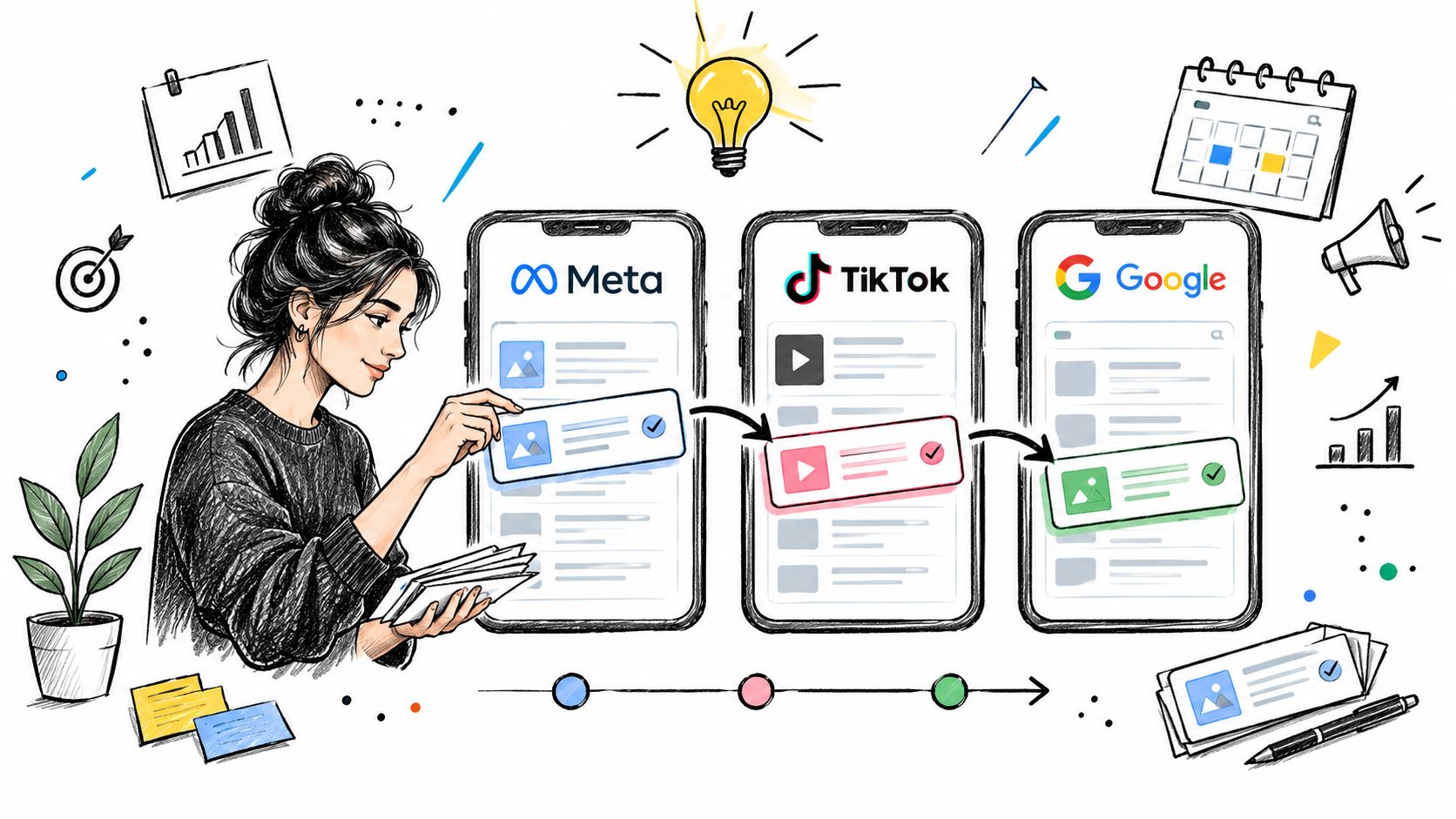
The system reads the connected account structures and returns a normalized view. Meta ad sets, TikTok ad groups, and Google campaign groups appear in their respective mappings. The buyer reviews spend, conversions, delivery status, and the attribution context before selecting a small set of actions.
The first action is to pause an ad that is no longer producing useful results. The second is to move budget within an approved campaign plan. The third is to prepare a new creative variation, but leave it paused. Each action has a target account and entity, so the system doesn’t confuse a similarly named campaign in another client workspace.
From diagnosis to a controlled write
The agent presents the proposed changes in plain language:
- Pause the selected ad on the connected network.
- Adjust the permitted budget field on the approved campaign.
- Create the new asset in a paused state.
- Leave targeting and bid fields unchanged.
- Record each request and response.
The buyer approves the plan. The server sends the mutations through the relevant native APIs. If a platform rejects a creative because of a format or policy requirement, that failure is returned as a specific result. The system shouldn’t claim success merely because the request was sent.
For a broader explanation of the measures practitioners use to assess delivery and efficiency, this guide to ad performance metrics provides useful terminology. Metrics support the decision, but they don’t replace the account and entity checks required before a write.
The activity record is part of the workflow, not an afterthought. It should capture the account, requested action, entity, originating user or agent, timestamp, before state, after state, and platform response. The documented server-side conversion logging pattern from Cometly illustrates why endpoint details, payload summaries, and response codes matter when systems send events across networks.
A campaign plan also keeps intent connected to execution. If the plan says a budget may move only between approved prospecting campaigns, the agent has a constraint to check before acting. That prevents a generic instruction such as “increase the winner” from becoming an uncontrolled change to a live account.
The buyer can then review the permanent record with the client or another team member. The important outcome isn’t merely that several platforms were touched from one interface. It’s that the team can explain what it decided, what the system attempted, what each network accepted, and what remains for human review.
When Cross-Platform Ad Ops Breaks and What to Watch For
Cross-platform work doesn’t remove complexity. It moves complexity into synchronization, translation, permissions, retries, and accountability. If those parts are weak, the unified interface can hide problems until an operator trusts stale or incomplete information.
A 2025 cross-platform data management study reported an average synchronization time of 4.2 hours and found that 53% of organizations experienced synchronization failures at least weekly, as documented in this cross-platform data management study. These figures aren’t ad-platform benchmarks, but they highlight a real operational question: how old can data be before a budget decision becomes unsafe?
Common failure signals
Watch for repeated discrepancies between the native ad platform and the unified layer. A status that remains active after someone paused it, a budget that takes too long to appear, or a missing error response can all indicate synchronization friction.
Authentication is another weak point. A connection may be valid for reading but lack the scope required for writing. An account may be accessible to one user but not another. A token can expire while the operator assumes the workspace still has current access.
Interoperability problems also arise from different operating systems, programming languages, data structures, architectures, APIs, and identity systems. A 2025 medical interoperability review describes these differences, while an April 2025 cross-data-space demonstration found that authentication, protocol, and data-model differences were major challenges and that an intermediary layer helped.
Migration and lock-in
Migration is often underestimated because teams count the API connection but not the surrounding operating habits. They must map naming conventions, preserve campaign history, retrain staff, validate reporting definitions, and decide which platform-specific features have no direct equivalent in the new model.
The same data management study reported 64% lower migration costs for organizations using open standards, which supports a practical preference for portable schemas and documented interfaces. Open standards won’t make every migration easy, but they can reduce the amount of proprietary structure a team has to rebuild.
If the unified layer can’t show freshness, failed requests, and ownership, it isn’t reducing operational risk. It’s relocating the blind spot.
How to Evaluate Cross-Platform Ad Operations for Your Team
Start with the work that currently consumes the most attention. If your team only needs consolidated reporting, a dashboard may be enough. If practitioners repeatedly diagnose the same conditions and then make controlled changes across several accounts, an orchestration layer may justify the added complexity.
Evaluate the system against the following questions:
- API coverage: Can it read the account structures and performance data you rely on?
- Write boundaries: Which networks and actions support writes, and which actions are intentionally blocked?
- Freshness: Can the interface show when data was last synchronized and whether a request failed?
- Schema clarity: Does it preserve platform-specific differences instead of hiding them behind misleadingly identical fields?
- Safety: Do new entities start paused, and are destructive actions restricted?
- Auditability: Does every mutation record the actor, request origin, target entity, before state, after state, and outcome?
- Commercial fit: Does pricing remain workable as you add accounts, users, or brands?
- Human control: Can a buyer review a proposed action before it reaches a live account?
A tool such as AdCrunch connects Meta, TikTok, and Google Ads to agent workflows, supports live performance queries, provides controlled Meta write actions, and records activity in a permanent log. Treat it as one implementation to test against your requirements, not as a substitute for platform knowledge or approval policies.
Run a small pilot with representative accounts. Compare native-platform results with normalized data, test rejected requests as well as successful ones, and ask an operator to reconstruct every change from the activity log. Cross-platform ad operations works when translation, execution, and accountability remain visible to the people responsible for spend.
AdCrunch connects Meta, TikTok, and Google Ads to agent workflows so teams can query performance and execute controlled ad operations from one place. Visit AdCrunch to review how its connectors, safety constraints, campaign plans, and permanent activity log could fit your team’s cross-platform process.