
Cross Channel Campaign Management Guide for 2026
Master cross channel campaign management across Meta, TikTok, and Google Ads. Learn unified reporting, orchestration, governance, and playbooks
Cross-channel campaign management works as an operating system for decisions and changes across accounts. Reporting is only one layer. Teams also need rules for resolving conflicting platform signals, controlled execution, and an audit trail that shows who changed what and why.
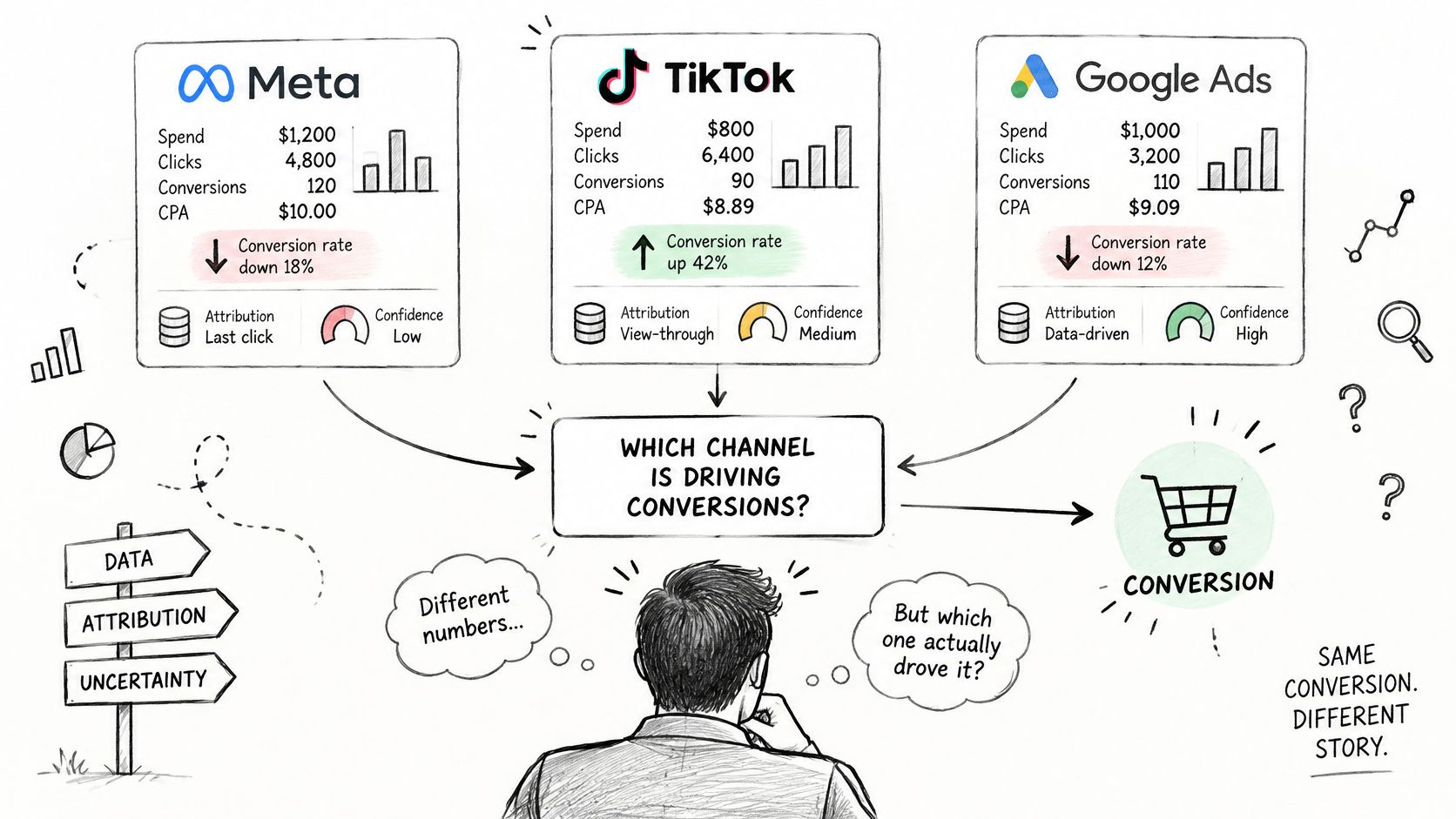
For example, a buyer might spot a conversion decline in Meta while Google Ads reports steady results. The next step is to check whether tracking, attribution settings, or campaign changes explain the difference before reallocating budget. A shared dashboard can surface the discrepancy; it cannot decide which signal deserves action or safely apply that decision across accounts.
Table of Contents
- Why Cross Channel Campaign Management Is Harder Than It Looks
- The Four Layers of Cross Channel Campaign Management
- Building Unified Reporting Across Meta, TikTok, and Google Ads
- Deciding When Platforms Disagree on Performance
- Comparing Approaches to Cross Channel Execution
- Turning Playbooks into Repeatable Campaign Operations
- Governance and Execution Safety at the Moment of Action
- Your First 30 Days of Cross Channel Campaign Management
Why Cross Channel Campaign Management Is Harder Than It Looks
Managing ads across Meta, TikTok, and Google Ads gets complicated at the point of action. A reported conversion may appear in more than one platform, while attribution windows and reporting rules differ. A buyer comparing platform totals needs to know what each figure represents before deciding which campaign should receive more budget.
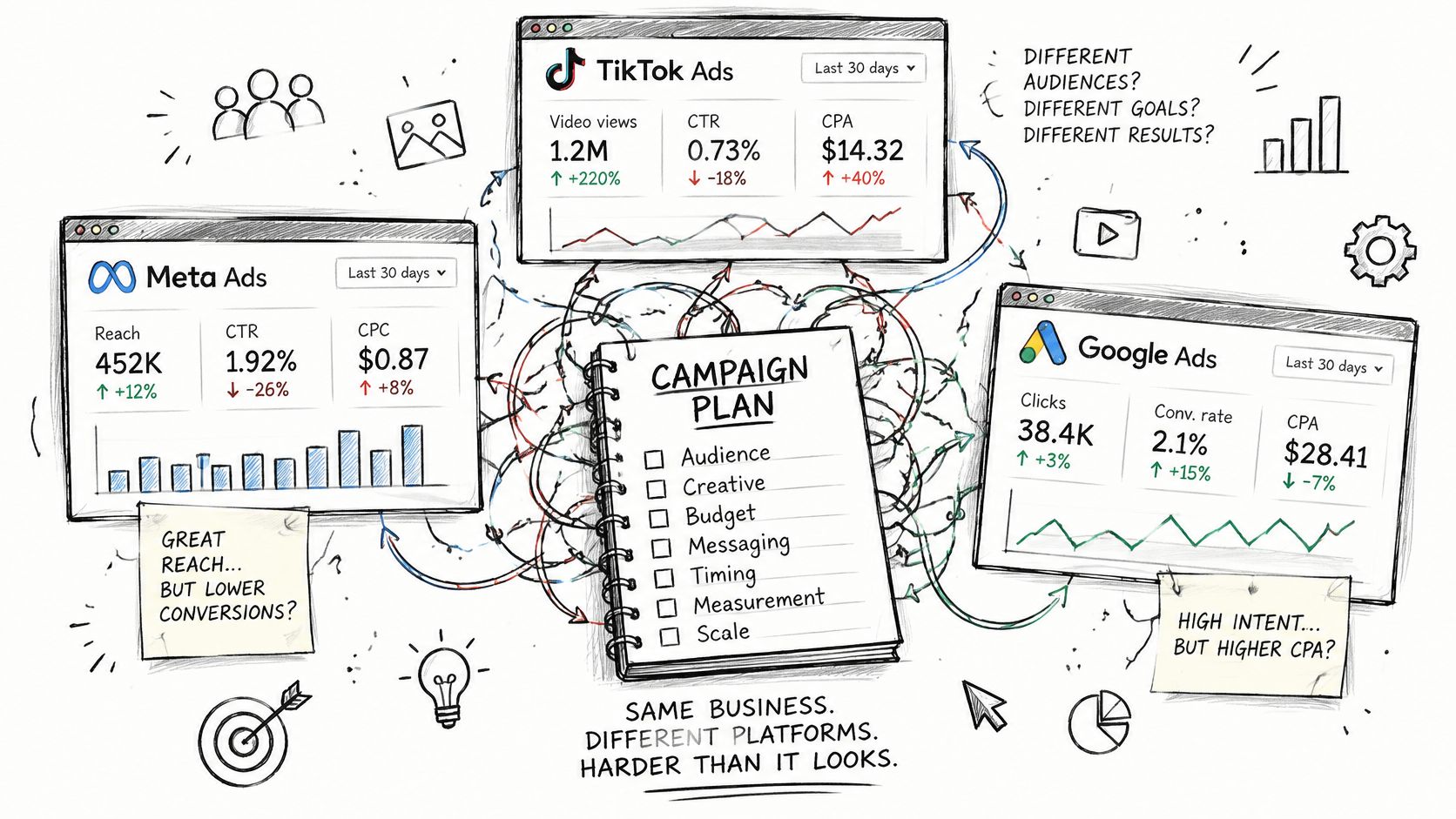
For teams responsible for multiple brands or client accounts, the operating challenge is making decisions consistent and traceable. A budget change needs a defined owner, a clear basis, and a record of what changed. Without those controls, two buyers can respond to the same performance shift in conflicting ways, or repeat a change without knowing why it was made.
Running across channels is a media plan. Managing across channels is an operating system.
That system connects readable account structures to decision rules, controlled execution, and a reviewable change history. Each part has a distinct job. Reporting makes results easier to inspect; decision rules determine whether a signal warrants action; execution controls limit mistakes; and governance records who changed what and why. A dashboard alone cannot settle a disagreement between platforms or show whether a resulting account change was approved.
The Four Layers of Cross Channel Campaign Management
A dashboard helps with only part of the job. Consider an agency team managing Meta, TikTok, and Google Ads accounts for several clients. A unified view may make their performance easier to compare, but it won’t determine which figures should trigger a change, carry out that change, or show who approved it.
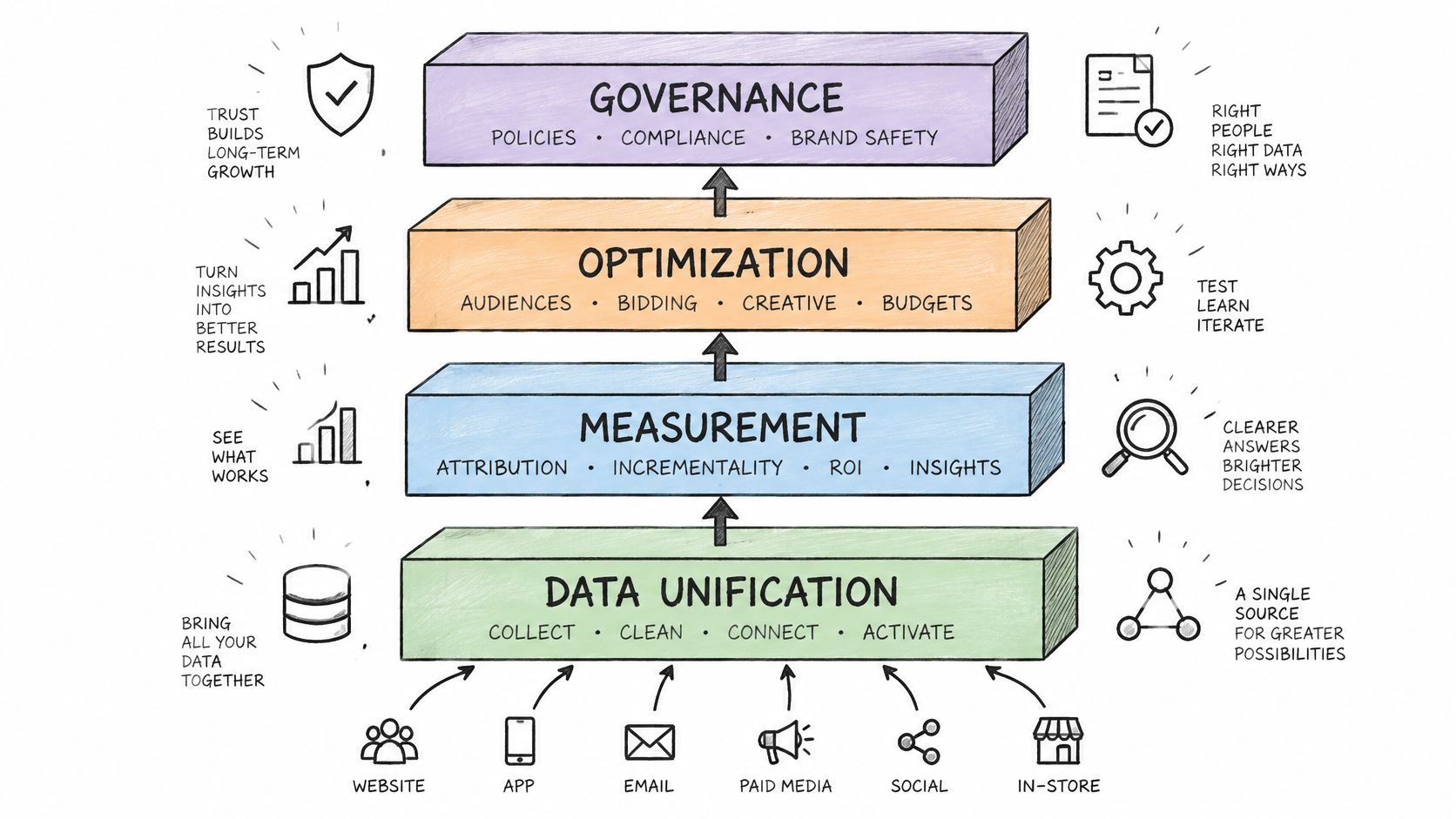
Data unification makes comparisons possible
The agency first needs a consistent way to read account structures and performance. That means mapping platform-specific campaign names, statuses, budgets, and results into a shared format without pretending each network measures outcomes identically. When a client asks why a campaign changed, the buyer should be able to connect the report to the actual campaign, not a loosely matched label.
Orchestration turns signals into decisions
Next, the team defines what deserves action. A budget adjustment might require a particular business outcome, enough supporting evidence, and an agreed approval path. Orchestration is where the team decides whether a weak result calls for a pause, a further check, or no change yet.
A resource on structured marketing execution with Sensoriium can help teams think through how planning, roles, and workflows fit together. The point isn’t to add another layer of process for its own sake. It’s to agree on decision ownership before a buyer is staring at conflicting platform reports.
Execution makes changes safely
Once a decision is clear, someone or something has to carry it out in the correct account and campaign. The agency needs controls that prevent a change intended for one client from reaching another, and it needs a way to confirm whether the platform accepted the action.
Governance keeps the work reconstructable
Finally, the agency records what changed, who requested it, and what happened. A useful audit trail helps a new team member understand an account’s current state without relying on someone’s memory or a trail of chat messages.
The framework is easier to apply when teams can see how the layers relate:
A dashboard covers the reading. Management also needs a decision, an action, and a record.
Building Unified Reporting Across Meta, TikTok, and Google Ads
Looking at each platform in isolation can hide how channels relate to purchase behavior. A 2023 peer-reviewed study examined 89,394 purchases from a European e-commerce business and found that Google Ads, price-comparison engines, and email explained 61% of the variance in the analyzed purchase outcomes (the study in Marketing Letters). That finding describes an association in one dataset, not a universal benchmark or proof that any channel caused a purchase. It does, however, illustrate why a channel-by-channel view can miss relationships between sources.
A unified report doesn’t place three platform exports side by side. It makes the definitions and account mappings clear enough that a buyer can compare like with like while retaining the platform context needed to interpret results. Before choosing a reporting tool, decide which attribution definitions the team will use for decisions and which are diagnostic views only.
| Reporting Element | Why It Must Be Consistent | Failure Mode When Inconsistent |
|---|---|---|
| Campaign and account identifiers | Connects a reported result to the correct campaign and client | Similar names become confused across accounts |
| Metric definitions | Clarifies what each reported result represents | Buyers compare different measures as if they were equivalent |
| Attribution settings | Makes the scope of platform-reported conversions visible | Each network appears to have a different winner |
| Dates and time periods | Aligns the reporting window used for comparisons | Performance shifts look real but reflect mismatched periods |
| Status and budget fields | Connects reported performance to the campaign’s current setup | Teams discuss changes against stale or incomplete context |
The practical failure mode is easy to spot: Meta, TikTok, and Google Ads each show a different winner, and nobody can explain whether the gap comes from campaign performance, attribution definitions, or inconsistent data. Keep the platform’s original figures available alongside normalized fields so standardization doesn’t erase useful context.
For teams building repeatable reports, scaling automated reporting workflows offers a useful perspective on reducing manual reporting work. Automation can improve consistency, but it can’t settle a team’s measurement definitions for it. Before calling a report unified, check that each figure maps to an account, uses a documented definition, and can be traced back to its source.
Deciding When Platforms Disagree on Performance
A single blended ROAS can look like a clean answer. It can also create false confidence when different platforms claim the same conversion and their reporting methods don’t align. The measurement challenge is substantial: 47% of advertisers identify consolidating fragmented metrics as their top programmatic-measurement challenge, while 45% can demonstrate ROI for 30% or less of their programmatic campaigns (AdExchanger and DISQO’s programmatic measurement report). Walled gardens, privacy restrictions, and inconsistent methods make deduplicated reach and causal attribution difficult.
When two platforms disagree, don’t treat the highest reported return as an automatic instruction to move budget. First ask what decision is being considered and what the cost of being wrong would be. A small, reversible adjustment can rely on faster platform signals; a substantial reallocation needs stronger evidence that the change is likely to improve the combined result.
Match the evidence to the size of the decision
Use platform reporting for quick optimization within a channel, especially when the action is limited and easy to reverse. When a decision would materially change the cross-channel mix, look for evidence beyond platform-reported conversions. Holdout tests can help assess what happens when a group doesn’t receive a campaign. Geo experiments can compare results across areas, and contribution analysis can help teams evaluate channels together while making assumptions visible.
Record a confidence level with the decision. A buyer might describe the evidence as directional, supported, or strong, then note why. The label isn’t a substitute for a test; it gives the next person enough context to understand whether the evidence was considered conclusive or provisional. For a practical reference on interpreting channel results, ad performance metrics and how to use them can support the diagnostic conversation.
Account for journeys that cross environments
Retail media adds another complication when a customer can encounter onsite, offsite, social-commerce, and in-store activity. No single platform necessarily sees the complete journey, and apparent channel credit can reflect both demand creation and demand capture. Use platform data to guide timely investigation, but set an explicit evidence threshold before a large budget move. That threshold should reflect the decision’s reversibility, the available test design, and the consequences of getting it wrong.
Comparing Approaches to Cross Channel Execution
The right execution method depends on a team’s workload, risk tolerance, and need for control. Manual workflows give buyers direct judgment at every step, but the work can become slow and difficult to trace as account volume grows. Dashboard-only stacks make patterns easier to spot, yet still hand the fix back to a person who must switch platforms and carry out the change.
Agent-based tools can connect reporting and action more closely, but speed only helps when write permissions and safeguards are deliberate. A tool that can change a campaign needs clear limits on what it can touch and a reliable way to inspect what it did. For a broader view of how channel choices fit into selling, selling across ecommerce channels provides useful context beyond ad operations.
| Approach | What Works | Trade-Off |
|---|---|---|
| Manual platform work | Buyers can apply judgment directly inside each ad network | Switching accounts and repeating changes takes time, while decisions can be hard to reconstruct |
| Dashboard-only reporting | Teams can review performance in a shared view | The dashboard identifies a possible issue but doesn’t execute the response |
| Agent-based execution | A workflow can connect a request to a controlled platform action | Teams need narrow permissions, previews, and a durable record of results |
For example, the described toolkit connects to Meta, TikTok, and Google Ads through OAuth for consistent read access. Its Meta write scope includes building campaigns, ad sets, creatives, and ads; adjusting daily or lifetime budgets; and pausing, resuming, or archiving entities. It doesn’t allow hard-deletes, targeting changes to existing ad sets, or bid edits, and creations start paused. That limits the actions available while keeping new work from immediately spending.
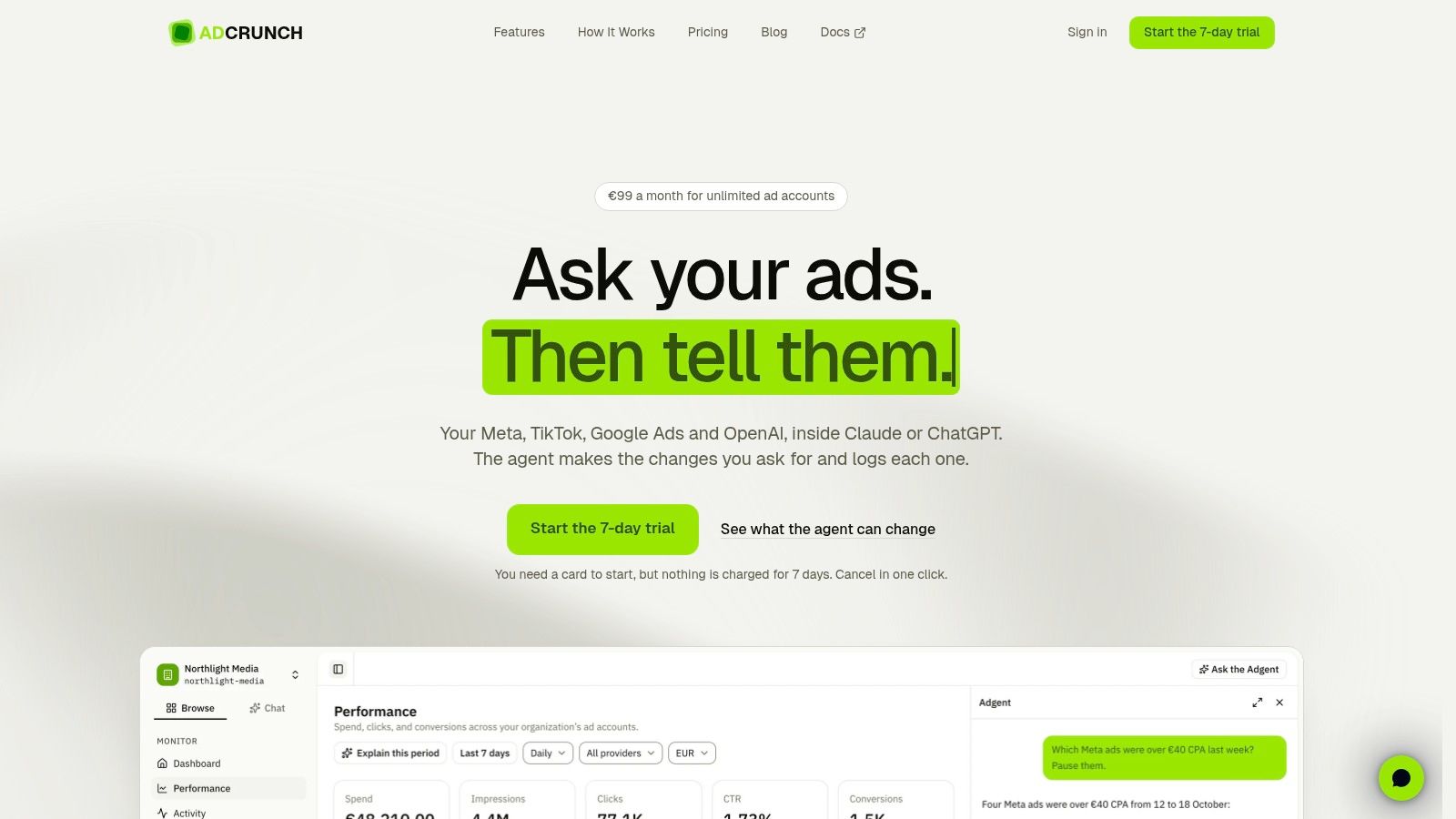
The same toolkit offers connectors for Claude, ChatGPT, and Cursor, alongside a REST API and an in-console agent for teams that don’t use an external LLM client. Its Pro plan is €99 per month with unlimited ad accounts and seats; that flat price may suit teams that want to add accounts without adding account-based or seat-based charges. Other teams may prefer manual controls or reporting-only tools if they don’t need write access. The key test is whether the selected approach matches the team’s authority to act and its ability to review those actions.
Turning Playbooks into Repeatable Campaign Operations
A playbook turns recurring judgments into rules that buyers can follow across accounts. It might specify what evidence is needed before shifting budget, when a weak asset should be paused for review, or which creative changes require brand approval. The rules should be specific enough to guide action but leave room for a buyer to flag exceptions rather than forcing every account into the same response.
Teams can encode those rules alongside brand guidelines so both a person and an agent have the same reference before execution. Structured campaign plans help keep planning and launch connected: line items can describe the intended channel, budget, audience, and timing, while the working plan remains the reference for what should be built. A large-account management process can help teams think about consistency as account portfolios grow.
A weekly rhythm that closes the loop
Start the week by reviewing unified performance and flagging accounts that need attention. For each one, identify the evidence, apply the relevant playbook rule, and decide whether the next step is a budget move, a pause, an experiment, or no change. Then log the outcome and revisit it in the next review so the team can distinguish a completed action from an unresolved diagnosis.
This cadence reduces the time between noticing a problem and making a considered response. That lag matters in multi-account work because a buyer may identify an issue but leave the follow-up buried in a report or chat thread. Assign an owner to each proposed action and record whether it was approved, executed, or held for more evidence.
Make onboarding repeatable
When a new client account arrives, adapt an existing playbook instead of rebuilding the operating process. Confirm that the client’s account structure and brand requirements fit the template, then record any exceptions before the first action. That gives new buyers a reliable starting point while preserving the details that make each account different.
Governance and Execution Safety at the Moment of Action
Centralizing data without controlling who can act on it doesn’t guarantee safer operations. A team may gain a shared view and still make contradictory edits, overspend, expose customers to repeated ads, or lose track of who changed what. As automation speeds up execution, governance needs to operate at the moment a change is proposed, not just during an after-the-fact review.
The scale of the coordination challenge is visible in cross-media measurement: an average campaign spans nine touchpoints, 86% of respondents cite data silos as a major hurdle, and 81% say measurement complexity increases costs and resource demands. Nearly one-third of agencies rarely or never unify measurement across screens. The same research reports that 80% of surveyed respondents associate poor frequency control with advertising “switch-off” (the World Federation of Advertisers’ cross-media measurement report). Those findings make clear why governance has to cover both team actions and the audience’s experience.
Centralization without permissions and review can help a mistake travel faster.
A practical operating model starts with least-privilege access. Give each person or agent only the permissions needed for their role, and set market-level approval thresholds so teams know which changes require review before execution. Preview the proposed change and its target account before applying it. For new campaign work, paused-by-default creation gives an owner time to inspect the setup before spend begins.
Keep actions reversible and traceable
Avoid workflows that make recovery difficult. No-delete safeguards preserve the ability to inspect an entity, while a documented rollback procedure gives the team a plan if a change creates an unexpected result. An activity history should record the account, the requested change, its origin, and the outcome, so colleagues can reconstruct what happened without relying on memory.
Frequency control belongs in the same governance conversation. Teams need to consider whether exposures are coordinated across channels, not only whether each platform’s campaign is performing against its own report. Before automating any cross-account action, test the preview, approval path, and record of results. The aim isn’t to remove human judgment. It’s to make decisions reviewable, limit unintended edits, and leave the team able to reverse a change when necessary.
Your First 30 Days of Cross Channel Campaign Management
Use a short, practical rollout rather than trying to rebuild every account at once.
- Week one: Audit the four operating layers and fix the weakest reporting definitions. Deliverable: a shared account and metric map.
- Week two: Write down the evidence needed for different budget decisions. Deliverable: an agreed decision rule.
- Week three: Apply one playbook to a single client account. Deliverable: a reviewed action with a recorded outcome.
- Week four: Add permissions, approval thresholds, and activity logging. Deliverable: a workflow the team can inspect and reverse.
A useful first step this week is to connect one ad account and read its structure through a unified view before changing anything. Track whether the team can move from diagnosis to an owned action and reconstruct that action later; campaign planning and execution can be organized with a practical campaign planning workflow.
Visit AdCrunch to explore a toolkit that connects Meta, TikTok, and Google Ads reporting with controlled Meta campaign actions and a permanent activity log. If your team manages several ad accounts, start by connecting one account and reviewing its structure before you authorize any changes.