
10 Agency Management Tools for Smarter Operations
Compare 10 agency management tools for projects, people, billing, and ad operations, with integration notes, limitations, and practical selection guidance.
- agency management tools
- agency operations
- agency project management
- advertising operations
- professional services automation
Your agency’s operating day probably starts in five places at once. A client needs a budget change in an advertising account, a project manager is chasing a late deliverable, finance is waiting for approved time, and someone is rebuilding a staffing plan in a spreadsheet. The problem isn’t a lack of software. It’s that each system owns only part of the workflow, so people keep moving information between project plans, staffing tools, time trackers, budgets, invoices, CRM records, and ad platforms.
The best agency management tools don’t all solve the same problem. A professional services automation platform can connect delivery, capacity, retainers, and profitability, but it usually won’t execute changes inside Meta Ads. A work-management platform can make intake and approvals easier, but it may need another system for accounting depth. An ad-operations layer can close the gap between performance analysis and campaign action without replacing the agency’s core operating system.
This comparison organizes the tools around the bottleneck they’re best equipped to solve. Look at how each one connects with accounting, CRM, calendars, APIs, webhooks, ad networks, and AI connectors before you buy. The right choice is often a coordinated stack, not a forced all-in-one purchase.
Table of Contents
- 1. AdCrunch
- 2. Productive
- 3. Teamwork.com
- 4. Scoro
- 5. Accelo
- 6. Workamajig
- 7. Function Point
- 8. Kantata OX and SX
- 9. BigTime
- 10. Wrike
- Top 10 Agency Management Tools, Feature Comparison
- Match the Tool to the Bottleneck
1. AdCrunch
A performance team can spot wasted spend in a report and still lose time locating the correct campaign, ad set, or creative in the advertising platform. AdCrunch addresses that execution gap by connecting Meta, TikTok, and Google Ads with Claude, ChatGPT, Cursor, or its built-in Adgent. Practitioners can investigate account activity and issue operational instructions within one workflow.
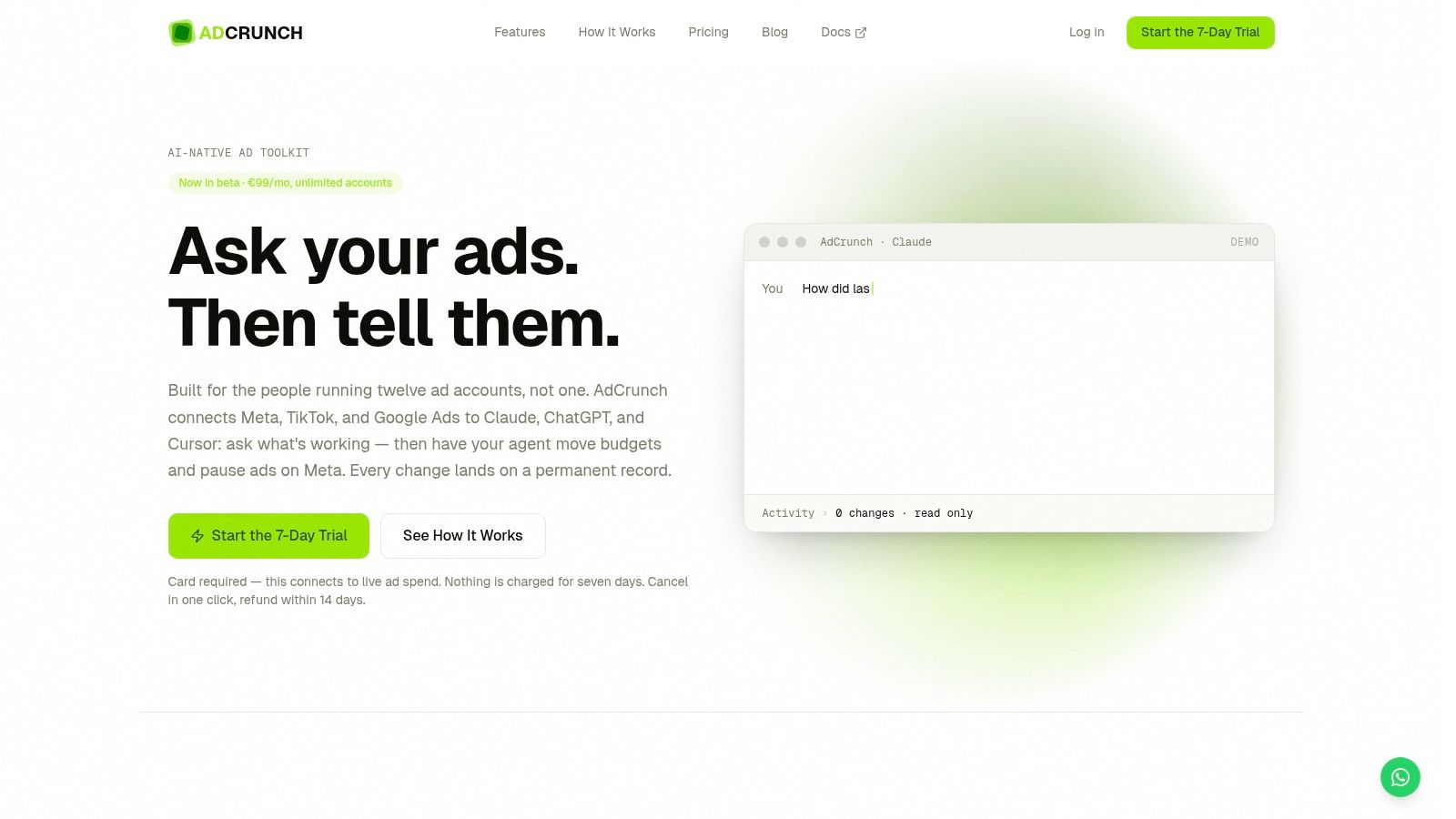
Its value sits beside the agency’s operating system, rather than replacing it. A reporting tool can surface weak delivery, while AdCrunch can carry out selected changes on Meta, including campaign, ad set, creative, and ad creation, budget updates, and pause, resume, or archive actions. TikTok and Google Ads currently provide a unified read layer. Write actions are available on Meta.
Practical rule: Use an ad-operations tool to shorten the path from diagnosis to action, but keep financial approvals and client commercial decisions in the agency’s operating system.
The write surface is intentionally constrained. New creations start paused, hard deletes are unsupported, existing ad-set targeting cannot be changed, and bids cannot be edited. The permanent Activity page records the account, exact change, requester, and outcome. Skills and Brands let teams encode playbooks and brand rules, while Campaign Plans keep launch instructions aligned with execution.
The pricing model suits agencies handling multiple advertisers. Pro costs €99 per month per organization with unlimited ad accounts and seats, according to the AdCrunch product site. Enterprise adds SSO, SLA, and custom integrations. A 7-day full trial requires a card, and paid plans include a 14-day refund policy, as described in the product brief.
AdCrunch fits performance agencies, freelance media buyers, multi-brand teams, ecommerce operators, and growth teams managing several accounts. A single-account advertiser may find the scope excessive, while teams requiring write automation across TikTok or Google Ads will encounter a current platform limitation.
Credentials stay with AdCrunch instead of being exposed to the connected LLM. The platform also provides a REST API and connectors for Claude, ChatGPT, and Cursor. For teams comparing the execution layer with broader ad account management tools, the key trade-off is clear: AdCrunch handles controlled advertising actions, while project, staffing, approval, and financial systems remain responsible for agency operations.
2. Productive
Productive works best when the agency’s main problem is the connection between sales, delivery, staffing, time, and cash. It combines CRM and estimating with resource planning, project and retainer budgets, time tracking, invoicing, and reporting, so a won opportunity can move into delivery without losing the commercial assumptions made during the sale.
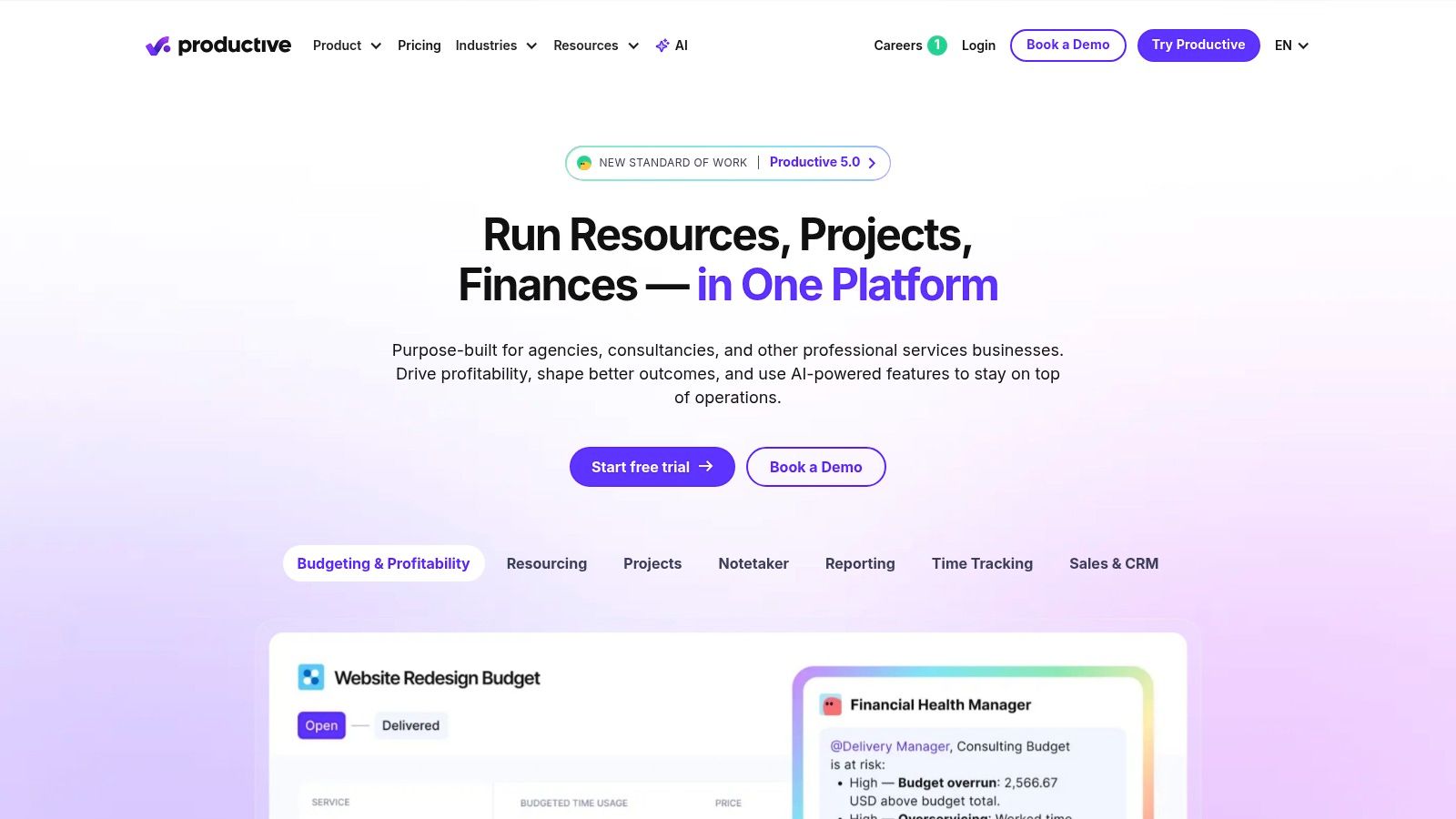
Its resource planning is more useful than a simple assignment list because availability can account for holidays, time off, and conflicts. Time approvals, policies, and conversion of bookings into time entries help connect planned capacity with actual delivery. On the financial side, teams can work with project and retainer budgets, billable and non-billable time, revenue recognition, and multi-currency reporting.
That makes Productive a strong choice for a multi-discipline agency that needs one source of truth for client and project economics. It connects with HubSpot, QuickBooks, Xero, HR systems such as Rippling, BambooHR, and Personio, Slack, Google and Microsoft calendars, and Jira through an add-on. Its open API and webhooks make it suitable for a wider stack rather than a sealed workspace.
Where Productive creates friction
The depth comes with a learning curve. Task-level updates can feel dense when teams are making heavy changes across many active projects, and the financial reporting needs careful onboarding. A rushed rollout often leaves teams using only the task layer, which wastes the platform’s stronger capabilities.
Productive also fits naturally beside an ad-operations layer rather than replacing one. Advertising performance and campaign actions can remain in a specialized platform, while Productive owns retainers, staffing, time, budgets, and invoicing. That separation is sensible for agencies exploring marketing automation for agencies without turning their PSA into an ad console.
3. Teamwork.com
Teamwork.com is a practical fit when client delivery and profitability need to live together, but the agency still wants familiar project-management views. It brings projects, resources, time, budgets, quoting, retainers, invoicing, and client-facing work into an agency-oriented environment, with templates that help teams get started without designing every workflow from scratch.
Its quote-to-project flow is useful because the delivery team inherits commercial context instead of rebuilding it manually. Profitability, time, and resource views help managers see whether work is consuming the planned budget and whether available people match upcoming demand. Multi-currency budgets and more advanced financial and resourcing functions sit in higher Optimize and Enterprise tiers, so buyers should evaluate the actual plan rather than the headline feature list.
A good middle ground for agency operations
Embedded AI teammates support summaries, planning, profitability forecasting, and natural-language questions across work data. That can reduce administrative searching, but AI usage and packaging need close review because AI credits move to usage-based pricing starting in September 2026, according to the Teamwork.com agency software coverage. This is a future pricing change, not a current performance claim.
The integration layer includes HubSpot and QuickBooks, with Salesforce and NetSuite connectivity available at higher tiers. Teamwork.com is a strong operational core for agencies that need collaboration, budgets, and resourcing, but it isn’t an ad execution system. Pair it with a specialized advertising operations tool when the team needs controlled campaign changes rather than another reporting dashboard.
4. Scoro
Scoro is aimed at agencies and professional services firms that need financial depth without separating every commercial workflow into another application. It combines CRM, estimating, projects, time and cost tracking, capacity planning, expenses, invoicing, and reporting, with modular apps that let a firm expand its operating model over time.
The advanced estimation matrix is particularly relevant to agencies that sell varied services. Teams can model effort, price, and margin before work begins, then carry those assumptions into delivery and billing. Multi-entity and multi-currency support makes Scoro more suitable for agencies with several offices or legal entities than lightweight project-management tools that rely on custom fields and spreadsheets.
Scoro connects with Xero, QuickBooks, Sage Intacct, HubSpot, Salesforce, Okta, Azure AD, and Zapier. Those connections allow the platform to sit inside a broader commercial stack, although integration quality and ownership still need testing during implementation. A finance leader will likely value the margin and entity controls more than a delivery manager who only needs tasks and deadlines.
The trade-off is operational weight
Scoro’s strength is also its main drawback. Configuration, data migration, rate structures, entities, and approval rules require more implementation discipline than a basic PM tool. Teams that haven’t agreed how they estimate, log time, recognize revenue, or approve expenses may experience the system as complex rather than clarifying.
Choose Scoro when the agency’s bottleneck is financial control across a growing operation. Don’t choose it because it has a long feature list. If campaign changes, budget movement, and ad-account governance are the immediate problem, Scoro should remain the commercial system while a dedicated ad-operations layer handles platform execution.
5. Accelo
Accelo is designed around agencies that mix retainers with project work, a model that creates operational problems generic project tools often handle poorly. Its workflows connect recurring revenue, delivery, billable time, utilization, invoicing, and revenue projections, giving managers a view from promised service through to billed work.
Retainer management is the central reason to consider it. Teams can track ongoing commitments alongside project delivery, monitor capacity, and use predictive risk signals to identify delivery or revenue problems before the billing cycle closes. QuickBooks and Xero integrations help connect the PSA to accounting, while mobile retainer management supports teams that need to review or update recurring work away from a desk.
Best for recurring client relationships
Accelo’s delivery-to-billing visibility can help reduce revenue leakage caused by missed time, unrecorded work, or unclear retainer scope. It also supports capacity planning, so account leaders can compare what clients have bought with the people available to deliver it. That connection is more valuable than a generic task board when retainers represent a large part of agency revenue.
The downside is the buying process. Pricing is quote-based, and implementation requires mapping real workflows before the platform can deliver its full value. That’s reasonable for a PSA, but it means Accelo isn’t a quick plug-in for an agency that only wants lightweight task management.
Use Accelo as the system of record for recurring commercial work, then connect specialist tools for CRM, accounting where needed, and advertising execution. The platform can tell you whether a retainer is healthy operationally, but it won’t replace the ad network interfaces where campaign changes happen.
6. Workamajig
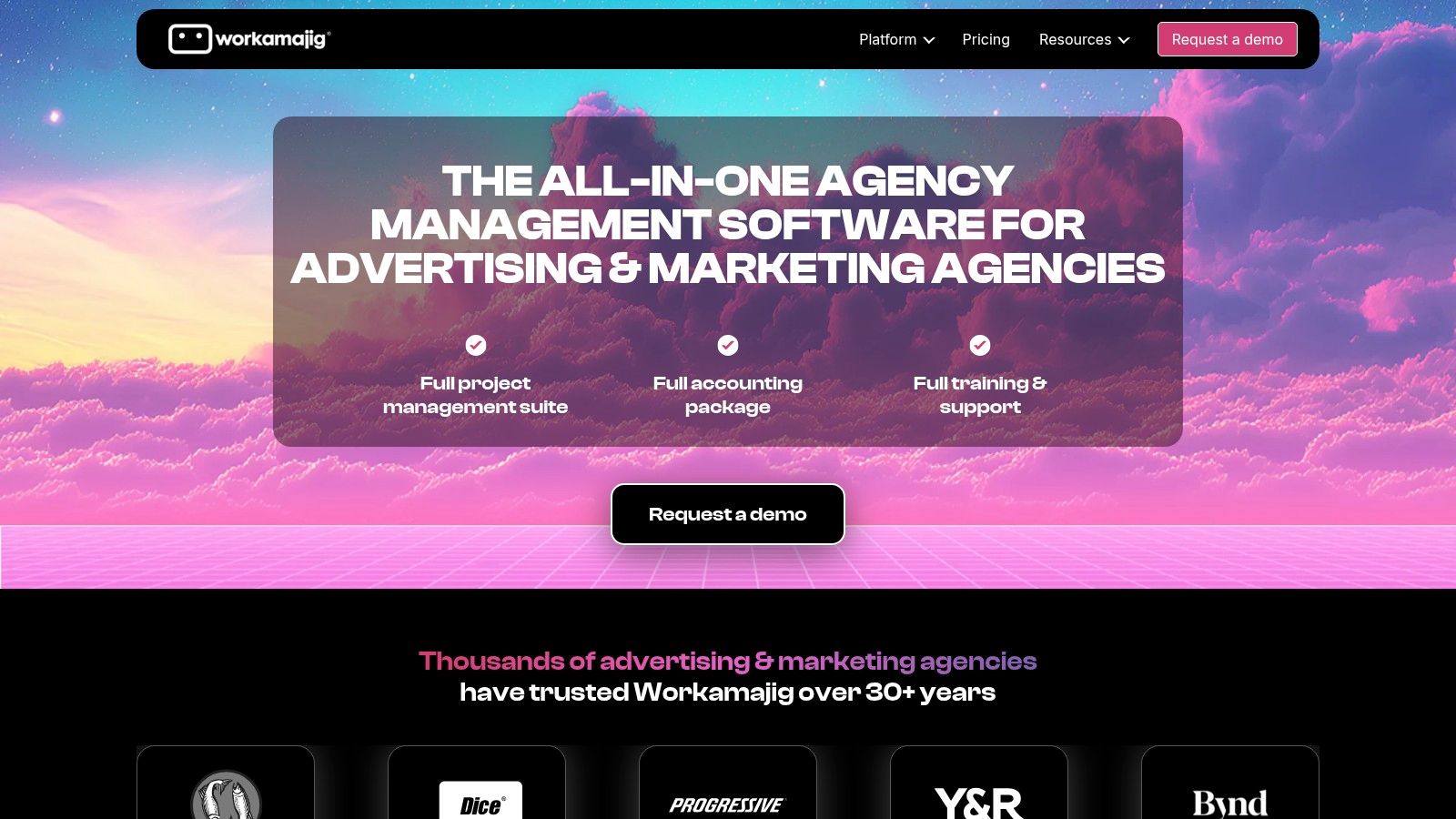
Workamajig is the most direct choice here for agencies that want creative and advertising delivery connected to native accounting. It combines project and traffic management, scheduling, time and expenses, CRM, invoicing, payables, receivables, general ledger, and multi-currency support in one platform.
That accounting depth changes the integration calculation. Instead of maintaining a separate bookkeeping system for every project-to-invoice handoff, an agency can run much of its financial operation in the same environment as production. Project managers can also use digital proofing and approvals, while resource management keeps traffic and staffing visible across creative work.
Revenue forecasting and multi-currency support make it suitable for firms with more involved commercial reporting. Unlimited client and vendor logins can simplify external collaboration, and optional on-premises hosting may matter to organizations with specific infrastructure requirements. Structured onboarding and training are important because the system’s value depends on consistent process adoption.
A powerful system that needs process discipline
Workamajig can feel heavyweight for a small team that hasn’t standardized traffic, approvals, time entry, and accounting responsibilities. A rich system doesn’t fix unclear ownership. It can expose the confusion, but managers still need to decide who approves work, when costs are posted, and how client changes affect margin.
Choose Workamajig when reducing the number of project-to-accounting integrations is a strategic priority. Keep ad execution separate unless the agency’s chosen advertising platform has a reliable connection for the actions it needs. The operating system should own the commercial record, while specialized ad tools can handle network-specific changes.
7. Function Point
Function Point is suited to small and mid-sized creative or digital agencies moving beyond spreadsheets and disconnected point tools. It covers CRM, estimating, project management, resource planning, time tracking, retainers, and financial workflows, with an emphasis on the path from estimate to delivery to invoicing.
The project hierarchy, briefs, templates, Gantt views, and Kanban views give delivery teams structure without forcing every client engagement into the same shape. Resource forecasting includes PTO and vacation tracking, while role, staff, and blended rates help managers plan work using actual cost assumptions rather than simple headcount.
A practical agency rollout
Function Point’s optional Business Intelligence tier adds profitability and utilization dashboards. QuickBooks integrations connect accounting data, although advanced BI and QuickBooks Online integration are reserved for higher plans. The platform also provides dedicated onboarding and unlimited support, which can be important for agencies whose main adoption risk is inconsistent use rather than missing features.
The trade-off is that onboarding carries a fee, and buyers need to understand which reporting and accounting capabilities belong to each plan. A smaller agency may prefer a narrower platform at first, but moving from spreadsheets to an agency-specific workflow can still be worthwhile if estimates, staffing, time, and retainers currently live in separate places.
Function Point works best as a core delivery system. It won’t replace an ad platform or an ad-operations layer, so define the handoff clearly. Campaign performance and account actions should flow through the advertising stack, while Function Point tracks the people, time, commercial scope, and client work surrounding those actions.
8. Kantata OX and SX
Kantata is built for mid-market and enterprise professional services organizations with complex resource, financial, and governance requirements. Its two deployment options address different operating environments. OX uses open infrastructure for faster time to value, while SX is Salesforce-native for firms that need deeper alignment between CRM, CPQ, and a governed Salesforce stack.
Resource management is a major strength. Skills-based allocation and demand forecasting help leaders match expertise, availability, and cost to upcoming work rather than assigning projects from a simple calendar. Financial management supports revenue recognition and complex billing, which matters when engagements have different commercial rules or span multiple entities.
Kantata also adds agentic business intelligence and an Expertise Agent for predictive insights and next-best actions. Those functions are most useful when the underlying data is reliable and the agency has agreed on definitions for utilization, margin, demand, and delivery risk. AI can surface a decision, but governance determines who can act on it and which approvals are required.
Governance before customization
Kantata’s deployment choice is valuable for enterprises, but it also signals the implementation burden. A smaller agency may find the process, change management, and configuration disproportionate to its needs. A global services organization, by contrast, may prefer that structure because it supports enterprise controls and roll-ups.
Kantata should sit above specialized execution systems rather than pretend to be one. It can govern demand, staffing, financials, and operational intelligence, while CRM, accounting, calendars, and advertising platforms remain connected through controlled integrations. Select it when the agency’s biggest risk is fragmented enterprise operations, not when the immediate need is faster campaign editing.
9. BigTime
BigTime suits agencies and professional services firms that want quote-to-project automation with finance-friendly controls. Its Services CPQ can create a project from an approved quote, reducing re-entry between sales and delivery and preserving the assumptions that shaped the original scope.
The platform also covers resource management, time and expenses, invoicing, multi-currency support, analytics, and custom reporting. AI staffing recommendations and scenario modeling can help managers compare possible allocations before committing people to work. The modular architecture means an agency can add capabilities such as Quotes, Resource Management, and Data Hub as its operating needs become more demanding.
The quote-to-delivery link is the practical differentiator. If approved scope, rates, milestones, and project setup remain aligned, managers have a better chance of spotting scope creep before it becomes an invoice dispute. That benefit depends on sales and delivery teams using the workflow rather than exporting quotes into a separate project template.
Evaluate the commercial fit early
BigTime doesn’t publish standard pricing, so purchasing is sales-assisted. That isn’t automatically a problem, but it makes a structured evaluation essential. Ask which modules are required, how users are counted, which integrations are included, and how reporting changes as the agency adds clients or teams.
The platform advertises a 99.99% uptime SLA, a product-level availability commitment described in the plan notes. For agencies that want a PSA without making Salesforce the center of the operating model, BigTime is a credible option. It still belongs beside ad execution tools, because quote and resource control don’t provide network-specific campaign write actions.
10. Wrike
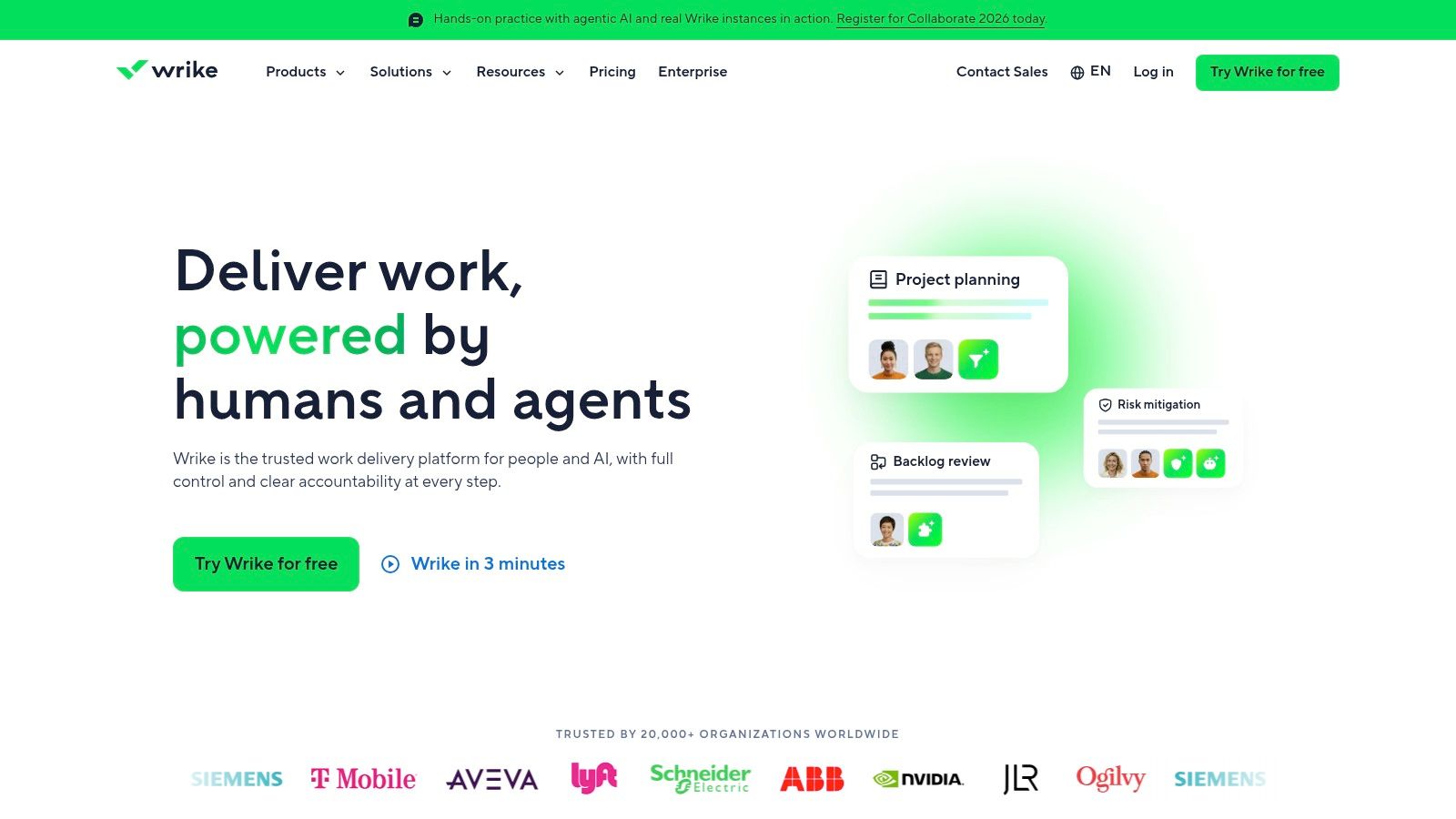
Wrike is a strong choice when the agency’s main bottleneck is intake, collaboration, proofing, approvals, and flexible cross-team workflows. Its agency and marketing solutions provide templates and structured paths for creative requests, while proofing tools help reviewers comment on assets, manage versions, and move work through approval stages.
That makes Wrike particularly useful for creative teams serving many stakeholders. A client request can enter through an intake workflow, move through production, collect feedback, and reach approval without relying on a long email thread. Resource planning and workload views add capacity visibility, while the broader integration ecosystem helps connect creative, CRM, communication, and asset-management tools.
Flexible workflows are not financial control
Wrike’s flexibility is an advantage for teams with varied delivery models, but it can become configuration work. Seat-based licensing and add-ons can raise total cost as the agency grows, and plan limits need careful review before procurement. Advanced agency financial management also isn’t its central strength, so teams may need accounting, time, or profitability systems alongside it.
Wrike is therefore better viewed as a collaboration and work-management layer than a complete PSA. It can manage creative approvals around an advertising campaign, but it won’t replace an ad execution environment. Agencies comparing specialist options can also use this guide to the best ad management software when the bottleneck moves from collaboration to account action.
Top 10 Agency Management Tools, Feature Comparison
| Product | Core features | Unique selling points ✨ | Price & value 💰 | Target audience 👥 | Quality ★ |
|---|---|---|---|---|---|
| AdCrunch 🏆 | AI-native ad ops; OAuth to Meta/TikTok/Google; Meta write actions; permanent activity log | ✨ Agent executes changes + audit; safety-by-design (paused creations, no hard-deletes); unified cross-network read layer | 💰 €99/month per org, unlimited accounts & seats; Enterprise SSO/SLA | 👥 Agencies, freelance media buyers, multi-account in-house teams | ★★★★☆ |
| Productive | Agency OS: resource planning, time tracking, project & financials, AI agents | ✨ Deep P&L, capacity planning, large report library | 💰 Per-seat pricing; onboarding recommended | 👥 Multi-discipline agencies needing financial control | ★★★★☆ |
| Teamwork.com | Client-focused hubs: profitability, resourcing, time/budgets, embedded AI | ✨ Quick-start templates, embedded AI agents (Scout, Flo…) | 💰 Clear tiers; Optimize/Enterprise (quote) for advanced finance | 👥 Agencies wanting fast deployment & integrations | ★★★★☆ |
| Scoro | PSA: projects, time/cost tracking, CRM, estimating, modular apps | ✨ Advanced multi-entity financials, modular adoption | 💰 Modular/quote-based pricing | 👥 Multi-office or growing agencies needing deep finance | ★★★★☆ |
| Accelo | PSA for retainers & projects: capacity, invoicing, revenue projections | ✨ Strong retainer workflows, delivery→billing visibility | 💰 Quote-based (sales-assisted) | 👥 Agencies with mixed retainer + project work | ★★★☆☆ |
| Workamajig | All-in-one for creative agencies: project/traffic, resource, native accounting | ✨ Run bookkeeping + projects in one system; proofing & approvals | 💰 Transparent seat pricing; enterprise options (SSO) | 👥 Creative/ad agencies needing integrated accounting | ★★★★☆ |
| Function Point | Agency suite: CRM/estimating, resource forecasting, time, optional BI | ✨ Practical estimating→delivery→invoicing flow, strong onboarding | 💰 Onboarding fee; advanced BI on higher plans | 👥 Small-to-mid agencies moving beyond spreadsheets | ★★★☆☆ |
| Kantata (OX/SX) | Enterprise PSA: resource mgmt, forecasting, financials, AI insights | ✨ Choice of OX or Salesforce-native SX; AI Expertise Agent | 💰 Enterprise/quote pricing | 👥 Mid-market & enterprise, multi-entity firms | ★★★★☆ |
| BigTime | PSA with Services CPQ, resource mgmt, time/expense, invoicing | ✨ One-click CPQ→project creation; AI staffing recommendations | 💰 Pricing not public (sales-assisted) | 👥 Professional services & agencies needing CPQ | ★★★★☆ |
| Wrike (Agency) | Work management: creative intake, proofing, resource planning, DAM | ✨ Mature ecosystem, agency templates, creative proofing | 💰 Seat-based + add-ons (cost scales with seats/features) | 👥 Agencies & marketing teams needing flexible workflows | ★★★★☆ |
Match the Tool to the Bottleneck
The right agency management tool depends on where work breaks today. Start by identifying the handoff that creates the most operational friction. Is a media buyer losing time moving between ad accounts and reporting screens? Are project managers unable to see capacity before accepting new work? Does finance discover margin problems after delivery? Are client approvals scattered across email, chat, and file comments?
Choose AdCrunch when multi-account advertising execution is the primary constraint. It’s the specialist option for teams that need consistent reads across Meta, TikTok, and Google Ads, controlled Meta write actions, playbook-based execution, and a permanent activity record. It doesn’t replace project budgets, staffing, retainers, accounting, or invoicing. That’s the point. It adds an ad-operations layer where general agency systems usually stop at reporting or task assignment.
Choose a PSA platform when profitability, resourcing, retainers, billing, revenue recognition, or accounting depth is the main issue. Productive and Teamwork.com are sensible choices for agencies connecting delivery with budgets and capacity. Scoro and Workamajig suit teams that need deeper financial control, while Accelo is especially relevant to retainer-heavy work. Function Point offers a practical path for smaller agencies, BigTime connects quotes to delivery, and Kantata is designed for complex enterprise operations.
Choose Wrike when intake, proofing, approvals, and flexible collaboration matter more than native agency accounting. It can be the right operating layer for creative teams that need to coordinate many stakeholders, provided the agency connects it to systems that own financial truth and advertising execution.
Evaluate the system around the tool
Before buying, map the current workflow from opportunity to delivery, time entry, invoice, client report, and advertising action. Mark every spreadsheet, manual export, approval, and duplicate data entry. Then test the shortlisted tool against a real client workflow, not a polished demo scenario.
Review five areas carefully:
- Integration ownership: Confirm how the tool connects to accounting, CRM, calendars, APIs, webhooks, ad networks, and AI connectors. Ask which system remains authoritative for each data type.
- Commercial model: Compare per-seat, per-account, per-project, modular, and organization-level pricing. A tool that looks affordable at launch can become expensive when account volume or user count grows.
- Implementation effort: Estimate data migration, workflow design, permissions, training, reporting configuration, and the time managers must spend enforcing adoption.
- Governance: Define approval rules, access boundaries, audit records, credential handling, and the actions an AI agent can or cannot perform.
- Operational outcome: Tie the purchase to a concrete bottleneck, such as missed billable time, budget leakage, slow approvals, overloaded staff, or delayed campaign action.
The wider market reinforces why this choice deserves operational attention. One 2026 estimate values the agency management software market at USD 7.8 billion and projects USD 17 billion by 2035 at a 9% CAGR, according to Business Research Insights’ agency management software forecast. A separate industry compilation reports average SaaS spend of USD 4,830 per employee in 2025, up 21.9% year over year, with 36% of licenses unused, 78% of IT leaders reporting unexpected SaaS charges, and companies running an average of 106 SaaS applications, based on its cited Zylo data and analysis at AgencyPro’s agency technology statistics page. More software isn’t automatically better. The winning stack gives each system a clear responsibility and reduces the number of manual handoffs between them.
AdCrunch’s flat organization pricing illustrates a different approach to one part of that problem. Pro costs €99 per month with unlimited ad accounts and seats, while Enterprise adds SSO, SLA, and custom integrations, as specified in the product brief. That can complement a PSA rather than compete with it, especially when an agency wants to protect its core delivery and financial workflows while giving media buyers a controlled way to act across advertising accounts.
Selection principle: Buy the smallest system that solves the most expensive bottleneck, then connect it to the platforms that already hold the truth.
AdCrunch gives agencies a controlled ad-operations layer for reading Meta, TikTok, and Google Ads performance, directing Meta changes through Claude, ChatGPT, Cursor, or Adgent, and recording every action in a permanent activity log. If campaign execution is the gap in your agency stack, visit AdCrunch to review the platform, request a demo, and start the live trial.