
10 AI Marketing Tools for Smarter Campaigns
Compare 10 ai marketing tools for creative, optimization, automation, and reporting across agency and in-house marketing teams.
- ai marketing tools
- marketing automation
- ad optimization
- AI copywriting
- creative testing
Your team can spot a performance problem quickly. The harder part starts after the diagnosis. Someone still has to move between creative files, ad platforms, automation rules, approval threads, and reporting dashboards before a useful change reaches a live account. Across multiple clients or brands, that operational friction can consume more time than the analysis itself.
This roundup evaluates 10 AI marketing tools by the work they change, not by feature count. The list covers creative production, copy optimization, campaign execution, channel-specific automation, search testing, and omnichannel planning. Each tool has a different workflow fit, level of implementation effort, channel focus, and ceiling for scale.
The right choice depends on your bottleneck. You may need more creative variants, stronger copy decisions, faster budget actions, or reporting that brings several networks into one view. You may also need to connect AI-assisted content creation to a broader production workflow, such as using video assets to create blog posts from long-form video. The tools below are strongest when each one has a defined job and a clear handoff.
Table of Contents
- 1. AdCrunch
- 2. Smartly.io
- 3. Pencil
- 4. Anyword
- 5. Jasper
- 6. Madgicx
- 7. Birch
- 8. Optmyzr
- 9. Adalysis
- 10. Skai
- Top 10 AI Marketing Tools Comparison
- Build the Smallest Stack That Closes the Gap
1. AdCrunch
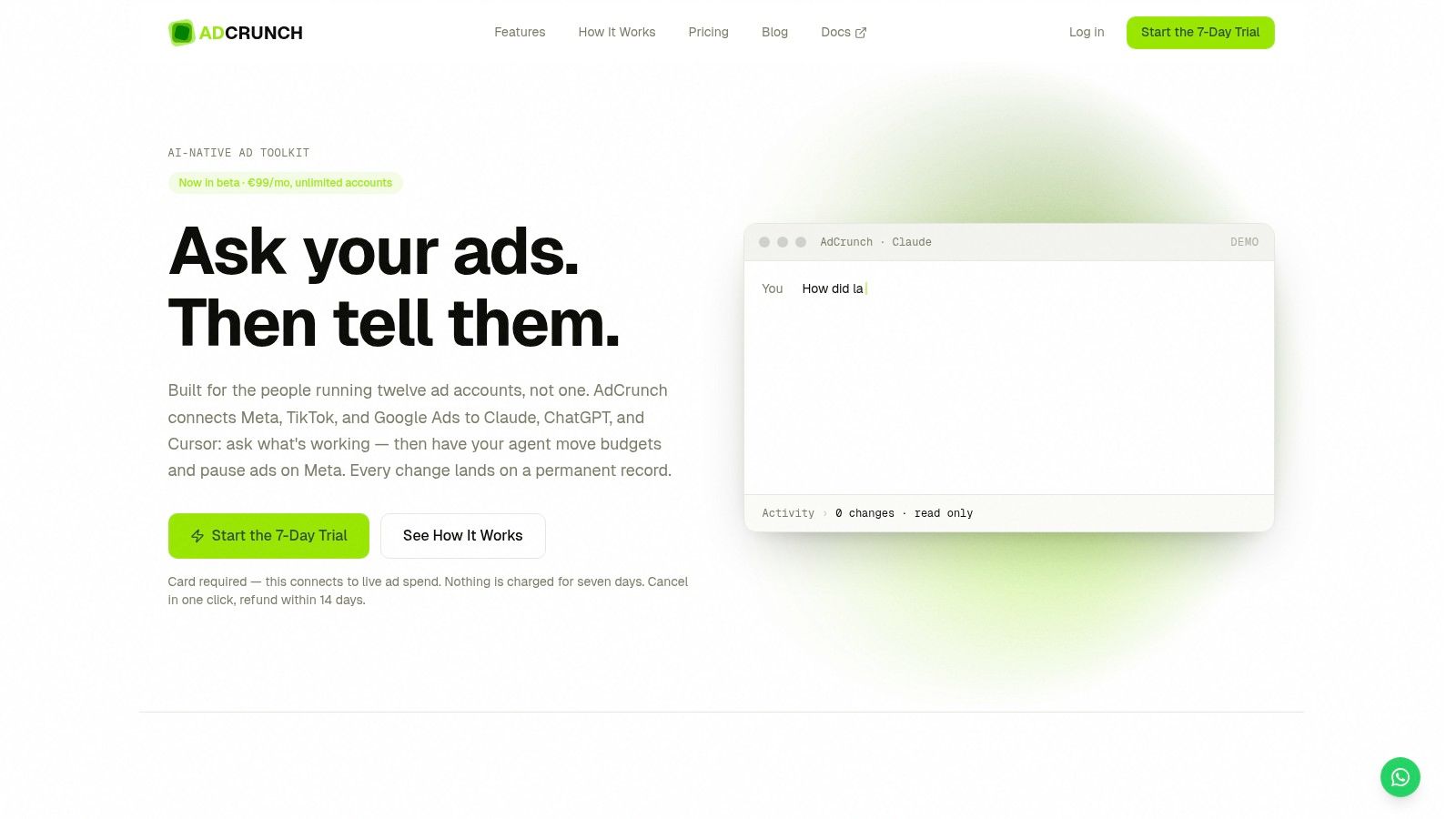
When a Meta campaign needs a budget change, the work often spans analysis, approvals, platform navigation, and documentation. AdCrunch brings those steps into one operating environment. It connects Meta, TikTok, and Google Ads with agents in Claude, ChatGPT, and Cursor, plus its built-in Adgent, so practitioners can investigate performance and prepare controlled actions without rebuilding account context elsewhere.
The platform standardizes account structure and performance data across all three networks. Its current write actions apply to Meta, where it can create campaigns, ad sets, creatives, and ads, change daily or lifetime budgets, and pause, resume, or archive entities. New items begin paused, and each action appears in a permanent Activity log.
Where it fits in a real account workflow
A practical setup assigns repetitive account work to the agent while the media buyer keeps responsibility for strategy. For example, a team can ask Adgent to find underperforming Meta ads, explain the supporting evidence, and prepare a pause or budget adjustment. The practitioner reviews the recommendation, approves the action, and checks the log afterward. The request, decision, and resulting change remain connected.
Skills and Brands help teams turn that process into a repeatable operating method. Playbooks, naming conventions, approval rules, and brand guidelines can be encoded for the agent to apply. Campaign Plans add structure by keeping planning details and launch actions in one synchronized document, rather than separating them between a brief, spreadsheet, and ad interface.
Practical rule: Start with a narrow decision boundary. Allow the agent to execute clearly defined actions, then expand its scope after the team has confidence in approvals and logging.
The guardrails are useful, but they also define the product’s limits. AdCrunch does not support hard deletes, targeting edits on existing ad sets, or bid changes. Credentials remain server-side instead of being exposed to connected language models. Meta has write access, while TikTok and Google Ads are read-only, so the platform currently works as an operational bridge for multi-account analysis and Meta execution, not as a fully autonomous activation layer across networks.
The flat Pro plan is €99 per month for unlimited ad accounts and seats, with an Enterprise tier covering SSO, SLA, and custom integrations. The product is marketed as beta, and its website does not list external awards or customer testimonials. The strongest fit is an agency, freelance media buyer, multi-brand team, or e-commerce operator managing enough accounts for context switching to become a regular cost. A single-account user may find the flat subscription harder to justify.
Pros
- Predictable scaling: An organization-level plan avoids expansion costs tied to additional accounts or seats.
- Diagnosis-to-action workflow: Agents can analyze performance and execute controlled Meta changes in the same environment.
- Safety by design: New assets start paused, destructive actions are restricted, and changes remain auditable.
- Broad read coverage: Meta, TikTok, and Google Ads share one connection pattern for cross-network analysis.
Cons
- Meta-only write access: TikTok and Google Ads currently support reading data only.
- Not ideal for one account: The pricing model fits teams managing multiple accounts better.
- Connection permissions matter: Connections grant read and write access together, with no read-only connection option.
Explore AdCrunch if your priority is shortening the path from a performance decision to a documented campaign action.
2. Smartly.io
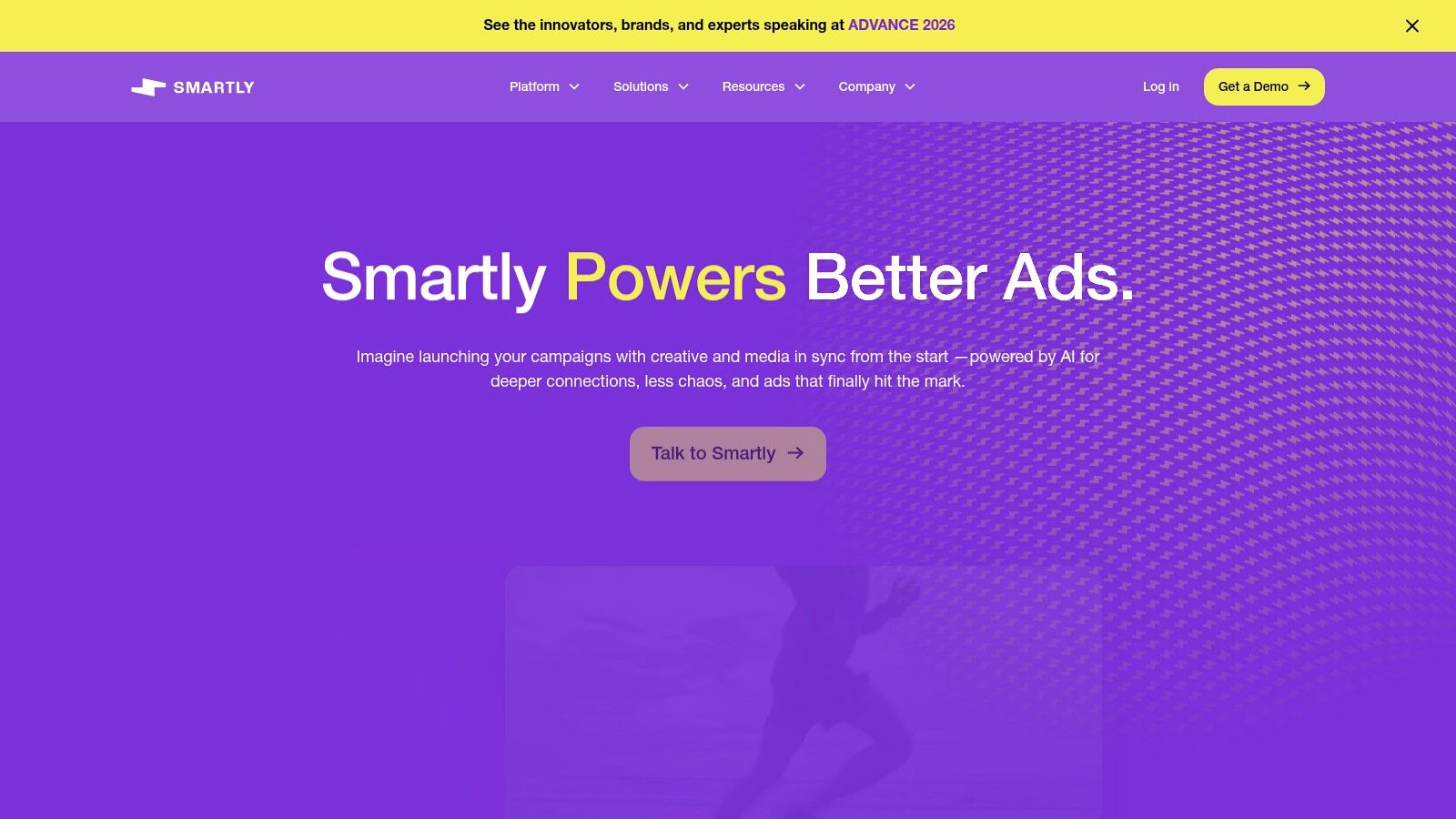
Smartly.io combines creative production, dynamic creative optimization, media activation, and creative intelligence for large social and video programs. It supports channels including Meta, TikTok, Pinterest, and YouTube or Google, giving enterprise teams one environment for producing and activating many variations across markets.
The strongest fit is a brand with a substantial creative operation. Product feeds can support dynamic ads, while automated video assembly helps teams adapt assets to different placements. Creative Predictive Potential adds a forecasting layer, and Brand Pulse brings cross-channel reach and attention measurement into the broader workflow.
Smartly.io is less compelling if your immediate problem is a small number of campaign changes or a lack of basic reporting discipline. Its depth creates implementation work, and teams need clear ownership across creative, media, data, and approvals. Without that operating model, a unified platform can become another complex place where tasks wait for review.
Best use: Build a repeatable creative-to-media pipeline for large, multi-market campaigns.
Main trade-off: You get deep creative and activation coverage, but enterprise packaging and a steeper learning curve can put it beyond the needs of smaller advertisers. Pricing requires a sales conversation, so teams should evaluate the full cost of onboarding, governance, and internal training rather than comparing subscription labels alone.
Smartly.io works best when the creative team and media team already share a testing framework. It won’t replace judgment about the offer, audience, brand risk, or why a creative concept should exist. It can make the production and activation system much more scalable once those decisions are clear.
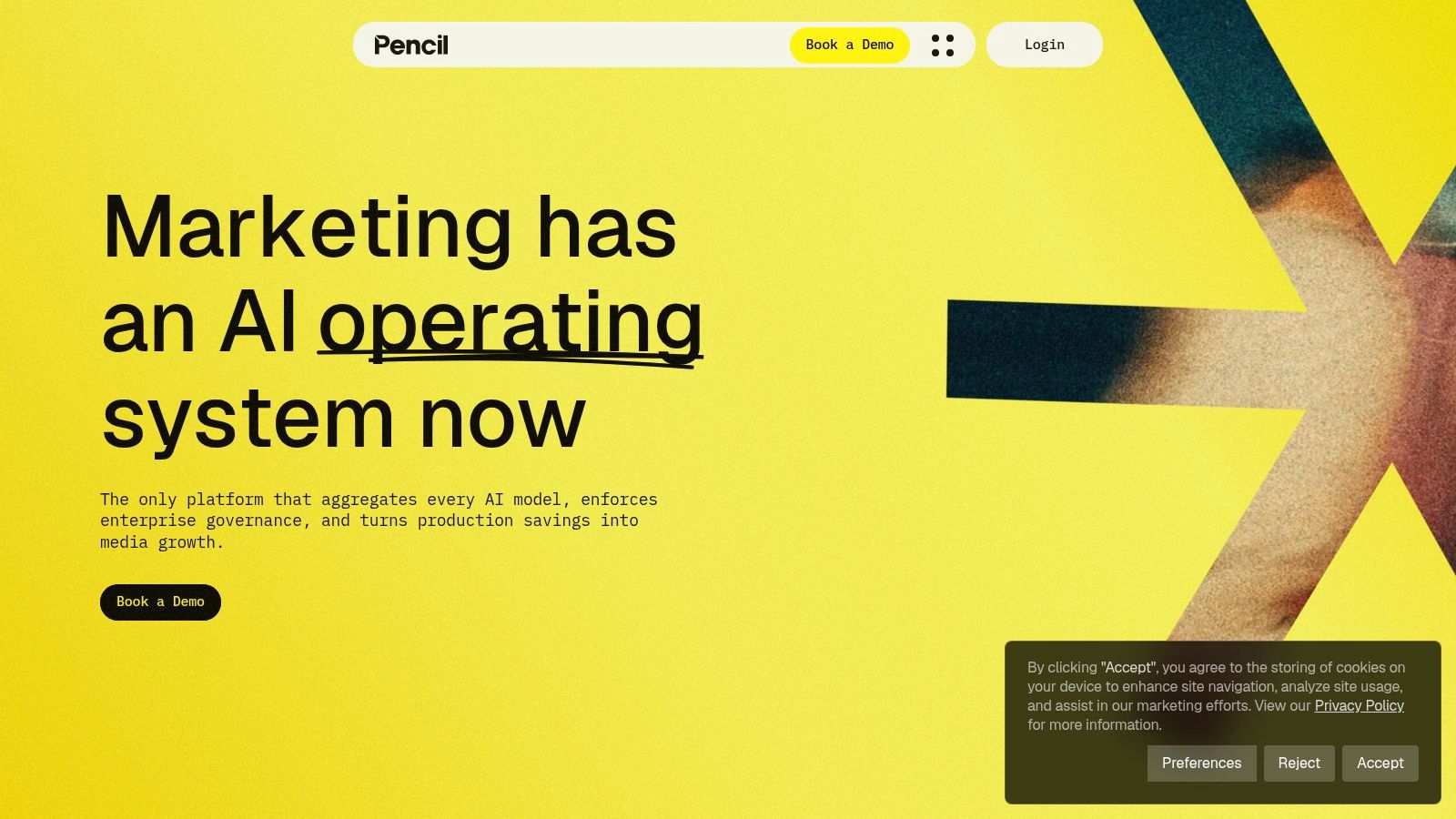
3. Pencil
Pencil focuses on producing ad creative rather than managing the whole media operation. It generates text, images, and short-form video for environments such as Meta, TikTok, YouTube, and Google Display, then provides predicted performance indicators to help teams prioritize variants before launch.
That makes Pencil useful when the constraint is creative volume. A performance team can turn a product brief into multiple aspect ratios and creative directions, review the strongest candidates, and export them into an existing launch process. Team workspaces and quota-based plans also make it easier to separate client or brand work.
The predictive layer needs careful interpretation. Pencil’s indicators depend on historical spend data, so they may be more useful for an established account with a meaningful creative history than for a new brand, unfamiliar audience, or completely new offer. A high predicted score should help prioritize review, not determine the launch decision by itself.
What works well
- Variant production: Teams can create many image and video options without sending every adaptation through a manual design queue.
- Format coverage: Static and short-form video output supports the realities of paid social testing.
- Workflow compatibility: Export and media-platform integrations make Pencil easier to pair with a separate activation tool.
Where it falls short
- Prediction quality varies: Historical data can bias recommendations toward familiar patterns.
- No complete operating layer: Pencil is strongest before launch, so teams still need structured testing, approvals, and campaign management elsewhere.
Pencil is a creative production engine, not a replacement for a media buyer. Use it to expand the set of credible options, then let people decide which ideas deserve budget and how the test should be designed.
4. Anyword
Anyword is aimed at performance copy, including ad text, landing page messaging, and audience-specific variations. It combines brand voice controls with predictive scoring for text and images, and its Insights panel can use connected advertising data to create custom scores.
That gives copy teams a more practical feedback loop than asking an AI writer for ten headlines. A marketer can generate several asset sets for distinct audiences, compare the tool’s predictions, and then move selected versions into the channel workflow. Integrations with tools such as Canva, Notion, ChatGPT, and the Chrome extension help keep the scoring closer to the places where copy is drafted.
Anyword’s value depends on the performance data connected to it. A mature account with clear conversion signals can provide a better basis for prioritization than a sparse account with inconsistent tracking. The score is a decision aid, not proof that a message will work with every audience, placement, or offer.
For a broader view of AI tools for marketers, compare Anyword with tools that focus on production, execution, or reporting rather than copy evaluation.
Keep the human decision in the loop
A copy score can’t determine whether a claim is legally supportable, whether a benefit is meaningfully differentiated, or whether the message sounds appropriate for a sensitive audience. Human reviewers still need to check factual accuracy, tone, product context, and the relationship between the landing page and the ad.
Best use: Prioritize copy variations and bring performance feedback into the writing stage.
Main trade-off: Anyword can make copy testing more systematic, but prediction quality depends on data quality and the platform won’t replace creative strategy or channel-specific review.
5. Jasper
Jasper suits teams that produce a large amount of brand-sensitive copy across paid, lifecycle, social, and SEO channels. Its brand voice and style controls help teams define how the company should sound, while templates and document management support repeatable production.
The practical benefit is coordination. A content lead can establish a voice, a campaign manager can request email or ad variants, and reviewers can work in a shared environment rather than passing loosely edited prompts between individuals. Permissions and collaboration features matter when several people or external partners create assets for the same brand.
Jasper isn’t an ad-operations platform. It doesn’t decide how a Meta budget should move, and a polished draft still needs channel-specific testing. A headline that reads well in a landing page brief may be too long for an ad placement, too vague for search, or poorly matched to the creative beside it.
Seat-based packaging can also become a concern as teams expand. Before adopting Jasper broadly, define who needs authoring access, who only needs review access, and where approved assets will live after they leave the platform.
Use Jasper when:
- Brand consistency is the bottleneck: Multiple writers need dependable voice and terminology controls.
- Asset volume is high: Teams need drafts for ads, email, blog content, and social posts in one collaborative workflow.
- Review is distributed: Permissions and document management can reduce uncontrolled copies of campaign messaging.
Don’t use it as:
- A media optimizer: It won’t replace testing in the advertising platform.
- A final editor: Humans still need to verify claims, compliance, positioning, and audience fit.
Jasper is a strong content operations layer. It becomes less valuable when a team needs campaign execution more than writing coordination.
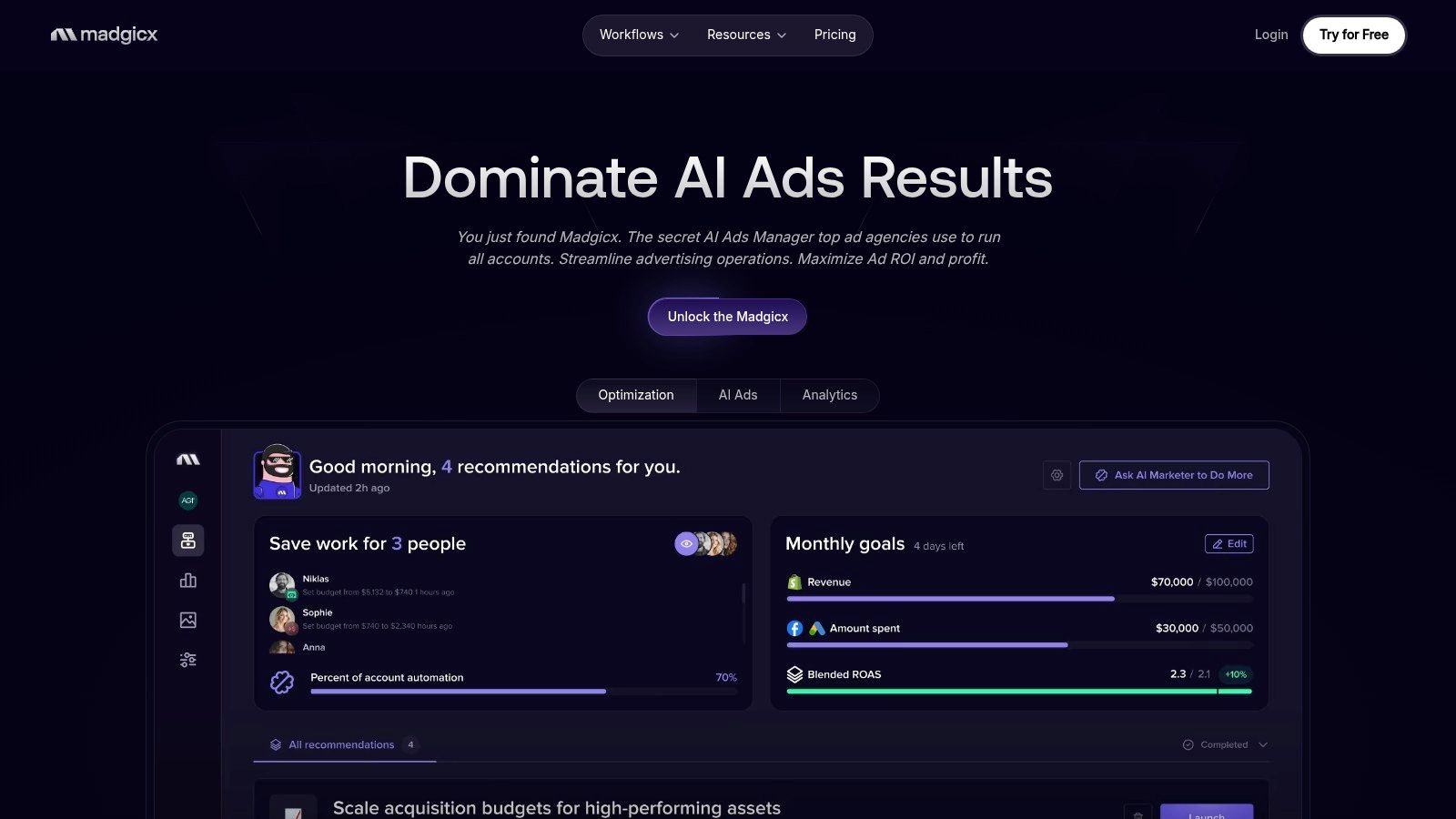
6. Madgicx
Madgicx is primarily a Meta advertising management and automation platform. It combines automation templates, custom rules, AI creative tools, analytics, and conversational control, while bringing reporting data from sources such as TikTok, Google, GA4, Shopify, and Klaviyo into broader dashboards.
Meta buyers will find the fastest path to value in the prebuilt strategies. Stop-loss and scaling automations can trigger from live account conditions, reducing the need to wait for a person to check every account manually. Bulk creative launch and optimization tools also help teams manage a high volume of Meta work from one interface.
The limitation is channel asymmetry. Madgicx can bring other platforms into reporting, but its activation strength is still Meta. If your operating model requires consistent write actions across Meta, TikTok, and Google Ads, you’ll need another execution layer or separate native workflows.
Budget rules deserve a controlled rollout. Start with alerts or small-scope actions, document the trigger conditions, and check how the platform handles conflicting rules. Teams should also understand spend-based pricing tiers before connecting multiple accounts.
Read this practical guide to ad budget optimization before deciding whether Madgicx’s automation model matches your approval process.
Best for: Meta-focused buyers who want fast access to ready-made automation strategies.
Watch closely: Pricing can vary with ad spend, and tier changes or overages need to be part of the evaluation. Madgicx can reduce repetitive monitoring, but it can’t decide whether a campaign’s underlying offer, audience, or creative direction is strategically sound.
7. Birch
Birch, formerly Revealbot, is a rule-engine product for teams that want explicit conditions behind automated campaign actions. It supports budget scaling and pausing, bulk launches, creative grouping, and performance exploration across Meta, Google, TikTok, and Snapchat.
Its core strength is transparency. A media buyer can define an if/then rule, specify the metric and time window, choose the action, and review the resulting behavior. That makes Birch easier to audit than a vague promise that an algorithm will optimize performance in the background.
A practical fit for scaling teams
Launcher and Stage help teams move assets into campaigns more quickly, while Explorer supports creative and ad-fatigue analysis. Integrations with Slack, Google Sheets, AppsFlyer, and Hyros make it suitable for teams that already communicate and report outside the ad platform.
The trade-off is pricing complexity. The product scales with monthly ad spend across connected accounts, and important automation features sit on the Pro tier. Teams should model likely spend bands and examine overage conditions before selecting a plan.
Birch works when:
- Rules are known: Your team has clear stop, scale, and alert conditions.
- Actions need to be explainable: Operators can inspect the logic rather than trust an opaque recommendation.
- Several channels need monitoring: Birch provides a broader automation footprint than a Meta-only tool.
Birch struggles when:
- The strategy is still undefined: Rules won’t fix unclear success criteria.
- The team wants agent-led execution: Birch is strongest as an explicit automation engine, not as a conversational operations layer.
The 14-day free trial provides a practical way to test rules against real account patterns. Start with non-destructive alerts, then introduce budget and pause actions only after the team understands how conditions behave.
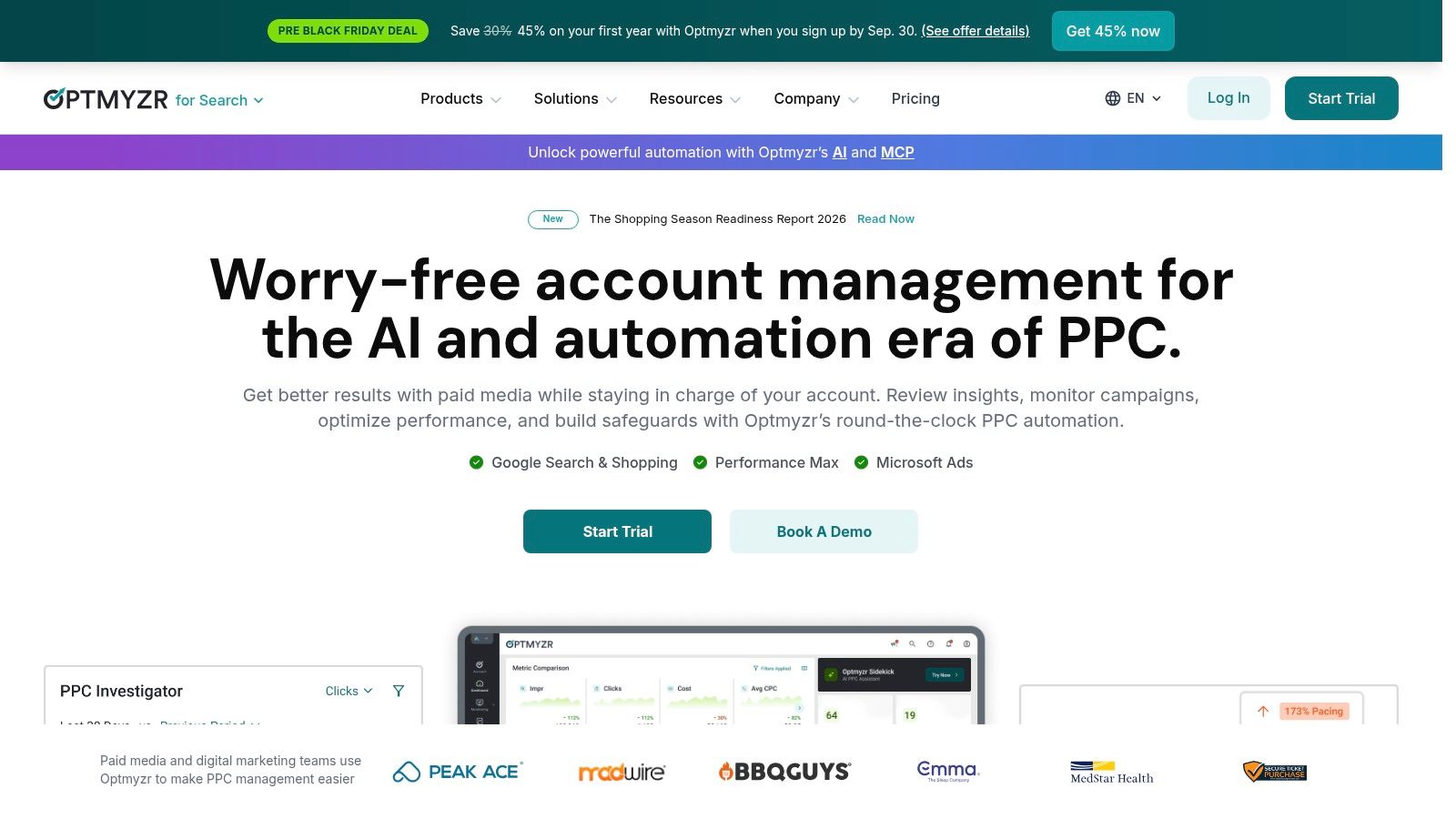
8. Optmyzr
Optmyzr is a mature PPC automation and audit platform with its deepest value in Google Ads and Microsoft Ads. Its Rule Engine supports large-scale custom automations, while Campaign Automator can build campaigns from feeds. Budget pacing, cross-account dashboards, and integrations with Slack, Teams, and Zapier support agency and in-house search workflows.
Search teams often need a balance between scripts and manual control. Optmyzr gives operators templates and reusable logic without requiring them to build every automation from scratch. Rapid audits can also surface structural issues across many accounts before a strategist spends time on deeper analysis.
The product’s feature density is both its advantage and its cost. New users need a clear account model, naming conventions, and an agreed set of automations. Without that preparation, teams can create rules that overlap, produce noisy alerts, or obscure which person owns the final decision.
For a focused comparison, review these Google Ads automation tools alongside Optmyzr’s search-first approach.
Strong fit: Agencies managing many search accounts, especially when custom rules and audits matter.
Weak fit: Teams looking for equal depth across paid social and search activation.
Optmyzr is a capable PPC companion, but its value comes from disciplined configuration. It helps search practitioners scale known processes. It doesn’t remove the need to inspect search intent, query quality, landing page relevance, or the commercial context behind a conversion.
9. Adalysis
Adalysis takes a narrower and more opinionated approach to PPC optimization. It focuses on Google Ads and Microsoft Ads, with automated ad testing, Quality Score diagnostics, anomaly alerts, pacing, maintenance checks, and what-if budget analysis.
That narrow scope is useful for search teams that want a repeatable testing discipline. Adalysis can identify ad winners and losers using multiple metrics rather than leaving the decision to a single headline score. Its Quality Score analysis also helps connect account changes to diagnostic issues that might otherwise be reviewed manually.
The product is not designed for paid social activation. It won’t help a team build a Meta ad set, pause a TikTok campaign, or coordinate creative production across video networks. That limitation is a feature for search specialists and a problem for generalist teams comparing broad platform coverage.
Use it for a defined testing system
Adalysis works best when the account has enough structure for ad testing to produce useful decisions. Teams still need to choose the right landing pages, protect brand terms, account for conversion lag, and decide whether a statistical winner is commercially better rather than merely more efficient on one metric.
Best use: Continuous search ad testing, Quality Score investigation, and maintenance.
Main trade-off: It offers focused search workflows and value-based pricing linked to ad spend levels, but no paid social execution.
Adalysis is a good example of why the “best” AI marketing tool depends on the job. A specialized search copilot can outperform a broader suite for a team whose real bottleneck is ad testing, even if it covers fewer channels.
10. Skai
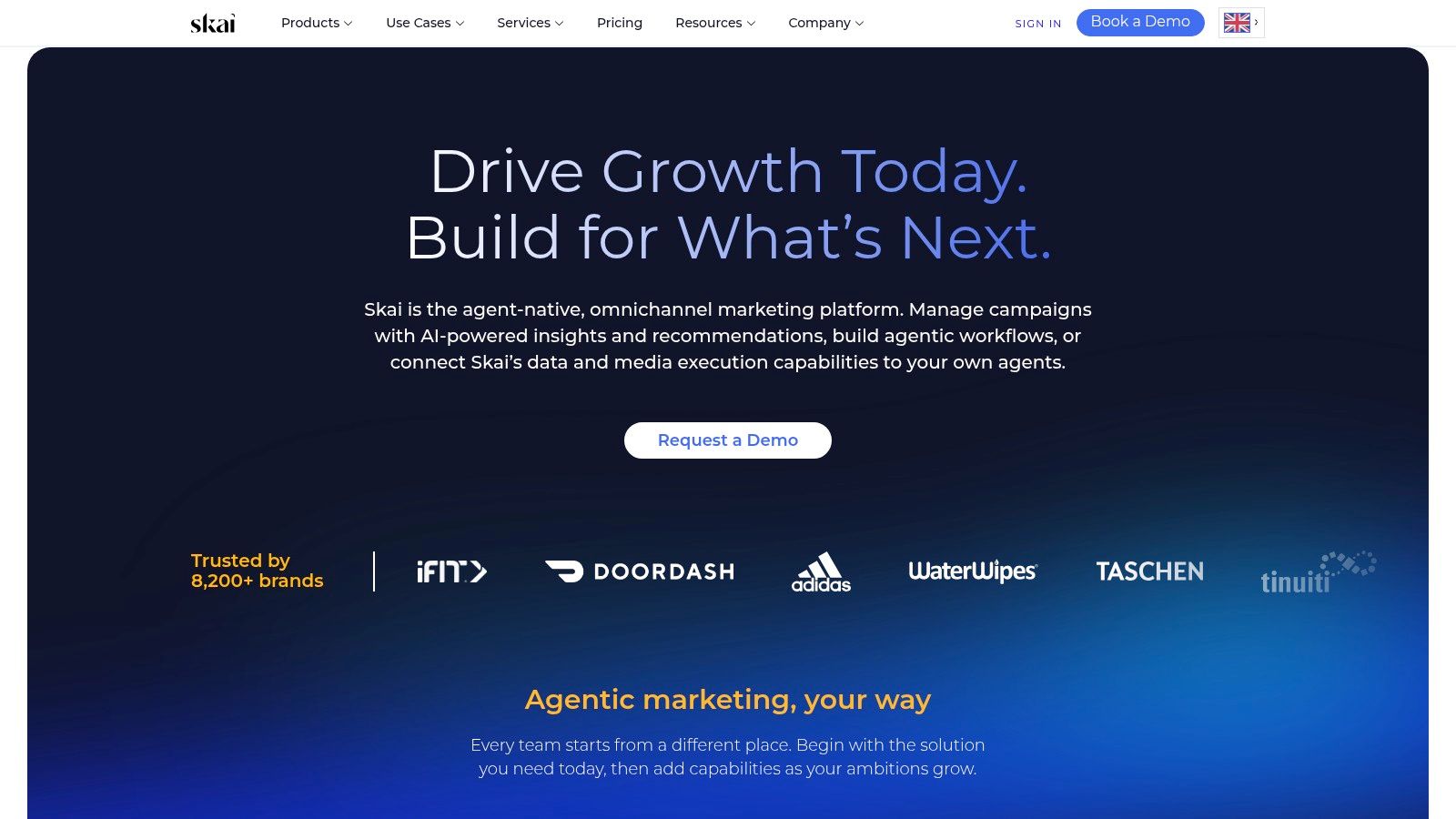
Skai, formerly Kenshoo, is built for enterprise teams running programs across search, social, retail media, and app advertising. Its platform combines planning, activation, optimization, measurement, and reporting, with Celeste AI providing a generative layer within the workflow.
The broad partner ecosystem is the main differentiator. Teams can coordinate programs connected to Google, Meta, Amazon Ads, TikTok, Walmart Connect, Instacart, and other major environments. Retail media coverage makes Skai particularly relevant for organizations that need marketplace advertising alongside traditional paid media.
Skai’s strength creates implementation overhead. A platform that unifies planning, budgets, bids, measurement, and reporting needs consistent taxonomy and dependable data connections. If the team only manages one channel or a small number of campaigns, that complexity can exceed the operational problem it solves.
Choose Skai when:
- Omnichannel planning matters: Search, social, retail media, and app activity need a shared view.
- Measurement is distributed: Leadership needs reporting that connects activity across platforms.
- Enterprise governance is required: Multiple markets and teams need a central operating layer.
Look elsewhere when:
- Activation is narrow: A search-only team may get more value from Optmyzr or Adalysis.
- Creative production is the bottleneck: Smartly.io or Pencil may be more directly useful.
- You need simple execution: Enterprise complexity can slow smaller teams.
Pricing is opaque and generally requires an enterprise quote. Evaluate implementation, data engineering, permissions, reporting definitions, and user adoption alongside the license. Skai is a planning and measurement environment first, while a tool such as AdCrunch is more directly focused on agent-assisted operational actions across connected ad accounts.
Top 10 AI Marketing Tools Comparison
| Product | Core features | Unique selling points | UX / Rating | Price & Audience |
|---|---|---|---|---|
| AdCrunch 🏆 | OAuth to Meta/TikTok/Google; Meta write actions (campaigns, budgets, pause/archive); Activity log; LLM connectors & in-console Adgent | ✨ AI-native exec + playbooks; paused-safe creations; permanent audit trail; unified agent across 3 networks | ★★★★☆ (beta) | 💰 €99/mo Pro (unlimited accounts/seats); Enterprise available · 👥 performance agencies, multi-brand/in-house teams |
| Smartly.io | Dynamic creative optimization; cross-channel activation (8+); AI video assembly; predictive creative scoring | ✨ Creative Predictive Potential & Brand Pulse for cross-channel creative intelligence | ★★★★★ | 💰 Enterprise pricing (contact sales) · 👥 large enterprises, global creative/media teams |
| Pencil | AI creative generation (static & short video); predicted performance indicators; platform integrations | ✨ Rapid on-brand creative variants + prioritization by predicted win-rate | ★★★★☆ | 💰 Quota-based plans; agency & self-serve tiers · 👥 creative teams, small agencies, advertisers testing creatives |
| Anyword | AI performance copy; predictive scoring; audience-targeted variations; editor integrations | ✨ Predictive copy scores + Website Agent for on-page testing & auto-implementing winners | ★★★★☆ | 💰 Subscription tiers (varied) · 👥 copywriters, performance marketers, growth teams |
| Jasper | Brand voice controls; templates (ads, email, SEO); team collaboration & docs | ✨ Scalable, brand-consistent content ops with collaborative workflows | ★★★★☆ | 💰 Seat-based pricing · 👥 content teams, marketing ops, agencies |
| Madgicx | Meta automation templates; AI creative tools; real-time rule triggers; cross-channel reporting | ✨ Broad library of ready-to-deploy automations & stop-loss scaling rules | ★★★★☆ | 💰 Spend-tier pricing · 👥 Meta buyers, scaling advertisers |
| Birch (Revealbot) | If/then automation rules; bulk launch & creative grouping; Explorer for fatigue analysis; integrations | ✨ Strong rule engine + Slack/Sheets integrations for ops automation | ★★★★☆ | 💰 Pricing scales with ad spend · 👥 scaling teams, agencies needing robust automation |
| Optmyzr | Rule engine & Campaign Automator; budget pacing; rapid audits; cross-account dashboards | ✨ Deep search/PPC automations and audit templates for large account volumes | ★★★★☆ | 💰 Subscription (search-focused); contact sales · 👥 search/PPC teams, agencies |
| Adalysis | Automated ad testing; Quality Score diagnostics; pacing & anomaly alerts; root-cause analysis | ✨ Opinionated ad-testing workflows and Quality Score-driven insights | ★★★★☆ | 💰 Spend-linked pricing · 👥 Google/Microsoft Ads specialists, performance analysts |
| Skai (Kenshoo) | Omnichannel planning, activation & optimization; retail media & marketplace support; GenAI (Celeste) | ✨ Broadest channel coverage and mature omnichannel measurement | ★★★★★ | 💰 Enterprise quotes · 👥 enterprise omnichannel teams, large advertisers |
Build the Smallest Stack That Closes the Gap
The best AI marketing tools aren’t the ones with the longest feature list. They’re the ones that remove a specific delay from your team’s work without creating another disconnected system to maintain.
Start by naming the operational job. Pencil, Smartly.io, and Jasper help with creative or content production, but they solve different levels of the problem. Pencil increases ad-variant output across formats. Smartly.io connects scaled creative production with activation and creative intelligence. Jasper supports brand-consistent writing across paid, lifecycle, social, and SEO work.
Anyword sits closer to copy optimization because it uses predictive scoring and connected performance data to prioritize messaging. It can improve the path from draft to test, but it still needs a launch workflow and human review. A score can’t validate a product claim, replace audience insight, or determine whether a concept fits the brand.
For channel-specific optimization, Optmyzr and Adalysis are strongest in search, with different emphases. Optmyzr provides a broader rule, audit, pacing, and campaign-building environment for Google Ads and Microsoft Ads. Adalysis is narrower and more focused on ad testing, Quality Score diagnostics, and maintenance. Madgicx and Birch are more useful for automated paid media operations, particularly when Meta is central or when explicit if/then rules are the preferred control model.
AdCrunch addresses a different gap. It combines cross-network reading across Meta, TikTok, and Google Ads with controlled write actions on Meta, agent connections through Claude, ChatGPT, and Cursor, and a permanent Activity log. That makes it the operational option for multi-account teams that want to ask questions and execute documented campaign changes in one workflow. The limitation is important: TikTok and Google Ads remain read-only for writes, so teams needing full cross-network activation will still need native tools or specialist platforms.
For broader planning and reporting, Skai is the enterprise choice among this list. Its coverage across search, social, retail media, and app advertising can suit complex omnichannel programs, but its implementation effort and opaque enterprise pricing require careful evaluation. Smartly.io may be the better fit when creative production and social-video activation are the central needs.
Before adding software, test one workflow from diagnosis to outcome. Choose a limited set of accounts, define who can approve actions, specify which changes are allowed, and record what the team expects the tool to do. Then compare:
- Channel coverage: Does the platform read and write where you operate?
- Data requirements: Does it need mature historical data, reliable conversion tracking, or product feeds?
- Integrations: Can it connect to the systems your team already uses without manual exports?
- Team permissions: Can contributors draft, reviewers approve, and administrators control access separately?
- Auditability: Can you see who requested a change, what happened, and whether the action succeeded?
- Pricing structure: Does cost grow per seat, account, spend level, usage unit, or organization?
- Implementation effort: How much taxonomy, training, rule design, and ongoing maintenance will adoption require?
A small, governed workflow is more valuable than a large stack nobody trusts. The teams that get the most from AI usually don’t remove human judgment. They reserve it for strategy, exceptions, claims, creative direction, and budget accountability, while software handles repetitive analysis, production, and controlled execution.
If you manage many accounts, start where the delay is most expensive. If that delay sits between performance diagnosis and Meta action, AdCrunch is a sensible first test. If the bottleneck is enterprise creative volume, search testing, or omnichannel reporting, choose the specialist that matches that job instead of forcing every problem into one platform.
AdCrunch connects Meta, TikTok, and Google Ads to AI agents so multi-account teams can query performance and take controlled Meta actions without losing context. Visit AdCrunch to test a workflow with paused creations, playbook-based guardrails, and a permanent activity record.